

Before sizing a greenhouse around a well, identify the evidence behind the proposed water-source capacity. A pump's delivery rating, a brief flow observation and a groundwater specialist's assessment answer different questions. The project needs a supported source assumption for its intended demand period, with the limitations left visible.
Start with the well report rather than a larger pump or tank. Neither a water-quality result nor additional storage establishes how the aquifer replenishes the water being withdrawn. Water availability, water quality, delivery equipment, storage and permission to abstract water each need their own evidence.
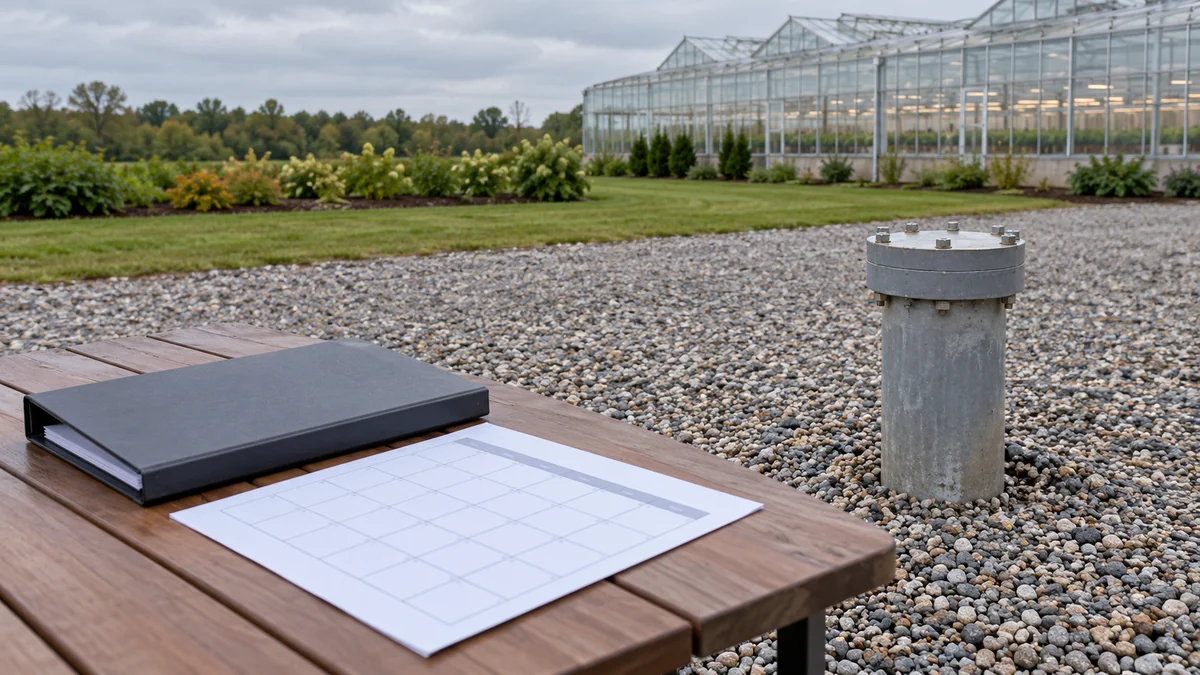
Three numbers that answer different questions
A pump rating describes equipment performance under stated conditions. It does not establish that the source can keep supplying that delivery. A measured flow records what was observed at a particular time and for a particular duration. Its usefulness depends on the surrounding records and what the observation was intended to establish.
A professional source assessment interprets relevant well and groundwater evidence within its stated scope. That may include water-level behavior, rate and duration records, seasonal conditions, recovery information and nearby pumping context. The buyer's job is to obtain and identify that assessment, not to turn a single observation into a long-term availability calculation.
Agriculture and Agri-Food Canada's well-monitoring guidance explains that well, pump and aquifer performance are interrelated. A decline can have different causes. It also emphasizes consistent measurement references, time and rate records, and comparison with baseline information. Those principles help you read the evidence package; they do not provide a do-it-yourself test plan for this project.
| Evidence supplied | What it can establish | Question still to answer |
|---|---|---|
| Pump data or a pump supplier's rating | The stated equipment duty and its conditions. | What evidence supports source availability for the proposed demand period? |
| A flow observation | The recorded rate during that observation. | Which well, duration, water-level records and seasonal conditions does it represent? |
| A qualified source assessment | The specialist's conclusion within the report's scope and limitations. | Does that scope cover the greenhouse demand assumption now being used? |
Match the report to the well and the season
Check the well identity and location first. A report for another bore, an earlier configuration or an unclear site reference may not support the source named in the proposal. Keep the report date, author and qualifications alongside the well identifier.
Next, retain the observed rate, units and duration exactly as recorded. Locate the static and pumping water-level records and their measurement datum. If the report includes recovery information, identify that record too. Missing information should become a question for the report author, not a value reconstructed from memory.
Ask which season and preceding conditions the evidence covers, and whether nearby pumping is addressed. The specialist should explain what those conditions allow the project to assume and where uncertainty remains. Do not diagnose aquifer depletion or a well defect from a changing water level yourself.
The UMass greenhouse water-supply guidance connects groundwater supply with aquifer and recharge conditions and discusses the different uses of water in greenhouse planning. This supports a basic purchasing question: is the source assessment being compared with the project's actual seasonal demand, including the uses included in the design brief?
A useful comparison without a capacity formula
Consider two hypothetical proposal packages quoting the same hourly water supply. Package A attaches a pump catalogue and a short, undated flow note. Package B identifies the actual well and a specialist report, including its observation period and seasonal limitations.
The identical headline rate does not make the evidence equivalent. A needs a source assessment or clarification before its supply assumption can be accepted. B allows the design team to ask a more specific question: does the specialist's conclusion support the required demand period, or does it leave a dry-season condition unresolved?
If B's report explicitly leaves that condition open, keep it open in the greenhouse proposal. More pages do not automatically mean the required capacity has been established. The value of the report is that it identifies what was assessed and what the responsible specialist can conclude.
This example contains no measured well result or test recommendation. It shows how the supporting document changes the next purchasing action.
Keep the dependent decisions in order
Record the greenhouse demand period and the source assumption used by the designer. Ask the groundwater specialist to address that assumption with the appropriate evidence. Testing design, interpretation and any further investigation belong to competent local specialists.
Once that source basis is understood, the separate water-storage planning method can address the agreed supply and demand timing. A tank can be part of that design, but its size does not prove the source can replenish it. Use the water-quality equipment-selection guide for the separate chemistry and treatment questions.
Also confirm that the project has the required rights and abstraction permissions through the appropriate local process. A favorable technical assessment is not itself permission to withdraw water.
Send back one clearly stated source question
The source-capacity evidence sheet is a manual record. It has no capacity formula, test duration or automatic pass. Enter the proposed demand period first, then link each quoted source assumption to the report and its observed conditions.
Finish with the specialist's stated conclusion, the limits that remain and the person responsible for the next response. Send the sheet with the actual report to the project team. The decision can then be to use a supported assumption, revise the project basis, or hold the dependent sizing work until the missing source evidence is resolved.