
The short answer
Before irrigation design, test every intended water source through a laboratory experienced with agricultural irrigation. At minimum, understand pH, alkalinity, electrical conductivity, major nutrients and ions, sodium, chloride, calcium, magnesium, iron, manganese, suspended material, and any biological or chemical risks relevant to the source and crop. Record seasonal variation, source yield, temperature, and required flow as well as chemistry.
The equipment decision comes after interpretation. A filter cannot correct alkalinity. Acid dosing does not remove suspended solids. Reverse osmosis may reduce dissolved salts but creates concentrate and changes fertilizer planning. Disinfection may reduce biological risk but does not repair poor hydraulic design. Each treatment step needs a defined problem, design flow, monitoring method, waste route, and operating responsibility.
This article is a procurement guide, not a universal water specification. Crop tolerance, substrate, fertilizer program, irrigation method, food-safety plan, local discharge rules, and equipment limits must be confirmed by qualified local advisers and the relevant suppliers.
Describe the water source before collecting a bottle
Record whether the source is municipal water, a well, surface water, harvested rainwater, treated wastewater, desalinated water, or a blend. Identify the exact sampling point, treatment already in place, storage time, and whether the source changes during the year. A sample from an office tap may not represent water after a long transfer line, open reservoir, fertilizer injector, or reuse tank.
Quantity matters as much as quality. Confirm the reliable flow and daily volume available during the production season, pressure at the connection, pumping limits, water rights, interruptions, and storage opportunity. The greenhouse site assessment checklist explains how water-source evidence fits the wider land and utility review.
For a new source, collect more than one sample where practical. Heavy rainfall, drought, pumping duration, municipal treatment changes, seasonal algae, seawater intrusion, and agricultural activity can change results. UMass Extension recommends testing potential irrigation water before new construction and monitoring established sources over time.
Use a controlled sampling method
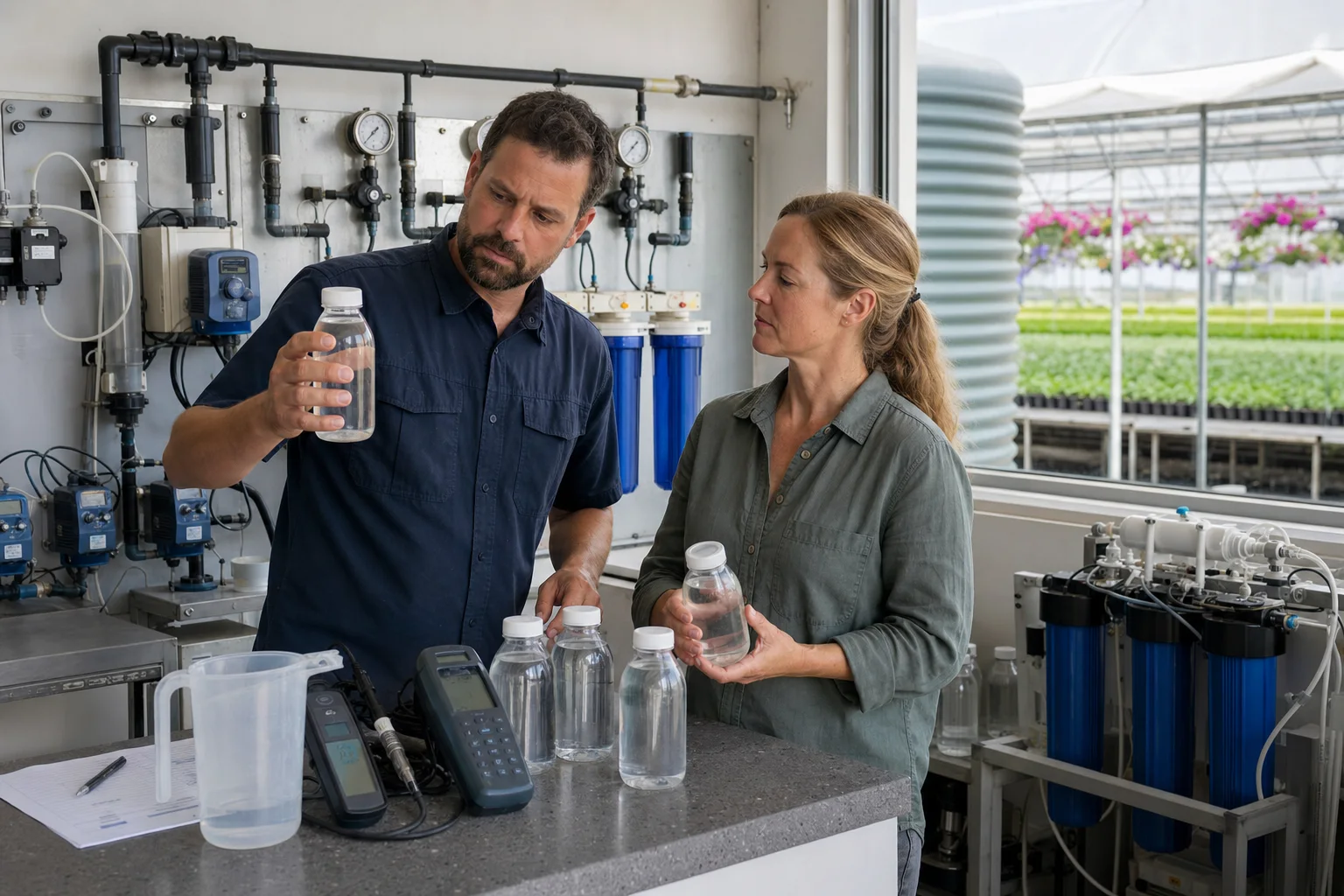
Ask the laboratory which bottle, preservation method, volume, temperature control, and delivery time are required. Microbiological, pesticide, heavy-metal, and nutrient analyses may need different containers or handling. Do not rinse a preserved laboratory bottle unless instructed.
Flush stagnant water from the sampling point when the objective is to represent the source or operating line. UMass guidance describes running water before collection and using a clean, full container for general irrigation analysis. Follow the laboratory instruction where it differs. Record the date, time, recent weather, source, pump status, treatment status, and sampler.
For an operating facility, consider samples before and after key treatment stages. That makes it possible to verify what the filter, acid system, softener, membrane, disinfection stage, or blending arrangement actually changes. It also helps separate source problems from storage or distribution problems.
Build the laboratory panel around design decisions
| Parameter group | Why it matters | Possible design consequence |
|---|---|---|
| pH and alkalinity | pH describes acidity at sampling; alkalinity describes acid-neutralizing capacity and strongly influences substrate pH management. | Fertilizer selection, acid dosing, blending, material compatibility, and monitoring. |
| Electrical conductivity and dissolved salts | Indicate the existing salt load before fertilizer is added. | Crop and substrate suitability, blending, membrane treatment, leaching strategy, and reuse limits. |
| Sodium and chloride | May accumulate and injure sensitive crops or constrain recirculation. | Alternative source, blending, desalination, discharge planning, and crop-specific limits. |
| Calcium, magnesium, bicarbonate, sulfate | Affect nutrition, hardness, precipitation, scaling, and injector compatibility. | Fertilizer formulation, acidification, cleaning, anti-scale strategy, and emitter selection. |
| Iron and manganese | Can oxidize, stain, form deposits, and support clogging organisms. | Aeration or oxidation, settling, media filtration, and regular flushing. |
| Suspended solids and turbidity | Particles clog emitters and reduce disinfection performance. | Settling, screen, disk, sand-media, or staged filtration sized to peak flow. |
| Biological indicators | Surface, stored, or recycled water may carry algae, biofilm organisms, or crop pathogens. | Source protection, filtration, disinfection, clean storage, and hygiene monitoring. |
Additional tests may include nitrate, ammonium, phosphorus, potassium, boron, fluoride, copper, zinc, aluminum, silica, heavy metals, pesticides, pathogens, or food-safety indicators. The correct panel depends on the source history, crop, irrigation system, local regulation, and intended reuse.
Do not interpret pH without alkalinity
UMass Extension emphasizes that pH and alkalinity are different. Water can have a high measured pH but limited capacity to change substrate pH, while high alkalinity can continuously add bicarbonate and push the root-zone pH upward. A supplier cannot size an acid system from the pH number alone.
Acid dosing design needs the alkalinity, target neutralization, acid type and concentration, peak flow, mixing time, control method, injection materials, storage requirements, ventilation, containment, worker protection, and local chemical rules. The final design belongs to qualified people familiar with the chemical and local requirements.
Likewise, EC is a total indicator rather than a complete diagnosis. Two waters with the same EC can contain different ions and create different crop or equipment risks. Review the ion analysis before deciding whether blending, membrane treatment, crop selection, or a different fertilizer strategy is appropriate.
Select filtration from the contaminant and emitter
Choose filter type and grade from particle size, particle concentration, organic load, peak flow, pressure, emitter passage, required redundancy, and cleaning method. Screen and disk filters are useful for many sources, while high organic or suspended loads may need settling or media filtration before final filtration.
Size for the real operating flow, not the average daily volume. Record clean and dirty pressure loss, backwash flow, backwash water route, isolation valves, pressure gauges, spare elements, and the condition that triggers cleaning. A filter that removes particles but cannot be serviced during irrigation may not suit a critical production system.
Consider what happens after filtration. Open tanks, warm pipes, dead legs, fertilizer residues, and poor flushing can reintroduce particles or biofilm downstream. Distribution hygiene is part of the water design.
Match treatment to a measured problem
Blending
Can combine sources to manage alkalinity or salts, but requires reliable source ratios, compatible chemistry, storage, and continuous monitoring.
Membrane treatment
May reduce dissolved constituents, but needs pretreatment, recovery assumptions, concentrate disposal, energy, cleaning, and post-treatment nutrient planning.
Oxidation and filtration
May help manage iron, manganese, or some biological loads when reaction time, pH, settling, and filter capacity are correctly designed.
Disinfection
UV, heat, ozone, chlorine-based, or other systems need validated dose conditions, water clarity, contact time, monitoring, worker safety, and crop compatibility.
Do not combine chemical products or treatment stages without professional review. Some mixtures can create dangerous reactions, precipitates, toxic gases, crop injury, or damage to equipment. Obtain supplier limits and local safety requirements in writing.
Give every irrigation bidder the same water package
Issue the source description, laboratory reports, sample dates, seasonal observations, required peak flow, daily volume, crop and substrate, fertilizer approach, irrigation zones, emitter or outlet needs, reuse plan, water-temperature range, local discharge conditions, and required redundancy. Mark provisional assumptions clearly.
Ask the bidder to state the design basis, equipment duty, treatment recovery, waste flows, consumables, monitoring instruments, chemical scope, operating limits, cleaning method, spare parts, and exclusions. This makes offers more comparable and supports the commercial greenhouse buying checklist.
Send laboratory results before equipment selection
Provide the complete laboratory report, water source, project location, crop, substrate, required flow, irrigation method, reuse intention, and local constraints. Chengfei Greenhouse can use that information to identify which irrigation and treatment questions must be resolved before a system quotation is compared.
Contact Chengfei GreenhouseReferences
- UMass Extension. Water Quality for Crop Production.
- UMass Extension. Water Analysis.
- UMass Extension. Floriculture Water Quality Project: I. Salinity, Sodium and Chloride.