
The short answer
Before ordering, give each supplier the same project brief and require the quotation to state its design basis, inclusions, exclusions, responsibilities, and document package. If one quote assumes a simple seasonal tunnel while another includes engineered foundations, cooling, controls, packing, and commissioning, the two prices do not describe the same project.
The buying process starts earlier than most price requests. The site, crop, production period, utilities, labor plan, and expansion path affect the structure and every supporting system. UMass Extension's guidance on selecting and building a commercial greenhouse begins with those operating inputs, then evaluates land, drainage, regulations, water, utilities, access, and expansion.
If the project is still at feasibility stage, work through the existing commercial greenhouse project planning guide before sending an RFQ. The checklist below assumes that the buyer has a defined production objective, even if some engineering values still need local confirmation.
Define the project before requesting a quotation
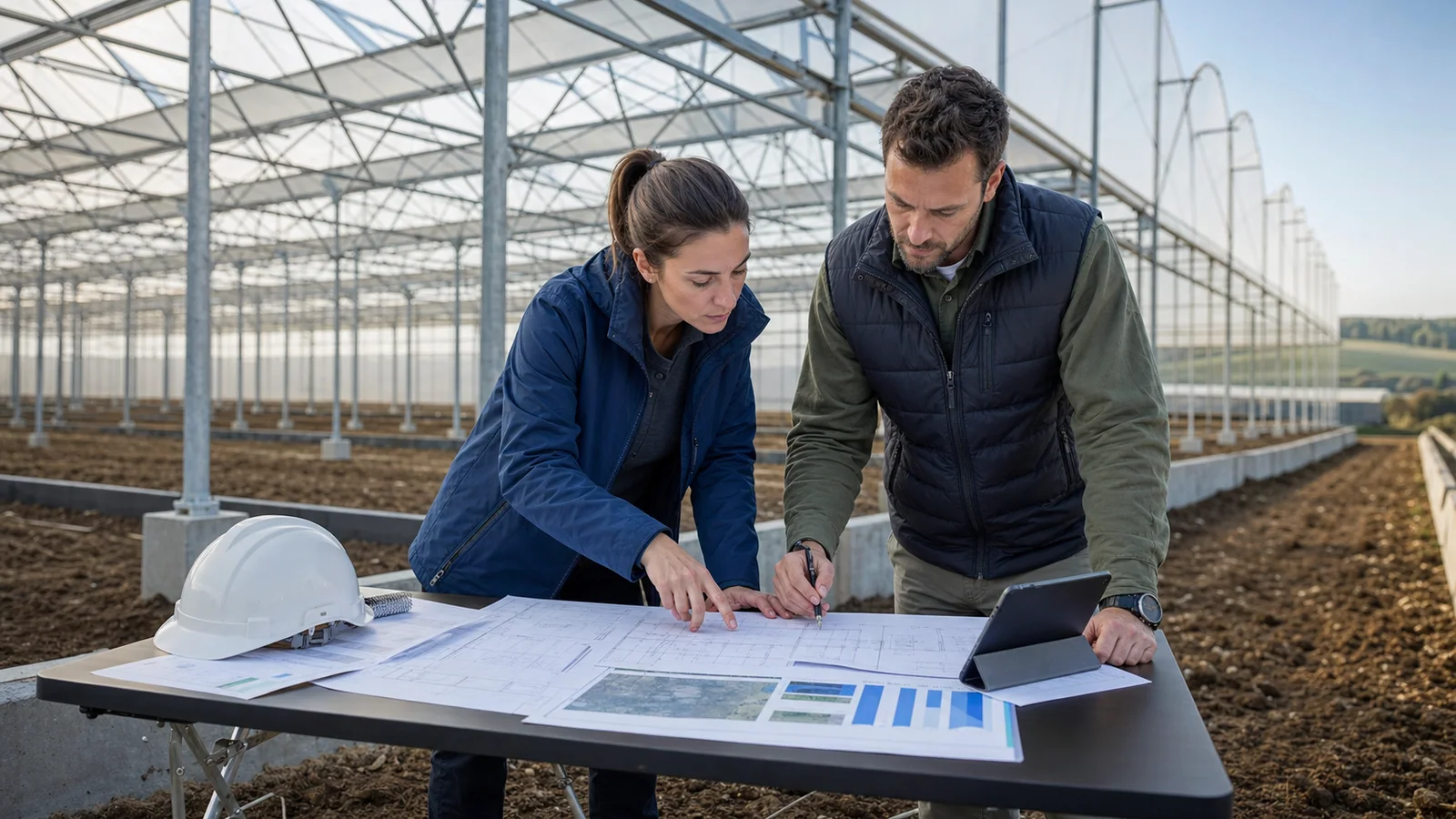
A supplier can offer alternatives, but it should not have to guess what the greenhouse must do. Send the same base information to every bidder. Mark unknown values as "to be confirmed" and assign responsibility for confirming them.
| Input | What to provide | Why it changes the offer |
|---|---|---|
| Project location | Country, city, site coordinates, elevation, plot survey, access constraints, and planned delivery point. | Location affects climate data, local code, transport, unloading, corrosion exposure, and service access. |
| Climate and design hazards | Local design wind, snow, rain, hail, seismic, flood, and temperature criteria from the authority or local engineer. | The structure, foundation, covering attachment, drainage, and equipment capacity depend on site conditions. |
| Crop and production plan | Crop, variety if known, growing method, production season, row layout, trellis or hanging loads, climate targets, and expected crop changes. | Crop workflow affects height, bay layout, ventilation, irrigation, support loads, work areas, and controls. |
| Water | Available flow and storage, laboratory water analysis, source reliability, discharge restrictions, and reuse plan. | Water quality and peak demand affect treatment, filtration, irrigation, fertigation, and drainage design. |
| Power and fuel | Voltage, phase, frequency, available capacity, outage history, backup plan, and heating-fuel options. | Motors, pumps, controllers, heaters, and protection devices must match the local supply. |
| Scope and schedule | Target area, expansion phase, required systems, target delivery window, installation model, and local labor capability. | Material supply, supervision, full installation, and commissioning are different commercial scopes. |
The FAO's greenhouse guidance treats site selection as an economic and technical decision that includes climate, water, electricity, labor, transport, drainage, and expansion. It also recommends water testing before selecting a site because salinity, suspended solids, hardness, and other characteristics can limit crop production or clog irrigation equipment. See the FAO publication Good Agricultural Practices for Greenhouse Vegetable Crops, especially the chapters on site selection and irrigation water quality.
For structure selection, start with use conditions rather than a preferred material. The existing comparison of film, polycarbonate, and glass greenhouse covering explains the main material categories. The final choice still needs to fit local loads, climate, crop value, replacement access, and operating budget.
Require the quotation to show what the price buys
A one-line price per square meter hides the differences that matter. Request a line-item commercial offer supported by drawings and specifications. The list below is not a substitute for contract review, but it makes early quotations easier to normalize.
Design basis and drawings
- Site and climate assumptions used for the offer.
- Applicable structural standard or calculation basis, with local review responsibility stated.
- Overall plan, elevations, bay and span geometry, gutter height, door positions, equipment areas, and expansion interfaces.
- Foundation loads and interface information, including what the civil contractor must design or supply.
Do not accept "wind resistant" or "snow resistant" as a design value. Wind pressure and uplift depend on location, exposure, openings, geometry, and local code. Snow loading also depends on site conditions and roof behavior. UConn Extension's review of greenhouse storm loads and failures shows why generic ratings cannot replace project-specific structural review.
Structure and covering
- Steel grade, section sizes, coating or galvanizing specification, connection details, fasteners, anchors, and quantities.
- Covering material, thickness or panel build-up, light and thermal properties claimed by its manufacturer, fastening method, and replacement scope.
- Permanent loads carried by the frame, such as screens, crop supports, irrigation lines, gutters, lighting, fans, and service equipment.
Steel weight alone does not prove structural adequacy. Member shape, grade, bracing, connection design, load path, corrosion allowance, and foundation anchorage also matter. Ask for the design assumptions and have the final structure reviewed under the rules that apply at the project site. The article on common greenhouse foundation types is useful background, but the foundation decision still depends on geotechnical and structural information for the site.
Environmental and production systems
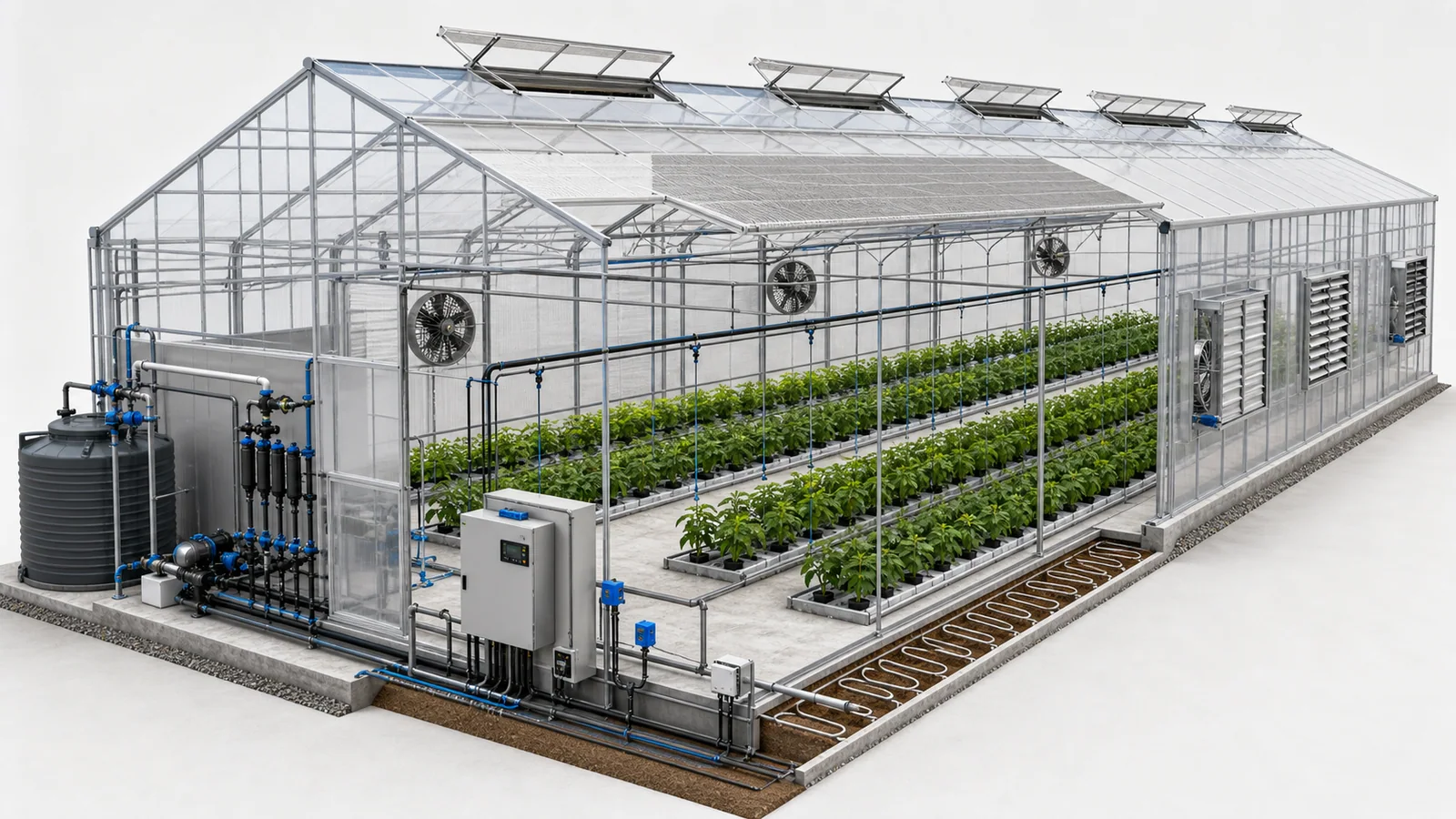
- System layout, equipment schedule, manufacturer and model, rated performance, control stages, and sizing assumptions.
- Vent openings, insect screens, fans, evaporative pads, heating, shade or energy screens, irrigation, fertigation, drainage, lighting, and sensors included in the price.
- Electrical single-line information, connected loads, motor starting requirements, local panels or cabling excluded, and backup-power interfaces.
- Control sequence, alarm behavior, manual override, data access, and response when a sensor or actuator fails.
A product name is not a performance specification. For example, a quote that says "fan and pad" should also state the design conditions, airflow basis, pad area, pump arrangement, water requirement, controls, and electrical load. Use the site's greenhouse electrical load guide to organize equipment loads, then have the final supply and protection design checked locally.
Documents, installation, and handover
- Bill of materials, packing list, container plan, item labels, assembly drawings, manuals, and spare-parts list.
- Buyer, supplier, civil contractor, electrical contractor, irrigation contractor, and freight responsibilities.
- Installation supervision scope, tools and lifting equipment, local labor assumptions, travel costs, and site readiness criteria.
- Inspection points, commissioning tests, operator training, acceptance records, warranty start date, exclusions, and support channel.
Normalize quotations before comparing totals
Create one comparison sheet and copy each bidder's answer into it. Leave a cell blank when the quotation is silent. A blank is a question for the supplier, not an invitation to assume that the item is included.
| Comparison line | What should match or be explained | Common reason totals differ |
|---|---|---|
| Design basis | Location, loads, crop, production period, and codes. | One supplier prices a catalog structure while another prices a site-specific design. |
| Area and geometry | Covered area, productive area, bay layout, height, doors, service rooms, and expansion provisions. | The same nominal area can contain different amounts of usable crop space. |
| Structure | Steel sections, grade, corrosion protection, bracing, fasteners, anchors, and foundations. | Foundation work, anchors, or secondary steel may be excluded. |
| Covering | Material specification, accessories, fastening, seals, spare material, and warranty boundary. | Quotes use different grades or omit installation accessories. |
| Climate systems | Performance basis, equipment quantities, controls, electrical work, and water requirements. | Equipment names match, but capacity and control scope do not. |
| Irrigation and fertigation | Water treatment, filtration, tanks, pumps, dosing, distribution, drainage, and return-water scope. | The quote begins at the pump outlet or ends before crop lines and drainage. |
| Installation and commissioning | Local labor, supervision, travel, lifting equipment, testing, training, and acceptance. | "Installation support" can mean a manual, remote calls, or an on-site supervisor. |
| Delivery and risk | Named Incoterm and place, version, freight, insurance, documentation, customs, unloading, and storage. | The price transfers cost and risk at a different point. |
| Lifecycle support | Recommended spares, consumables, remote support, service response, and warranty process. | The lowest initial price may omit the parts and documents needed after handover. |
Compare delivered and installed cost, not factory price
Use one cost boundary for every bid. The exact items will vary by country and contract, but the worksheet should expose each handoff.
Delivered and installed cost = goods + engineering and documents + packing + inland transport + international freight + insurance + duties and taxes + unloading and storage + civil works + installation + utility connections + commissioning + initial spares
State the Incoterm, named place, and version in the quotation and contract. The U.S. International Trade Administration explains that Incoterms 2020 allocate shipping tasks, costs, and risks, but they do not define every condition of sale, payment timing, title transfer, product conformity, delay liability, or dispute resolution. Those items belong elsewhere in the contract.
The existing article on hidden costs in international greenhouse logistics provides additional questions for freight and import planning. Obtain current quotations from freight, customs, and local contractors because those costs are time- and location-specific.
Pause the comparison when these details are missing
- The structure is described as suitable for a country or climate, but the quotation states no design values or calculation basis.
- The price is expressed only per square meter, with no bill of materials, drawings, or exclusions.
- Climate equipment is listed by name without design conditions, quantity, capacity, control logic, water demand, or electrical load.
- The supplier gives a yield, payback period, temperature, or energy-saving promise without crop, weather, operating, and cost assumptions.
- The offer does not say who supplies foundations, main electrical distribution, water storage, drainage, lifting equipment, local labor, commissioning, or permits.
- The warranty does not identify covered components, start date, remedies, exclusions, required maintenance, or the process for obtaining parts.
- The delivery term lacks a named place and version, or the packing list is not part of the commercial review.
Missing detail does not always mean a supplier is unsuitable. It does mean the price is not ready for comparison. Resolve the gaps in writing and update the scope sheet before selecting a bid.
Complete four reviews before signing
- Production review: The grower or agronomist confirms that the layout and systems fit the crop plan and operating skill.
- Engineering review: Qualified local professionals confirm structure, foundations, drainage, utilities, fire and life safety, and code compliance.
- Commercial review: The buyer normalizes scope, Incoterms, taxes, payment milestones, inspection, acceptance, warranty, delay, and dispute terms.
- Execution review: The project team confirms site readiness, access, storage, labor, tools, supervision, commissioning, training, and spare parts.
A supplier quotation is one part of that record. Local permits, structural approval, crop advice, customs treatment, and legal terms require the appropriate professionals in the project country.
Prepare the first project brief
Send the project city and coordinates, crop and growing method, target area, production season, site survey, available climate data, water analysis, electrical supply, required systems, delivery point, and installation scope with your inquiry. Mark any missing values so they can be addressed before the quotation is treated as final.
Contact Chengfei GreenhouseReferences
- University of Massachusetts Amherst Extension. Selecting and Building a Commercial Greenhouse. Page updated June 16, 2026.
- Food and Agriculture Organization of the United Nations. Good Agricultural Practices for Greenhouse Vegetable Crops: Principles for Mediterranean Climate Areas. 2013.
- UConn Extension. Reducing Storm Damage to Your Greenhouses. Published January 31, 2015.
- U.S. International Trade Administration. Know Your Incoterms. Accessed July 16, 2026.