
The short answer
Commission the greenhouse against written owner requirements and approved design documents. Verify installation first, then start each item safely, test every control sequence and alarm, record measured results, correct defects, train the operating team, and deliver a controlled handover package. Do not use the first crop as the commissioning test.
Commissioning is a process rather than a final inspection. The Whole Building Design Guide describes installation verification, functional performance testing, issue tracking, training, and documentation as connected activities. That approach suits a commercial greenhouse because structure, vents, screens, fans, heating, cooling, irrigation, dosing, lighting, sensors, alarms, and backup systems influence one another.
This checklist does not replace electrical, structural, gas, pressure-system, water-treatment, fire, or occupational-safety approval. Qualified local professionals and the authority having jurisdiction must complete the inspections and certifications required for the project location.
Free editable project tool
Download the commissioning and handover workbook
Define the project basis first, then use the workbook to agree acceptance criteria, verify greenhouse systems, record measured evidence, control failures and retests, track handover documents, and protect the owner’s final acceptance decision.
- 59 buyer-focused inspection and verification items
- Project basis and acceptance-target register
- Automatic readiness, issue, and document summary
- 16 handover records and 18 buyer questions
Commercial Greenhouse Commissioning & Handover Workbook
Download the Excel workbookNo email required. Adapt it to the project contract and local approvals. Browse all greenhouse planning resources.
Define acceptance before testing starts
The team cannot decide whether a greenhouse passes without an agreed basis. Collect the contract scope, approved drawings, equipment schedules, control descriptions, crop and climate requirements, utility conditions, local approvals, manufacturer instructions, and agreed exclusions. Where documents conflict, record which document governs and obtain written resolution.
The owner should identify critical operating outcomes in plain language. Examples include maintaining a defined crop-zone temperature range under stated outside conditions, completing an irrigation cycle at the required flow and pressure, opening vents safely during a power interruption, or sending an alarm when a tank reaches a defined level. The exact values are project-specific and should come from the crop plan, engineering design, and local requirements.
| Input | What it establishes | Evidence to retain |
|---|---|---|
| Owner and crop requirements | Environmental targets, production zones, operating hours, hygiene limits, redundancy, and alarm priorities. | Approved owner requirements and crop brief. |
| Design and equipment documents | Installed capacity, system arrangement, interfaces, control points, and design assumptions. | Approved drawings, schedules, submittals, and calculations. |
| Contract responsibility matrix | Who installs, powers, connects, tests, certifies, trains, and corrects each system. | Signed scope matrix and interface register. |
| Commissioning plan | Test order, prerequisites, witnesses, instruments, acceptance criteria, and reporting format. | Approved plan and test forms. |
Complete readiness checks before functional tests
Functional testing should not begin while construction work is incomplete. Confirm that foundations and frames are accepted, cladding and seals are complete, drains are clear, electrical panels are labeled, protective devices are installed, piping is flushed, filters are clean, tanks are safe, sensors are mounted correctly, and communication networks are stable. Remove temporary jumpers and construction overrides unless they are controlled by the test procedure.
Check access for maintenance. A motor that works but cannot be removed without dismantling another system is a handover problem. Confirm safe access to gutters, vents, screens, fan guards, filters, pumps, valves, dosing equipment, luminaires, control cabinets, sensors, and emergency devices. Confirm that isolation points can be identified and operated.
Calibrate or verify test instruments before use. Temperature, humidity, pressure, flow, electrical, pH, EC, light, and water-level readings are only useful when the instrument range and accuracy suit the test. Record the instrument identifier and calibration status on the test form.
Test systems as coordinated sequences
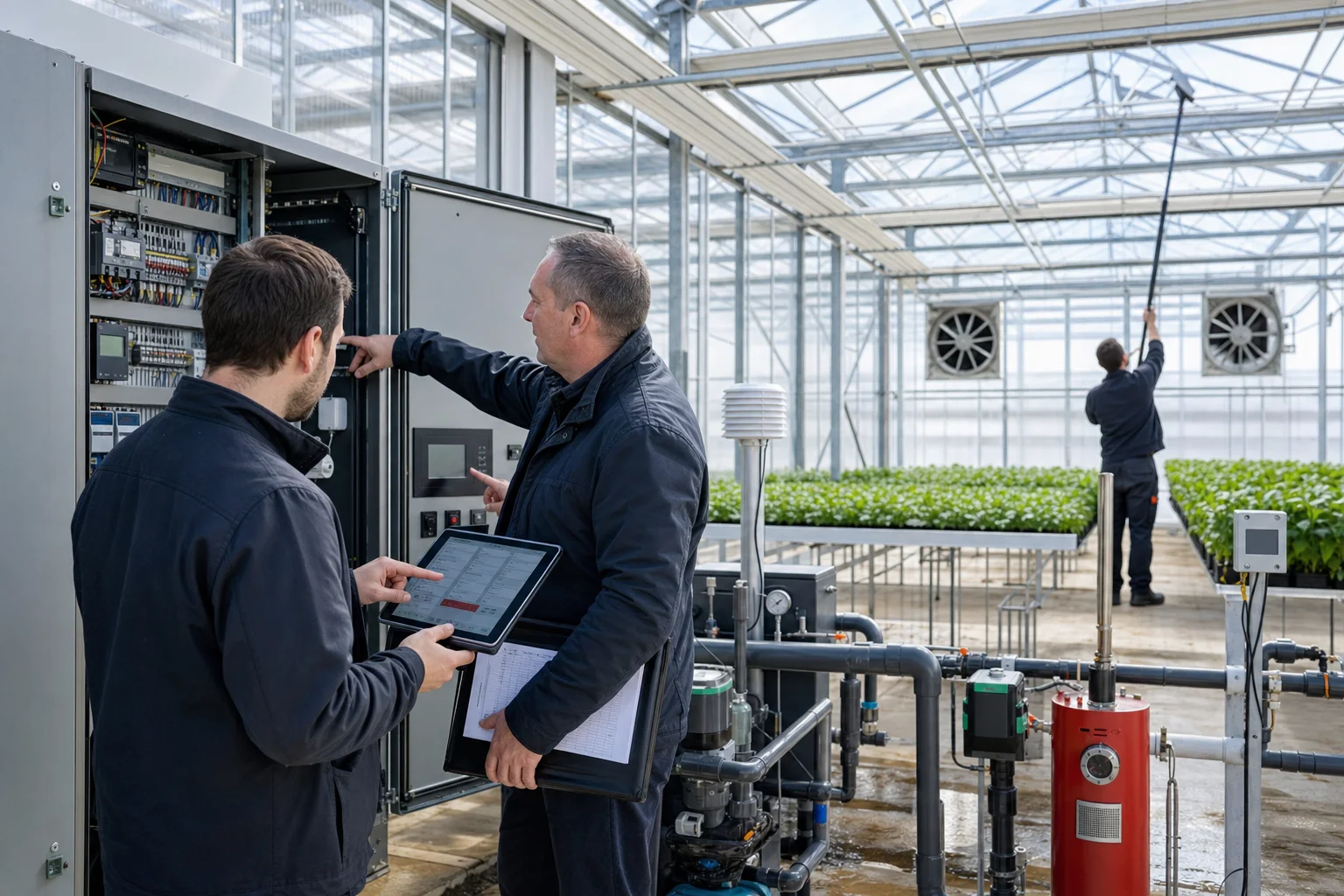
Start with point-to-point checks. Confirm that each sensor appears at the correct control point, each command operates the intended device, each status feedback is truthful, and each alarm reaches the intended user. Then test automatic sequences under controlled conditions.
Ventilation and screens
Test staged opening, wind and rain responses, interlocks, travel limits, obstruction protection, manual control, and safe recovery after power loss.
Heating and cooling
Verify equipment enable conditions, pump and fan proving, temperature stages, freeze protection, pad or fog controls, and conflicts between heating and ventilation.
Irrigation and dosing
Confirm source selection, tank levels, pump duty, filter pressure, zone flow, dosing response, flushing, drain return, low-level protection, and alarms.
Lighting and power
Test schedules, groups, dimming where provided, electrical demand controls, emergency circuits, generator transfer, and restart behavior.
Test failure modes, not only normal operation. Simulate a failed sensor, stopped fan, loss of water pressure, empty chemical tank, communication failure, power interruption, generator start, high wind, high temperature, low temperature, and alarm acknowledgement where those conditions apply. The procedure must protect people, crops, and equipment while the test is performed.
Measure conditions in the crop zone
A controller display does not prove uniform conditions. Compare reference measurements at representative crop height and locations, including areas near intake pads, fans, doors, gables, gutters, heating pipes, perimeter walls, and the center of long bays. Test during operating conditions that can reveal gradients.
For irrigation, measure representative outlets or zones rather than checking only the pump room. Record start pressure, operating pressure, flow, cycle time, drain volume where relevant, and evidence of blocked or uneven delivery. Confirm that water treatment and dosing equipment operate within the supplier and design limits using suitable laboratory or field tests.
Any performance demonstration must state the weather, crop or simulated load, vent and screen positions, operating mode, and test duration. Without those conditions, a temperature or humidity result cannot be compared with the design basis.
Control defects with one issue register
Record every defect, incomplete item, failed result, temporary arrangement, document gap, and training action in one issue register. Give each item an owner, due date, effect on safety or production, corrective action, and retest requirement. Photographs can support the record but should not replace a clear description and location.
Classify issues by acceptance effect. A life-safety, structural, electrical, gas, pressure, water-hygiene, or crop-protection failure may block operation. A lower-risk documentation item may be accepted with a firm completion date. The owner and responsible professionals should define these categories before the final inspection.
Do not close an issue merely because work was reported complete. Inspect the correction and repeat the relevant test. If the correction changes software, wiring, hydraulics, airflow, or a related sequence, test the affected interfaces again.
Train operators with the actual installed systems
Training should occur after the controls and equipment are stable enough to demonstrate. Use the installed greenhouse, not only slides. Operators should practice normal start and stop, manual and automatic modes, schedule changes, alarm response, safe isolation, filter service, sensor checks, irrigation flushing, backup operation, and recovery after a failure.
Record the trainer, attendees, date, subjects, and any remaining questions. Provide short operating procedures for critical and infrequent tasks. The WBDG commissioning guidance includes training records, systems manuals, test reports, and issue logs in the handover documentation because operations depend on all of them.
Require a controlled handover package
| Document group | Contents | Acceptance check |
|---|---|---|
| As-built information | Drawings, equipment schedules, cable and pipe routes, control points, setpoints, software versions, and network details. | Matches the installed facility and includes approved changes. |
| Test and approval records | Inspection certificates, startup forms, calibration records, functional tests, measured results, and retests. | Signed by the responsible people with unresolved items identified. |
| Operations information | Manuals, system descriptions, alarm list, maintenance schedules, spare-parts list, warranties, and supplier contacts. | Organized by system and available to the operating team. |
| Training and issue records | Attendance, training materials, open issues, agreed completion dates, and temporary operating restrictions. | Owner understands remaining risk and responsibilities. |
Link final payment and acceptance to the contract, not to a generic checklist. The commercial greenhouse buying checklist helps buyers define those responsibilities before ordering. Site and utility assumptions should also be consistent with the greenhouse site assessment checklist.
Prepare commissioning requirements before shipment
Send the greenhouse scope, crop plan, system list, local approvals, responsibility matrix, and required handover documents before finalizing the project schedule. Chengfei Greenhouse can use that information to clarify which supplier tests, records, and training items should be included in the project scope.
Contact Chengfei GreenhouseReferences
- Whole Building Design Guide. Building Commissioning: The Process.
- Whole Building Design Guide. Determining Project Performance Requirements.
- Whole Building Design Guide. Commissioning Documents: Process, Contents, and Acceptance.