
The short answer
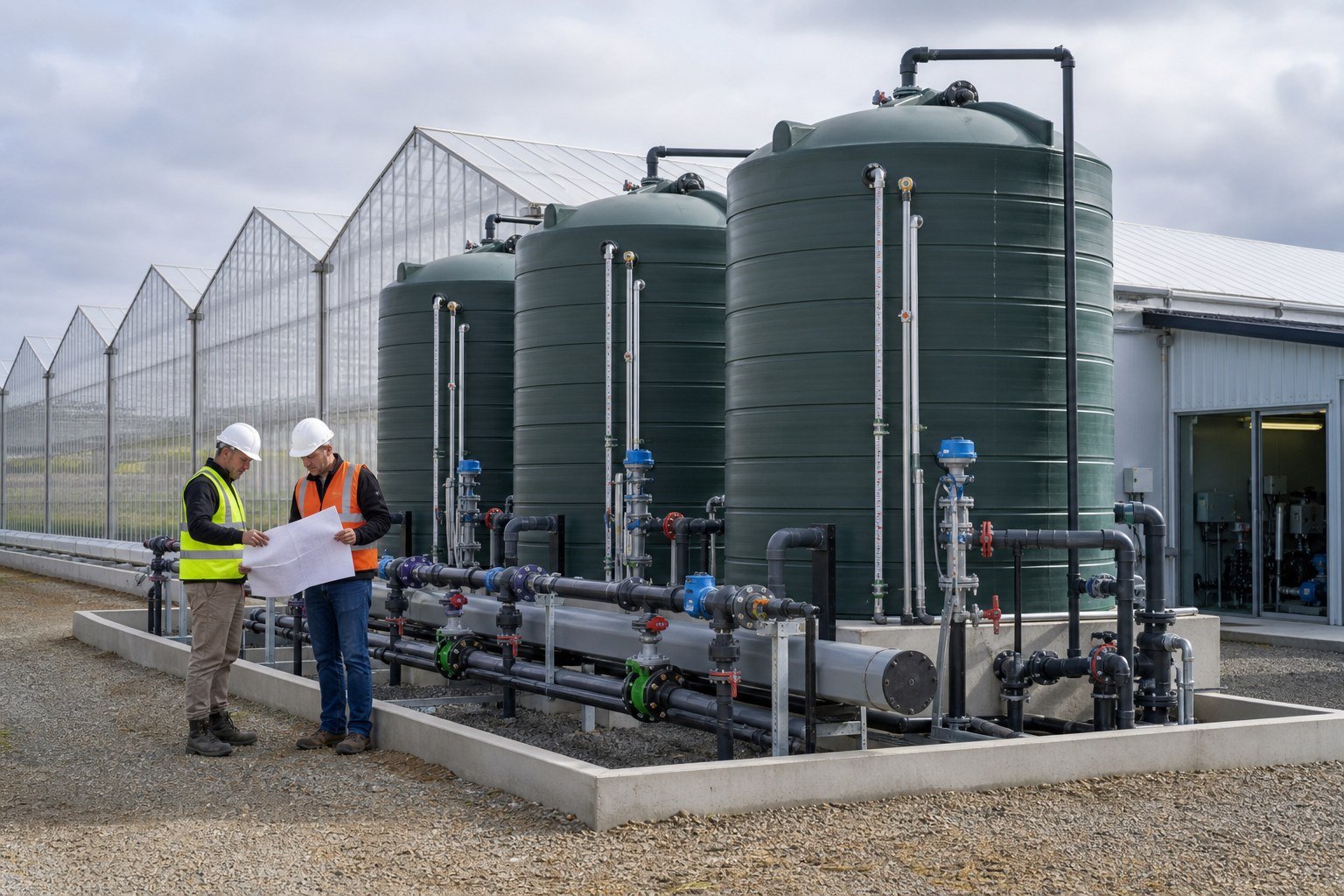
Create an hourly and daily water balance for each operating mode. Record crop area and stage, irrigation and misting demand, drain fraction, cleaning, pad cooling, humidification, filter backwash, staff and packhouse loads, refill flow and schedule, treatment production and recovery, rainwater and return-water rules, required outage duration, fire or emergency reserves, high and low operating levels, dead volume, overflow allowance, pump submergence, water-quality residence limits, expansion, and measurement uncertainty.
Daily average demand can hide the short irrigation window that controls pump and buffer volume. A reliable source may refill continuously while irrigation occurs in pulses. A slow treatment plant may require a treated-water buffer even when raw water is abundant. Conversely, a very large tank can create long residence time, warming, sediment, algae, and disinfection problems.
Raw source water, treated irrigation water, nutrient solution, roof rainwater, disinfected return water, untreated drain water, domestic water, and fire water can have different quality and regulatory duties. Combining them without a written basis can create crop, health, cross-connection, and compliance risks.
This planning guide supports procurement and coordination. Project-specific values and safety decisions remain with the grower, qualified designers, equipment manufacturers, contractors, and authorities responsible for the installation.
Inputs that should be fixed before supplier selection
| Input group | Record | Decision supported |
|---|---|---|
| Demand | Crop and stage, area, emitter flow, cycles, drainage target, maximum day, peak hour, mist, pad, washdown, filter backwash, staff, packhouse, and other users. | Defines the withdrawal profile rather than one average value. |
| Supply and treatment | Source flow, pressure, permitted hours, reliability, seasonal yield, treatment rate, recovery, reject flow, backwash, rainwater, return-water availability, and source switching. | Defines refill capacity and interruptions. |
| Storage duties | Operating buffer, treatment balance, source outage, crop emergency, fire reserve, flush volume, high and low levels, dead volume, freeboard, sediment allowance, and future phase. | Separates required volumes that may have different rules. |
| Water quality | Temperature, light exclusion, materials, residence-time limit, mixing, aeration, disinfection, sampling, cleanout, sediment removal, contamination separation, and overflow destination. | Prevents storage from degrading usable water. |
| Civil and controls | Tank dimensions, loading, foundation, access, bunding, drainage, overflow, vents, covers, level sensors, alarms, pump protection, isolation, bypass, metering, and maintenance clearance. | Connects calculated volume to a buildable installation. |
Identify each provisional item and the date by which it must be closed. A supplier can offer alternatives, but each alternative should state which input changed and how that change affects capacity, layout, utilities, controls, maintenance, and price.
A practical design and review sequence
1. Build demand from emitters and operations
Calculate each irrigation zone from emitter count and actual design flow, then apply irrigation duration and cycles for the peak crop stage. Add drain-target allowance and separate non-crop users. Put demands on a timeline so simultaneous irrigation, filter backwash, pad cooling, washing, and packing loads are visible.
2. Model refill and treatment on the same timeline
Record source and treatment production by hour, including permitted pumping windows, low-yield periods, treatment recovery, cleaning, backwash, and source interruptions. The maximum cumulative deficit between inflow and demand establishes one part of the operating storage requirement.
3. Assign every reserve a rule
State who can use the emergency volume, what event releases it, and how it is protected from normal operation. Fire reserve may require a dedicated compartment, connection, or authority approval. Crop survival volume should be linked to an agreed reduced-irrigation mode and outage duration, not an arbitrary number of days.
4. Check physical usable volume
Subtract inaccessible bottom volume, pump submergence, sediment allowance, high-level cutoff, freeboard, and any compartment that normal irrigation cannot use. Confirm overflow and emergency drainage can handle credible fill or valve failures without damaging foundations, neighboring property, electrical rooms, or watercourses.
Keep the assumptions with the calculation or equipment schedule. When the crop plan, source condition, greenhouse geometry, or operating sequence changes, the responsible designer can then identify which result must be recalculated instead of relying on an obsolete approval.
Divide responsibilities at the interfaces
Owner and grower
Provide crop, operating hours, acceptable risk, local practices, staff capability, utilities, expansion plan, and approval priorities.
Greenhouse supplier
Provide structure, envelope, equipment, layout, loading, utility, control, installation, and commissioning interface data within the contracted scope.
Specialist designer
Apply local climate, codes, calculation methods, safety duties, equipment selection, system integration, and professional approval.
Contractor and operator
Confirm site conditions, installation, access, testing, records, training, safe operation, inspection, and maintenance.
Use a responsibility matrix for supply, design, installation, power, water, drainage, controls, network, civil works, testing, permits, consumables, spares, training, and warranty response. Phrases such as complete system are not enough when the interfaces cross several contracts.
Common specification failures
| Failure | Why it matters and what to do |
|---|---|
| Average daily demand drives the design | Peak withdrawal and restricted refill can empty a tank even when the daily totals balance. Use hourly or shorter time steps for critical modes. |
| Nominal tank volume equals usable volume | Dead space, low-level cutoff, pump submergence, freeboard, sediment, and protected reserves reduce available operating water. State each volume. |
| All water is combined | Different sources and returns may need separation, treatment, or backflow protection. Define quality classes and permitted transfer paths before laying out tanks. |
| Expansion is an undocumented allowance | State the future greenhouse area, crop, timing, source, treatment, and connection points. A percentage without a planned duty can understate pumps, foundations, or pipework. |
Record every accepted deviation. A verbal clarification during a meeting should be transferred to the controlled drawing, schedule, calculation, or specification that governs manufacture and site work.
Plan acceptance before equipment is ordered
Agree on document review, factory checks where appropriate, delivery inspection, installation inspection, pre-start checks, calibration, functional tests, representative operating tests, abnormal-mode tests, training, and handover. State the instruments, conditions, tolerances, data format, witnesses, and corrective-action process.
Use the project commissioning plan to connect design intent to field evidence. Where continuity matters, coordinate power, alarms, operator response, and recovery through the site resilience plan. Keep final settings, test results, and approved changes with the equipment record so maintenance staff have a usable baseline.
Acceptance is not a substitute for ongoing observation. Trend the measurements that reveal deterioration, compare them with the commissioned condition, and define who investigates a sustained change. This is particularly important where crop damage can begin before a component reaches complete failure.
Questions the project team should answer
What is the peak crop-stage demand by hour? Which other water users overlap? How quickly and when can each source refill? What is the treatment production and recovery? Which outage must the crop survive? Is fire storage separate? What volume is unusable? How long can water remain stored without quality loss? Where do overflow, drain-down, backwash, and treatment reject go? Which future phase is included?
Frequently asked questions
How many days of water should a greenhouse store?
There is no universal number. Determine the credible source and treatment interruption, crop consequence, reduced-irrigation strategy, climate, refill alternatives, cost, water-quality residence limit, and local requirements.
Can raw and treated water share one tank?
Usually they represent different process points. Combining them can bypass treatment or cause unstable quality. Any shared arrangement needs a clear process, isolation, monitoring, and approval from the relevant designers and authorities.
Should rainwater be counted as guaranteed supply?
Use a conservative availability model based on roof area, rainfall sequence, collection efficiency, first-flush losses, storage, and seasonal coincidence with demand. Keep a case for low or absent rainfall.
What level instruments are needed?
Provide continuous measurement where operations need volume trends, plus independent high and low protection where consequences justify it. Define alarms, calibration, stilling or turbulence control, pump interlocks, overflow backup, and manual verification.
Prepare the input schedule before requesting a fixed offer
Send the crop-area schedule, irrigation zones, peak-day program, other water users, source flow and reliability, treatment data, return-water plan, outage target, fire requirements, site levels, and expansion plan. Chengfei Greenhouse can coordinate greenhouse demand and connection data with the irrigation and civil designers.
Contact Chengfei GreenhouseReferences
- FAO Chapter 2: Crop Water Needs. FAO Chapter 2: Crop Water Needs.
- FAO Chapter 4: Irrigation Water Needs. FAO Chapter 4: Irrigation Water Needs.
- A Water Quality Toolkit for Greenhouse and Nursery Production. A Water Quality Toolkit for Greenhouse and Nursery Production.