
The short answer
Approve a startup method before adding treatment chemicals or connecting crops. Confirm source capacity and current analysis, protect against cross-connection, inspect tanks and pipework, remove construction debris, clean filters and strainers, flush from larger mains toward smaller laterals, and sample representative near and remote points. If sanitization is required, a qualified person must select a product compatible with the crop, water, pipework, emitters and treatment equipment; follow the current label and local discharge rules; verify concentration with an appropriate method; achieve the required contact; then flush or neutralize as specified. Test pressure, flow, distribution and emitter operation before crop release.
New systems may contain dust, plastic swarf, sealant, metal particles or stagnant test water. Existing systems can carry sediment, mineral deposits and biofilm. Organic residue can reduce disinfectant effectiveness, while an incompatible oxidizer or acid can damage components, release hazardous gas or injure crops. The sequence matters: inspect and physically clean first, then apply only an approved treatment.
Create a simple system map showing source, storage, treatment, backflow protection, pumps, filters, dosing points, mains, zones, drain ends, return lines and sample points. Mark dead legs and sections that cannot be drained. The map becomes the basis for flushing order, sample selection, isolation and future troubleshooting.
This guide is an operating-control framework, not a substitute for the approved design, crop protection plan, product labels, manufacturer instructions, employment and safety procedures, local law, or advice from qualified growers, engineers, water-treatment specialists, plant-health advisers, and safety professionals.
What the buyer should control
| Control point | Required record or action | Release evidence |
|---|---|---|
| Water source and duty | Confirm source ownership, seasonal capacity, pressure, current laboratory results, crop use, treatment assumptions, backup and restrictions. | Approved water basis and a current result set interpreted by a competent adviser. |
| System condition and materials | Inspect tanks, lids, screens, pumps, filters, valves, backflow devices, dosing equipment, pipe materials, emitters, drains, dead legs and construction cleanliness. | Walkdown record and closed defects before chemical treatment. |
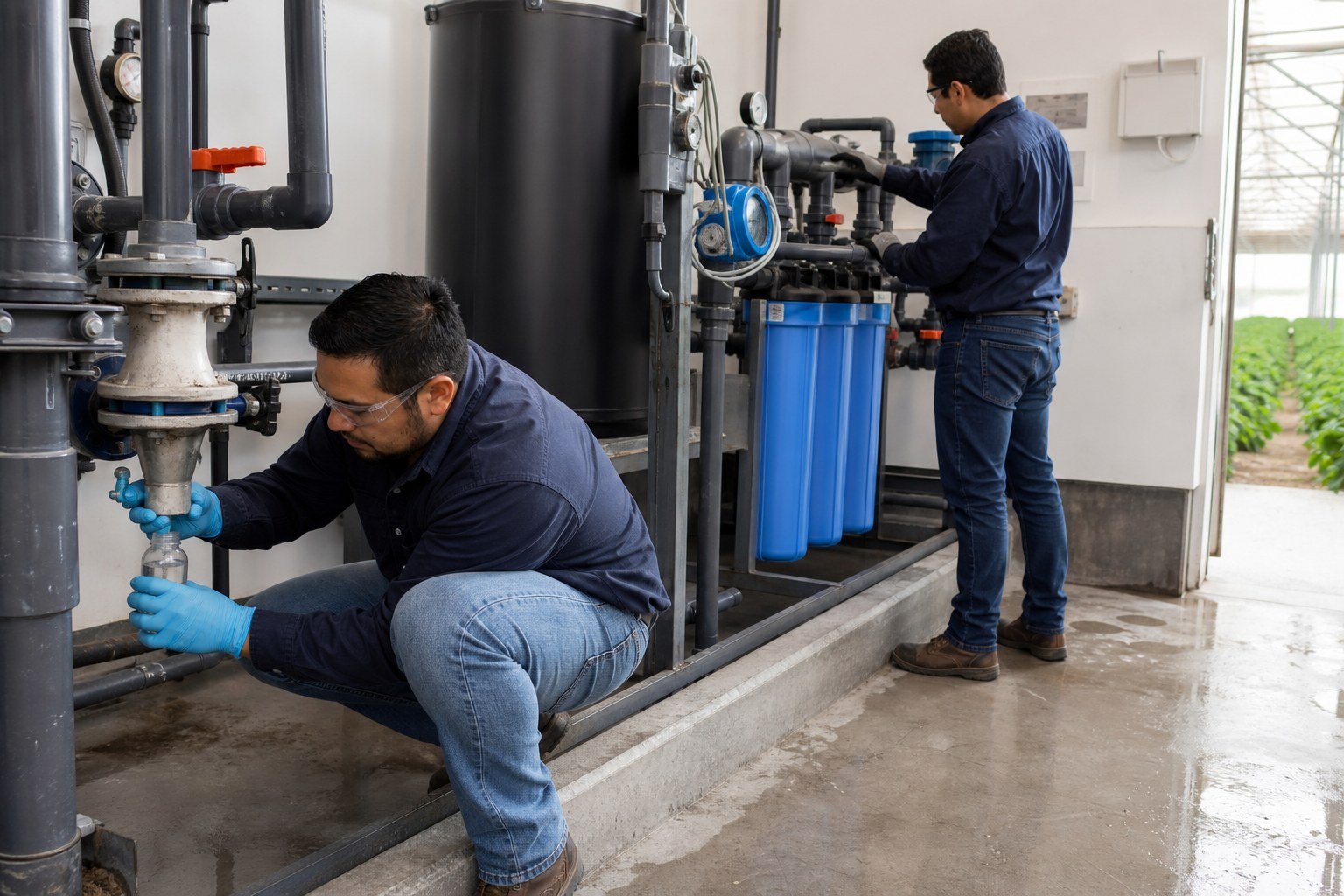
| Mechanical cleaning and flushing | Remove debris, clean tanks and filters, establish safe discharge, flush in a documented sequence, maintain adequate velocity or flow and observe remote ends. | Flush log records sections, times, flow or pressure, appearance and completion. |
| Treatment method | Identify target organism or deposit, compatible labeled product, water chemistry, concentration method, contact, temperature, PPE, ventilation, mixing prohibition, spill control and discharge. | Approved task method, current label, competent authorization and measured treatment record. |
| Sampling and verification | Select source, post-treatment, tank, zone and far-end points; use clean technique, correct containers, chain of custody and an appropriate laboratory or field method. | Results meet the project-specific crop, safety and equipment release criteria. |
| Hydraulic and emitter test | Measure pressure, flow, pump response, filter differential, valve operation, leaks, zone timing, emitter output samples, drain or return behavior and alarm functions. | Accepted distribution test with outliers corrected and retested. |
| Handover and routine control | Save baseline settings, chemical safety information, calibration, filter cleaning, flushing frequency, sample schedule, responsible roles and response to adverse results. | Operations sign-off and a current water-system log ready for the first crop. |
Give every open item an owner, due date, status, related drawing or package, and effect on cost, time, quality, safety, and performance. “Discussed,” “in progress,” or “by others” is not a closure record.
A practical workflow
1. Define the release point and the people at risk
State whether the system supplies irrigation only or also fogging, cooling, handwashing or another use. Separate potable and non-potable duties and obtain local specialist review where required.
2. Walk the actual flow path
Check that valves, arrows, drains and sample points match drawings. Confirm backflow protection and identify branches that can trap untreated or concentrated solution.
3. Clean and flush in controlled sections
Work from the source through treatment and distribution. Protect emitters while large debris is removed, then reconnect and flush laterals. Record what leaves the system rather than flushing for an arbitrary time.
4. Apply treatment under an approved method
Do not copy a dose from another greenhouse. Water demand, pH, organic load, temperature, materials and target organisms change effectiveness and risk. Measure what is required by the selected method.
5. Release by evidence and keep the baseline
Review sample results, hydraulics, alarms, settings and deviations. Keep initial values so a later pressure, flow or quality change can be recognized early.
Use one controlled register and preserve superseded records. The team should be able to reconstruct which instruction, setting, role and asset condition applied when an event was observed, adjusted, maintained, tested, restored and accepted.
Roles at the operating interfaces
Owner and operations manager
Set the crop, safety, production and business priorities; assign authority; approve operating limits; and make sure urgent decisions can be made outside normal hours.
Grower and plant-health lead
Define crop-sensitive conditions, hygiene zones, scouting evidence, water-quality needs, permitted treatments, release criteria and the response to suspected pests or disease.
Maintenance and controls team
Keep assets, sensors, software, backups, alarms, isolations, spares and work records usable. Report degraded functions before they turn into crop or safety events.
Suppliers and local specialists
Provide scope-specific instructions, competent service, replacement parts and technical evidence. Local professionals must control regulated electrical, pressure, chemical, fire and environmental work.
Use evidence before releasing the next step
Before people, water, chemicals, crops or equipment enter a released area, confirm that the approved method is current, the responsible person has checked the work, exceptions are controlled, affected teams have been informed, and the record can be retrieved. If a condition is not met, state what may continue, what remains on hold, who owns the action, and when it will be checked again. This is more useful than a general statement that the greenhouse is ready.
Common failure modes
| Failure | Buyer response |
|---|---|
| Sanitizer is added before debris is removed | Organic matter and deposits can shield contamination and consume treatment. Clean and flush first. |
| Only the pump room is sampled | Remote laterals and dead ends may remain stagnant or under-treated. Use a risk-based set of representative points. |
| A universal chemical recipe is copied online | Compatibility, label legality, crop sensitivity and water demand vary. Use a qualified, product-specific method. |
| Flushing discharge is improvised | Plan containment, neutralization or disposal under local rules before startup begins. |
Buyer decision questions
What is the intended water duty and who could be exposed? Is the source analysis current for the season? Which materials, membranes, emitters and sensors limit chemical choice? Where are dead legs and remote ends? How will concentration and contact be verified? Where may discharge go? What measured results release the system to crops?
Link the answer to the greenhouse water quality guide, the greenhouse irrigation system guide, the commissioning checklist, so operating decisions remain connected across the crop, equipment, maintenance and evidence.
Frequently asked questions
Can clear water be considered clean enough?
No. Appearance does not prove chemical suitability, microbial condition or uniform distribution. Use the project-specific analysis and release plan.
Which sanitizer should a greenhouse use?
There is no universal answer. Selection depends on the target, local registration, water chemistry, crop, materials, treatment equipment, safety and discharge constraints.
Should emitters be installed during the first flush?
Follow the system designer and manufacturer. Large debris may require flushing open lines first, followed by an emitter-level distribution and cleanliness check.
What should remain in the startup record?
Keep the system map, source results, method, product label, measurements, flush sections, samples, hydraulic results, deviations, approvals and final settings.
Turn the requirement into a controlled deliverable
Share the water source analysis, irrigation drawing, crop, pipe and emitter materials, treatment equipment, intended duties and local discharge constraints. Chengfei Greenhouse can help define startup checks for its supplied irrigation scope while qualified local specialists approve water treatment and legal compliance.
Contact Chengfei Greenhouse