
The short answer
Calculate the contingency from measured demand by crop zone and service, not from tank nameplate volume. Record usable storage after dead volume, treatment reserve and operational limits. Rank propagation, hydroponic circulation, young plants, high-transpiration zones, cooling, sanitation and other uses for the season. For every alternate source, approve quality, treatment compatibility, cross-connection protection, pumping, power, hose or pipe route, delivery access and the time needed to place it in service. Define the maximum interruption each zone can tolerate and the decision to reduce area, hand-water, consolidate plants or suspend production. When normal supply returns, inspect for contamination, stagnation, pressure shock and treatment upset before reconnecting every zone.
A water interruption can start upstream or inside the greenhouse. The well may stop, municipal pressure may fall, a pump or variable-frequency drive may trip, a filter may block, the treatment system may lock out, a main may leak, storage may be contaminated, or backup power may not include the water system. The plan should identify the failed function before staff connect another source.
Water quantity and water quality cannot be separated. A nearby pond, tanker, roof tank or second well may have enough volume but unsuitable salinity, alkalinity, pathogens, sediment, temperature or chemical history. It may also be incompatible with filters, injectors, disinfectant demand or a recirculating system. Approve and test alternatives before the emergency rather than sampling after crops are already thirsty.
This guide is an operating-control framework. The approved design, crop plan, product labels, manufacturer instructions, site safety procedures, local law and directions from competent local professionals govern the actual work.
What the buyer should control
| Control point | Required record or action | Release evidence |
|---|---|---|
| Demand and tolerance | Measure irrigation, cooling, fertigation, propagation, cleaning and other essential demand by zone and time. State maximum delay by crop condition. | Meter and schedule data support a grower-approved seasonal priority table. |
| Usable storage | Record tank geometry, dead volume, minimum pump level, treatment reserve, turnover, cover, overflow, isolation, indication accuracy and leakage. | Drawdown test or verified calculation states usable volume and hours at each contingency mode. |
| Alternate source quality | Test chemical, physical and biological parameters required by crop, system, food-safety and local rules; define sampling and release authority. | Current laboratory and field results are accepted against written source-specific limits. |
| Treatment compatibility | Check filtration, disinfection demand, pH or alkalinity control, injectors, recirculation, concentrate recipes, corrosion and disposal implications. | Water specialist approves settings, monitoring, chemicals and waste route for the alternate source. |
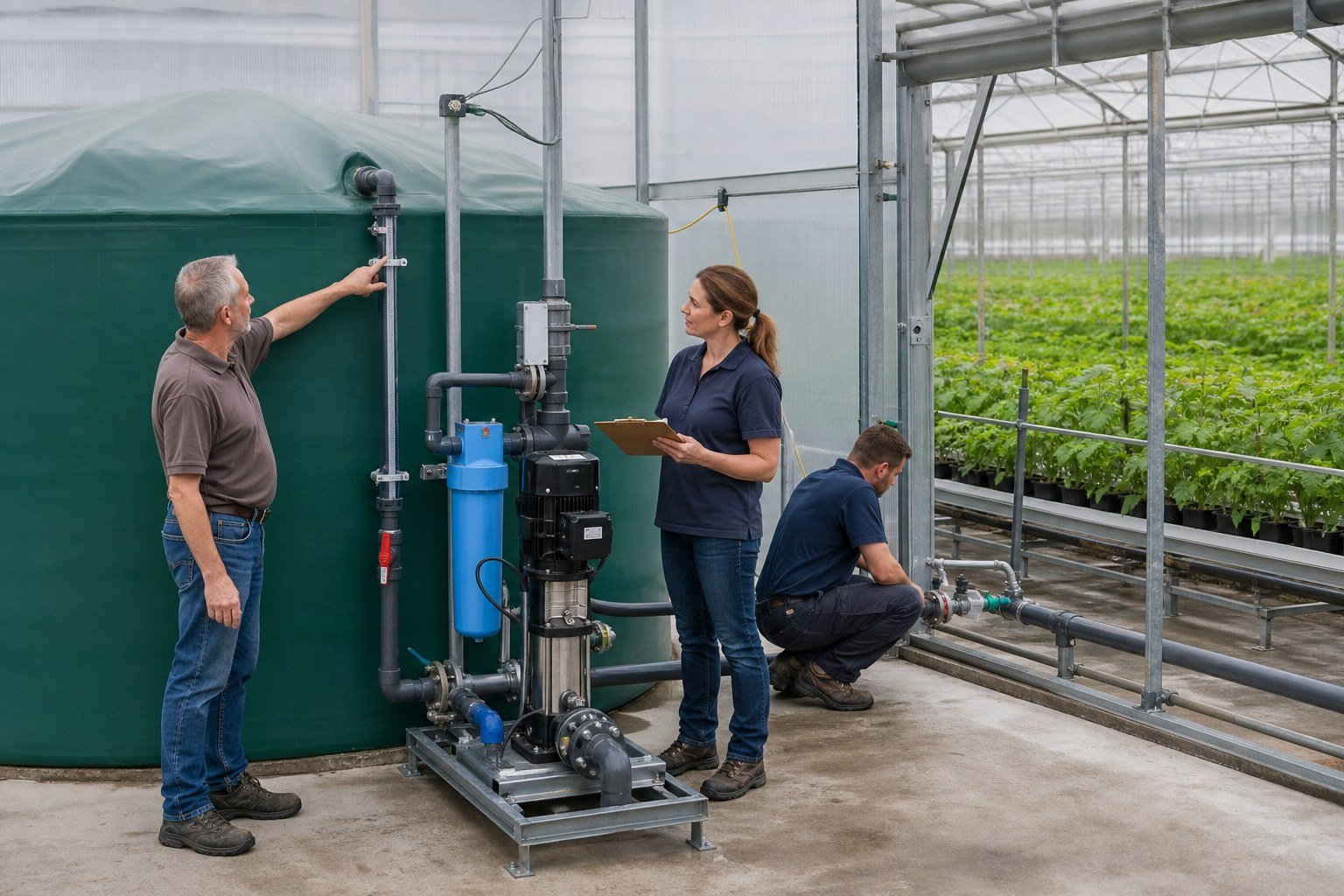
| Connection and distribution | Define legal cross-connection protection, approved couplings, clean hoses, pumps, backup power, route, pressure control, zone isolation and secure delivery access. | Controlled connection drawing, equipment inspection and witnessed deployment test. |
| Crop allocation | Rank zones, set reduced irrigation recipes or manual cycles, prevent duplicate automation, track delivered volume and state the stop or crop-movement decision. | Duty sheet records zone, time, volume, water source, operator and observed response. |
| Normal-source return | Sample if required, flush or sanitize under the approved method, stabilize pressure and treatment, reconcile tanks and recipes, then release zones in stages. | Water-quality, sanitation and functional records support signed return to normal operation. |
Every open item needs an owner, due date, status and effect on safety, production, cost and recovery time. A note that something was discussed or is being handled does not prove closure.
A practical workflow
1. Measure the demand curve
Use meters and irrigation records to show when each crop zone and cooling system draws water. Include simultaneous demand, pump duty, filter backwash, line flushing and treatment needs. A daily total does not show whether the backup can meet the peak hour.
2. Rank crop and service priorities
The grower should state which zones cannot wait, which can accept a reduced cycle, which can be consolidated or moved, and which production work stops. Revisit the ranking as crops, weather and propagation schedules change.
3. Qualify alternate sources
Sample under a defined method and retain the source history. Check the parameters relevant to the crop and system. Confirm permits, supplier hygiene, tanker previous contents, storage protection and the treatment changes needed before approval.
4. Prove the physical connection
Deploy the approved pump, hose, fittings, backflow protection, power and route during a drill. Confirm clean storage, pressure, zone reach, traffic control and the practical labor needed. Do not leave unprotected temporary hoses as a permanent connection.
5. Write the reduced-operation sheet
Give staff a simple zone list with source, target volume or approved cycle, time, operator, automatic schedule status and crop observation. The sheet should prevent one zone from receiving both manual and automatic irrigation while another receives none.
6. Control the change back
When normal water returns, inspect the fault, sample where needed, flush or sanitize through the approved procedure and stabilize treatment. Restore zones gradually and compare pressure, flow, pH, electrical conductivity and crop response with the normal baseline.
Preserve the event sequence and earlier versions of records. The team should be able to reconstruct what was observed, which condition applied, who decided, what changed, how the result was tested and which limitation remained.
Who owns each decision
Head grower
Owns zone priority, acceptable irrigation delay, reduced recipes, crop movement and crop release. These decisions use current crop and weather conditions.
Water-quality and plant-health lead
Defines source tests, sampling, treatment, hygiene, food-safety restrictions, recirculation controls and the evidence required before use.
Maintenance and irrigation team
Maintains tanks, pumps, meters, filters, valves, backflow devices, power and approved temporary connections, then records actual delivered flow.
Logistics and continuity owner
Keeps supplier agreements, tanker access, purchase authority, delivery timing, staff coverage and a current estimate of remaining usable water.
Release evidence before the next step
Release an alternate source only after quantity, quality, treatment and connection controls have all passed. A satisfactory field pH or electrical-conductivity reading cannot replace required laboratory, microbial, food-safety or chemical checks. When returning to normal water, release the source, treatment system and crop zones separately. Record temporary recipes and remove or isolate temporary connections so cross-connection risk does not remain.
Common failure modes
| Failure | Buyer response |
|---|---|
| Tank nameplate equals available water | Subtract dead volume, minimum suction level, treatment reserve, unusable or stale water and operational limits, then verify indication accuracy. |
| Any clear water is accepted | Approve alternate sources through the crop, system, hygiene, food-safety, environmental and local compliance criteria that apply. |
| Manual watering is not recorded | Track zone, time, source and quantity so staff avoid omissions, duplication and treatment errors. |
| Cooling consumes the crop reserve | Set a seasonal allocation and decision rule for cooling versus irrigation before both compete during a hot interruption. |
| Normal supply is reconnected immediately | Inspect the cause, control pressure, verify water and treatment condition, and release the system in stages. |
Buyer decision questions
What is the peak hourly demand, not only the daily total? How much water is usable above the pump and treatment limit? Which crop zone shows stress first? Can backup power operate the source, treatment and distribution path together? Which alternate source has current quality evidence? Can the tanker reach the fill point without entering a clean production zone? Who changes fertilizer or disinfectant settings? How will staff prevent duplicate irrigation? What evidence permits return to the normal source?
Keep these decisions connected to the greenhouse water balance audit, the greenhouse water startup sanitization plan, the greenhouse biosecurity entry plan. The emergency plan, equipment evidence and crop plan should describe the same operating reality.
Frequently asked questions
How many days of water should a greenhouse store?
There is no universal number. Calculate demand by season and mode, source-restoration time, delivery access, crop tolerance, treatment needs, legal limits and the business consequence of shortage.
Can rainwater be the emergency source?
It may be part of a designed system, but collection, first flush, storage, treatment, quality, available seasonal volume and cross-connection control need prior approval.
Can municipal drinking water be used without testing?
Confirm current suitability for the crop, treatment system and intended use. Municipal composition and treatment may affect sensitive crops, injectors or recirculation.
Should fertigation continue during reduced watering?
The grower and water specialist should define source-specific recipes, stock-tank status, monitoring and the transition back. Do not assume the normal recipe fits a different source or reduced volume.
What is the fastest useful preparation?
Meter major zones, measure usable storage, test likely alternate sources, label approved connections and run one timed deployment drill with the people who will do the work.
Turn the requirement into a controlled deliverable
Share the water sources, recent analyses, crop-zone demand, storage, pump and treatment data, irrigation schedules, backup power and alternate-supply options. Chengfei Greenhouse can help map dependencies in supplied irrigation systems while qualified local water, crop and compliance professionals approve contingency use.
Contact Chengfei Greenhouse