
The short answer
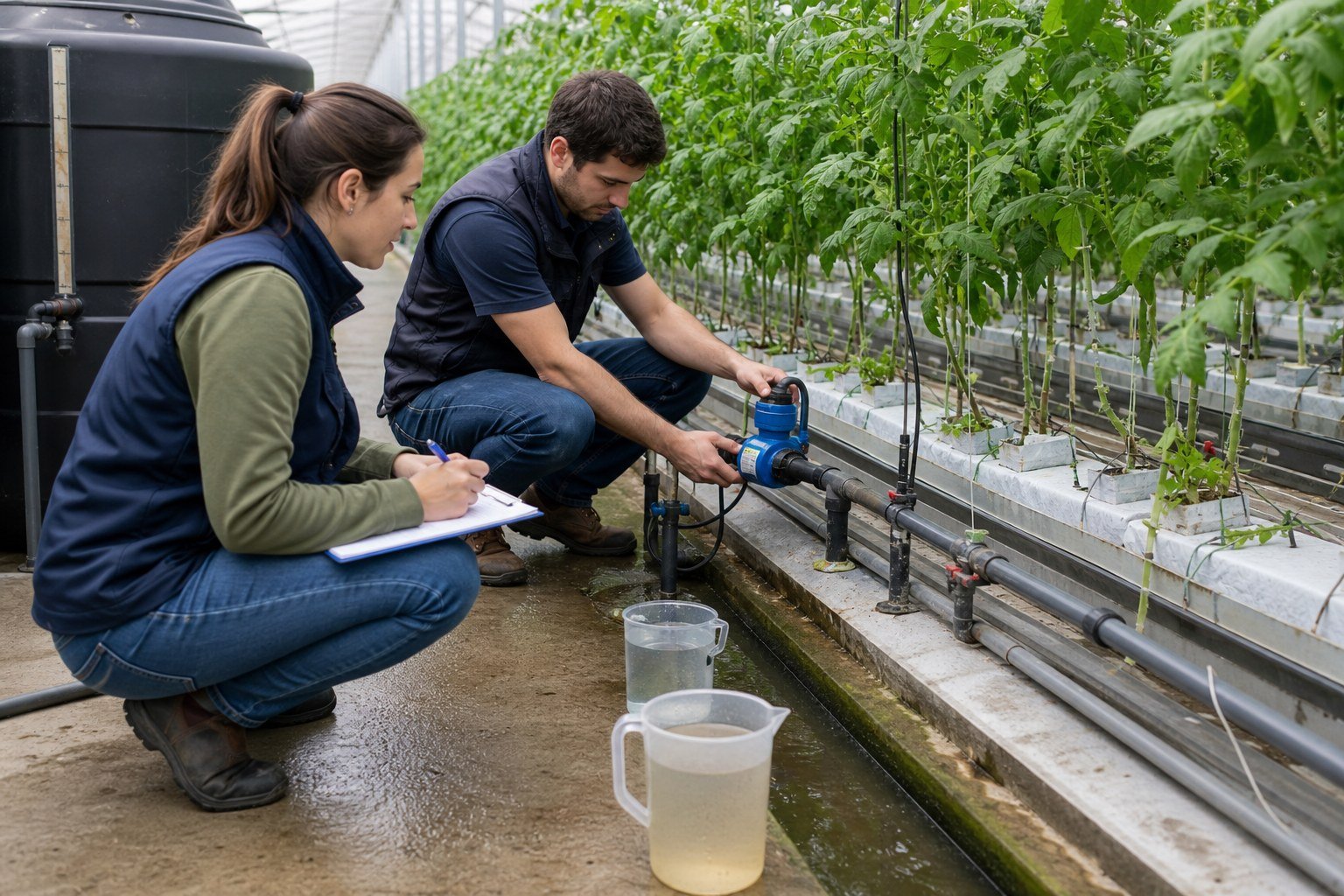
Define one audit boundary and time period. Read source and makeup meters, record tank levels at the start and finish, total irrigation sent to each zone, measure representative emitter output, collect or estimate drainage under a stated method, record reuse returned, water discharged and known cleaning or cooling uses. Reconcile units and meter clocks before calculating the unexplained difference. Review crop stage, weather, substrate, irrigation events and water quality with the grower. Correct leaks, valve bypass, meter error, poor uniformity and control problems without reducing crop water below an agronomically justified requirement.
A water balance is an accounting identity, not proof that every missing litre leaked. Tank storage, pipe filling, meter resolution, sampling error, evaporation, crop uptake, humidification, cooling, cleaning and unmeasured uses can explain part of the difference. State what is measured, estimated and unknown.
Run the audit over a period long enough to smooth individual irrigation events but short enough that tank changes and crop conditions remain traceable. One representative day may diagnose a valve or emitter issue. A full production week or crop cycle may be better for management and cost decisions. Repeat suspect manual measurements rather than relying on one container or one meter reading. Record container volume, collection time, sample location and operator so the team can distinguish real spatial variation from inconsistent measurement technique.
This guide is an operating-control framework, not a substitute for the approved design, crop protection plan, product labels, manufacturer instructions, employment and safety procedures, local law, or advice from qualified growers, engineers, water-treatment specialists, plant-health advisers, and safety professionals.
What the buyer should control
| Control point | Required record or action | Release evidence |
|---|---|---|
| Boundary and period | Define source, tanks, treatment, zones, drains, reuse, discharge, cooling and cleaning uses; set start and finish times with consistent units and clocks. | Signed schematic and audit period prevent missing or double-counted flows. |
| Meter confidence | List range, resolution, multiplier, direction, installation condition, verification method, communication gaps and manual reading responsibility. | Meter reconciliation or field check supports the intended accuracy. |
| Source and storage | Record municipal, well, rainwater and recovered inputs; tank levels and geometry; overflows; tanker deliveries; and water diverted to other duties. | Volume change is calculated from verified dimensions or level instrumentation. |
| Zone delivery and uniformity | Capture irrigation duration, command, valve feedback, pressure, flow and representative emitter containers across near, middle, far and elevation extremes. | Distribution results identify blocked, leaking or pressure-affected sections. |
| Crop and drainage | Record occupied area, crop stage, substrate, weather, events, runoff or drain fraction method, root-zone observations and rejected product. | Grower interpretation confirms whether delivery supports crop performance. |
| Reuse and discharge | Measure collected return, treatment losses, filter backwash, bleed, intentional discharge, spills and quality-based diversion. | Destination, volume and water-quality decision are traceable. |
| Action and follow-up | Rank meter faults, leaks, valve problems, pressure loss, clogged emitters, scheduling, treatment and reuse opportunities by risk and payback. | Owner, target, verification measure and review date are assigned. |
Give every open item an owner, due date, status, related drawing or package, and effect on cost, time, quality, safety, and performance. “Discussed,” “in progress,” or “by others” is not a closure record.
A practical workflow
1. Walk the water route before reading meters
Follow every pipe and drain from source to destination. Check bypasses, overflows, hose connections, tank level marks and uses that drawings may omit.
2. Synchronize the audit
Use one time reference for meters, controller events and manual readings. Record irrigation that crosses the boundary and avoid mixing cumulative totals from different reset times.
3. Test distribution, not only total volume
A correct zone total can hide overwatering near the inlet and blocked emitters at the far end. Sample locations that represent pressure and elevation differences.
4. Interpret water with crop evidence
Compare drainage, substrate moisture or weight, root condition, climate and growth. A conservation target cannot replace crop-specific irrigation strategy.
5. Verify the result after correction
Repeat the same measurement boundary after repair or scheduling change and watch water quality, crop uniformity and labor. Preserve the original result for comparison.
Use one controlled register and preserve superseded records. The team should be able to reconstruct which instruction, setting, role and asset condition applied when an event was observed, adjusted, maintained, tested, restored and accepted.
Roles at the operating interfaces
Owner and operations manager
Set the crop, safety, production and business priorities; assign authority; approve operating limits; and make sure urgent decisions can be made outside normal hours.
Grower and plant-health lead
Define crop-sensitive conditions, hygiene zones, scouting evidence, water-quality needs, permitted treatments, release criteria and the response to suspected pests or disease.
Maintenance and controls team
Keep assets, sensors, software, backups, alarms, isolations, spares and work records usable. Report degraded functions before they turn into crop or safety events.
Suppliers and local specialists
Provide scope-specific instructions, competent service, replacement parts and technical evidence. Local professionals must control regulated electrical, pressure, chemical, fire and environmental work.
Use evidence before releasing the next step
Before people, water, chemicals, crops or equipment enter a released area, confirm that the approved method is current, the responsible person has checked the work, exceptions are controlled, affected teams have been informed, and the record can be retrieved. If a condition is not met, state what may continue, what remains on hold, who owns the action, and when it will be checked again. This is more useful than a general statement that the greenhouse is ready.
Common failure modes
| Failure | Buyer response |
|---|---|
| Tank level change is ignored | Stored volume can make inflow and irrigation appear unbalanced. Record start and finish levels. |
| Controller minutes are treated as measured volume | Flow changes with pressure, blockage, valve condition and emitter wear. Verify with a meter and field samples. |
| All missing water is called leakage | Account for crop uptake, evaporation, storage, cleaning, cooling and measurement uncertainty first. |
| Water savings reduce required leaching or distribution | Use crop and water-quality criteria so efficiency work does not create salt or uniformity problems. |
Buyer decision questions
Where does the audit boundary begin and end? Which flows are measured, estimated or unknown? Are clocks, units and meter multipliers consistent? Does zone total hide poor emitter uniformity? What crop and water-quality requirement explains drainage? Where does collected water go? Which correction can be verified with the same balance?
Link the answer to the greenhouse irrigation system guide, the greenhouse water quality guide, the greenhouse drainage and water reuse guide, so operating decisions remain connected across the crop, equipment, maintenance and evidence.
Frequently asked questions
How exact must the balance be?
Accuracy should match the decision. State meter and estimation uncertainty instead of forcing totals to agree.
Is drainage always waste?
No. Some systems require drainage for salt management or control, and recovered water may be treated and reused. Use crop and water-quality advice.
Can one flow meter serve the whole site?
It supports total accounting, but zone or temporary measurements may be needed to locate loss and uniformity problems.
What should be checked first when use rises?
Confirm meter and tank data, occupied area, weather, crop stage, controller events, leaks, overflows, valve response and cleaning or cooling uses.
Turn the requirement into a controlled deliverable
Share the water schematic, source and tank data, zone schedule, crop and substrate, drainage or reuse arrangement and recent meter history. Chengfei Greenhouse can help identify measurement points for its supplied irrigation scope while crop and local water specialists set release criteria.
Contact Chengfei Greenhouse