
The short answer
Prepare a water balance and keep drainage streams separate until their quality and legal route are known. Calculate roof runoff, external stormwater, irrigation supply, crop uptake, leach or return volume, wash water, treatment waste, sanitary flow, overflow, and emergency discharge. Reuse only after the crop, pathogen, salt, pesticide, worker-safety, and regulatory risks are assessed.
Combining clean rainwater with fertilizer-rich drain water can increase treatment cost. Sending sanitary or chemical-contaminated water into an irrigation return tank can make reuse unsafe. The layout should prevent accidental cross-connection and provide sampling, isolation, overflow, cleaning, and monitoring.
Local environmental, plumbing, food-safety, pesticide, and water-reuse rules differ. Qualified local designers and authorities must approve the final system and discharge route.
Name every water stream
| Stream | Typical source | Design concern |
|---|---|---|
| Roof rainwater | Gutters and downpipes from greenhouse roofs. | Rainfall intensity, first flush, debris, storage, overflow, roof material, and treatment before use. |
| External stormwater | Roads, yards, slopes, loading areas, and neighboring land. | Sediment, fuel or chemical contamination, erosion, detention, and legal discharge. |
| Irrigation return | Drain from substrate, gutters, benches, floors, or hydroponic channels. | Nutrients, salts, crop pathogens, pesticides, debris, collection timing, and reuse treatment. |
| Floor and equipment wash water | Cleaning of aisles, tanks, filters, packing, and production equipment. | Cleaning chemicals, organic load, soil, disinfectant, and whether the flow may enter reuse. |
| Treatment residuals | Filter backwash, membrane concentrate, sludge, chemical cleaning, and disinfection systems. | Concentration of contaminants, volume, storage, and approved disposal. |
| Sanitary and domestic water | Toilets, sinks, showers, and staff facilities. | Must follow local sanitary requirements and remain isolated from irrigation systems. |
Map normal, cleaning, storm, failure, and fire-response flows. Use physical separation, backflow prevention, identifiable valves, and controlled connection points. A line shown as drain on a drawing should state what it carries and where it ends.
Prepare daily and peak water balances
Start with crop area, irrigation method, production stage, climate, crop uptake, target drain fraction where applicable, cleaning schedule, rainfall, and system recovery. Daily averages help estimate storage and resource use, but pipes, pumps, channels, and sumps require peak flows.
Hydroponic and substrate systems may return water quickly after an irrigation event. Floor drains may receive localized washdown peaks. Roof gutters may produce intense short-duration discharge during storms. Show these events separately rather than adding average daily volumes.
Include water retained in crops and substrate, evaporation, leaks, sampling, filter cleaning, disinfection, membrane recovery, bleed, tank cleaning, overflow, and unusable residuals. State which values are measured, calculated, or provisional.
Design collection to stay clean and inspectable
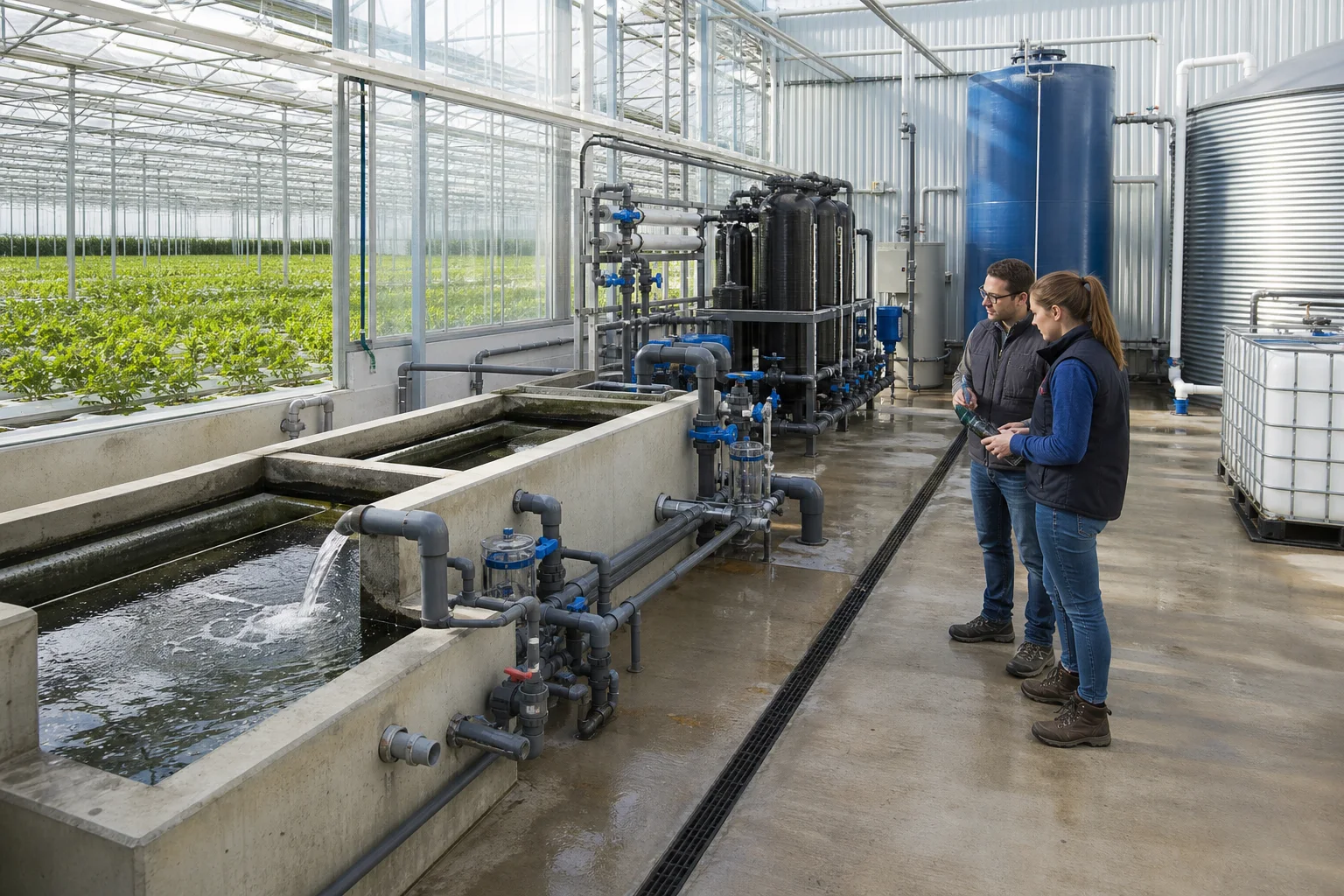
Provide slopes, channels, gutters, drain inlets, strainers, and sumps that can be inspected and cleaned. Avoid stagnant pockets and inaccessible buried traps. Protect drains from roots, growing media, leaves, packaging, and vehicle damage.
Separate zones where crop or pesticide history differs if reuse risk requires it. UMass guidance on subirrigation notes that some growers divert solution following pesticide application rather than return it to the recirculating tank. The correct practice depends on the product label, crop, system, and local regulation.
Use high-level alarms, duty and standby arrangements where justified, emergency overflow, and safe access. An overflow should not flood electrical rooms, foundations, neighboring land, or crop areas.
Define water-quality limits for reuse
Test source and return water for the chemical and biological parameters relevant to the crop and system. EC, individual ions, pH, alkalinity, suspended solids, nutrients, organic load, and pathogens may change through production. The required panel and frequency depend on risk.
Salts that plants do not absorb can accumulate in a closed system. Sodium and chloride are common concerns, but the full ion balance matters. Define when to blend, treat, bleed, change crop, or discharge. The guide to water tests required before greenhouse irrigation design explains the source-water evidence needed before equipment selection.
Biological risk can move between zones through shared water. Assess crop pathogens, algae, biofilm, organic particles, storage temperature, treatment barriers, and post-treatment contamination. A disinfection system needs validated operating conditions and monitoring.
Build treatment as a train
Treatment normally works in stages. Coarse screening protects pumps and downstream equipment. Settling or media filtration may remove suspended material. Fine filtration can protect emitters or disinfection equipment. Chemical, UV, heat, ozone, membrane, or other processes may address specific risks.
Sequence depends on water quality and the selected technology. UV performance falls when water transmittance is poor. Membranes need pretreatment and create concentrate. Oxidants need dose, contact time, residual control, compatibility, and worker protection. Heat requires energy and heat recovery analysis. No technology should be specified only by flow rate.
Provide sampling before and after critical barriers, flow measurement, pressure monitoring, alarms, bypass control, cleaning, and a route for off-spec water. Prevent an untreated bypass from silently entering clean storage.
Separate raw, treated, and clean storage
Tank volume should consider irrigation timing, treatment capacity, source interruptions, storm collection, overflow, and required reserve. Large storage can buffer flow but may increase residence time, temperature, algae, and cleaning difficulty.
Use covers or shading where appropriate, screened vents, accessible drains, mixing or circulation if required, level measurement, high and low alarms, safe ladders or platforms, and controlled overflow. Materials must suit the water chemistry, disinfectants, temperature, and structural loads.
Rainwater storage should include debris control and an approved response when the tank is full. Do not direct overflow back toward foundations or public roads. Site stormwater questions belong in the greenhouse site assessment checklist.
Prevent cross-contamination after treatment
Clean-water tanks, pipes, valves, and emitters can become contaminated through open access, backflow, dead legs, poor cleaning, or connection to untreated systems. Establish hygienic filling, sampling, maintenance, and repair procedures.
Separate chemical storage and dosing from accidental drains. Provide containment, ventilation, eyewash or emergency facilities where required, compatible materials, and trained operators. Chemical selection and mixing must follow labels, safety data, equipment limits, and local law.
Document which water can be used for irrigation, foliar application, cleaning, food-contact surfaces, and worker facilities. Different uses may require different standards.
Monitor the water balance and treatment barriers
Track source volume, irrigation volume, return volume, treatment flow, storage level, bleed, overflow, and discharge. Unexpected differences can indicate leaks, blocked drains, sensor error, or changing crop uptake.
Trend relevant quality measurements and laboratory results. Establish action limits, responsible people, calibration, sampling points, and response steps. A controller alarm is useful only when staff know who receives it and what action protects the crop.
Review performance after crop changes, sanitation events, pesticide applications, treatment maintenance, and major weather. Update the water balance when production area or irrigation strategy changes. Keep records long enough to distinguish a one-time upset from a seasonal trend, and include manual sampling when online sensors cannot measure the relevant contaminant.
Information to issue for design and quotation
- Site plan, levels, rainfall criteria, roof areas, stormwater routes, and permitted discharge points.
- Crop, irrigation method, zones, daily and peak supply, expected return, cleaning, and production schedule.
- Source and return-water analyses, pathogen concerns, pesticide practices, food-safety requirements, and reuse targets.
- Treatment barriers, recovery, residual streams, storage, redundancy, monitoring, alarms, maintenance, and operator skill.
- Responsibility for civil work, tanks, power, controls, laboratory testing, permits, commissioning, and training.
Ask bidders to provide a water-flow diagram, mass balance, equipment duty, treatment basis, utility demand, waste streams, operating limits, and exclusions.
Prepare one project water balance
Send the crop plan, irrigation method, greenhouse area, rainfall criteria, source analysis, expected drain fraction, reuse objective, discharge rules, and site layout. Chengfei Greenhouse can use that information to clarify collection, storage, treatment, and equipment boundaries.
Contact Chengfei GreenhouseReferences
- Texas A&M AgriLife. Treating and Recycling Irrigation Runoff.
- UMass Extension. Subirrigation for Greenhouse Crops.
- University of California Statewide IPM Program. Irrigation Recirculation and Reuse.