
The short answer
Map every route by which people, plants, growing media, tools, carts, packaging, water, waste and outside contractors can reach production. Divide the site into practical risk zones and set a clean-to-dirty work direction. For each controlled entry, provide the required clothing, hand and footwear hygiene, clean tools, visitor supervision and supplies. Inspect incoming plant material separately, control suspect material, keep waste moving out without crossing clean routes, and define what staff must do when they see symptoms. Train the reason behind each step and audit whether the route works during real peak activity.
A rule that says use the footbath may fail if the solution is dirty, the mat is bypassed, staff enter through loading doors, contractors bring tools from another farm or carts move both waste and clean trays. Effective controls follow the pathways and remove practical reasons to bypass them.
Set controls by risk rather than appearance. Propagation and young plants may need stricter entry than a packing corridor. A suspected disease zone should be visited last with dedicated tools and clothing. Emergency exits must remain available, so emergency re-entry and post-event cleaning should be planned rather than blocked.
This guide is an operating-control framework, not a substitute for the approved design, crop protection plan, product labels, manufacturer instructions, employment and safety procedures, local law, or advice from qualified growers, engineers, water-treatment specialists, plant-health advisers, and safety professionals.
What the buyer should control
| Control point | Required record or action | Release evidence |
|---|---|---|
| Pathway and zone map | Show staff, visitors, plants, media, tools, carts, deliveries, waste, water and emergency routes; define clean, transition, production and suspect zones. | Approved map and site walk confirm every routine entry is covered. |
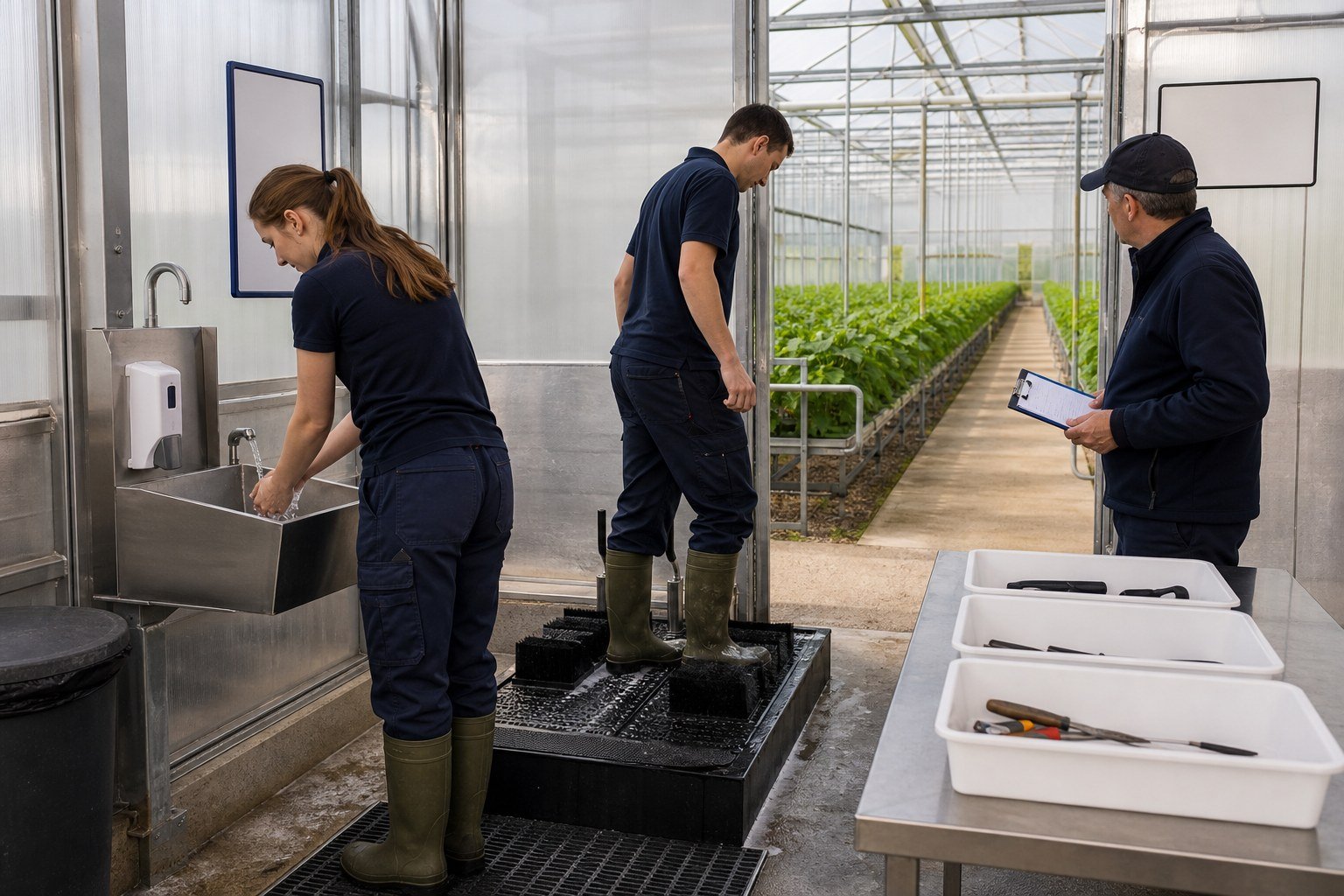
| People and clothing | Set hand hygiene, footwear cleaning or dedicated footwear, protective clothing, jewelry or personal-item rules, illness reporting, training and shift movement. | Entry supplies, role instructions and observed compliance records. |
| Visitors and contractors | Require pre-arrival questions, host, permitted areas, clean equipment, protective items, work sequence, waste control and sign-out. | Visitor authorization and host record proportional to risk. |
| Plants, media and packaging | Approve suppliers, inspect on arrival, separate new or returned material, identify lots, manage packaging and define rejection or isolation authority. | Receiving and inspection record with suspect material physically controlled. |
| Tools, carts and equipment | Use dedicated or cleaned items by zone, remove soil and debris before disinfection, control hoses and nozzles, and prevent dirty returns through clean storage. | Zone inventory and cleaning record with missing or shared items investigated. |
| Suspected pest or disease | Stop movement where appropriate, identify and isolate the area, notify the plant-health lead, preserve samples and records, control people and tools, and follow the approved diagnosis and response plan. | Incident log, movement controls and authorized release after corrective action. |
| Audit and supply readiness | Check station layout, product condition, label, concentration where applicable, replenishment, waste, bypass routes, staff behavior and recurring nonconformance. | Routine audit with responsible action and follow-up date. |
Give every open item an owner, due date, status, related drawing or package, and effect on cost, time, quality, safety, and performance. “Discussed,” “in progress,” or “by others” is not a closure record.
A practical workflow
1. Walk the site as a person and as a cart
Follow start-of-shift entry, breaks, maintenance calls, deliveries, waste removal and emergency routes. Include shortcuts people use when doors, sinks or supplies are inconvenient.
2. Define a simple movement rule
Where possible, schedule work from cleaner and younger crop areas toward higher-risk or suspect areas. Use dedicated people or equipment where the consequence justifies it.
3. Build stations around the required behavior
Place handwashing, footwear control, clean clothing, tools and waste where the decision occurs. Assign replenishment and cleaning, and make the correct route faster than bypassing it.
4. Control exceptions before they happen
Prepare for service contractors, urgent repairs, emergency responders, large deliveries, tours and staff who must move between sites. State who can approve an exception and what compensating steps apply.
5. Audit causes, not only compliance
If a rule is repeatedly missed, check layout, workload, training, product condition and supervision. Correct the system as well as the individual behavior.
Use one controlled register and preserve superseded records. The team should be able to reconstruct which instruction, setting, role and asset condition applied when an event was observed, adjusted, maintained, tested, restored and accepted.
Roles at the operating interfaces
Owner and operations manager
Set the crop, safety, production and business priorities; assign authority; approve operating limits; and make sure urgent decisions can be made outside normal hours.
Grower and plant-health lead
Define crop-sensitive conditions, hygiene zones, scouting evidence, water-quality needs, permitted treatments, release criteria and the response to suspected pests or disease.
Maintenance and controls team
Keep assets, sensors, software, backups, alarms, isolations, spares and work records usable. Report degraded functions before they turn into crop or safety events.
Suppliers and local specialists
Provide scope-specific instructions, competent service, replacement parts and technical evidence. Local professionals must control regulated electrical, pressure, chemical, fire and environmental work.
Use evidence before releasing the next step
Before people, water, chemicals, crops or equipment enter a released area, confirm that the approved method is current, the responsible person has checked the work, exceptions are controlled, affected teams have been informed, and the record can be retrieved. If a condition is not met, state what may continue, what remains on hold, who owns the action, and when it will be checked again. This is more useful than a general statement that the greenhouse is ready.
Common failure modes
| Failure | Buyer response |
|---|---|
| The plan covers only the main personnel door | Loading, maintenance, waste and emergency routes remain uncontrolled. Map all pathways. |
| Footbath condition is not checked | Organic matter, dilution and product age can make it ineffective. Follow the current label and record assigned checks. |
| Staff work from suspect crops back into clean areas | Change the sequence or require dedicated clothing, footwear and tools with an approved cleaning route. |
| Incoming plants join production immediately | Use receiving inspection and risk-based separation or quarantine under plant-health advice. |
Buyer decision questions
What are the highest-consequence introduction pathways for this crop and site? Which areas need separate tools or clothing? How do deliveries, waste and maintenance move? Who can isolate a lot or zone? Are supplies maintained on every shift? Can emergency access occur without leaving the site blind to contamination? What behavior does audit evidence show alongside the written rule?
Link the answer to the greenhouse pest management guide, the greenhouse water quality guide, the preventive maintenance plan, so operating decisions remain connected across the crop, equipment, maintenance and evidence.
Frequently asked questions
Does every greenhouse need the same biosecurity level?
No. Crop value, propagation stage, known pests, production model, local requirements and connected sites change the risk and controls.
Are disposable shoe covers always enough?
Not necessarily. They can tear, spread contamination during removal or create slip risk. Select footwear controls for the pathway and maintain them properly.
Should visitors be banned?
A risk-based hosted process can permit necessary visits. Restrict suspect areas, control movement and provide clean equipment and clothing.
What should happen after suspected disease is found?
Limit movement, notify the plant-health lead, identify affected lots and pathways, preserve evidence and follow the approved diagnostic and response plan. Do not improvise a chemical treatment.
Turn the requirement into a controlled deliverable
Share the crop flow, building entrances, staffing, delivery and waste routes, recent pest history and current hygiene rules. Chengfei Greenhouse can help review physical entry and equipment interfaces while the owner's plant-health advisers approve the complete biosecurity program.
Contact Chengfei Greenhouse