
The short answer
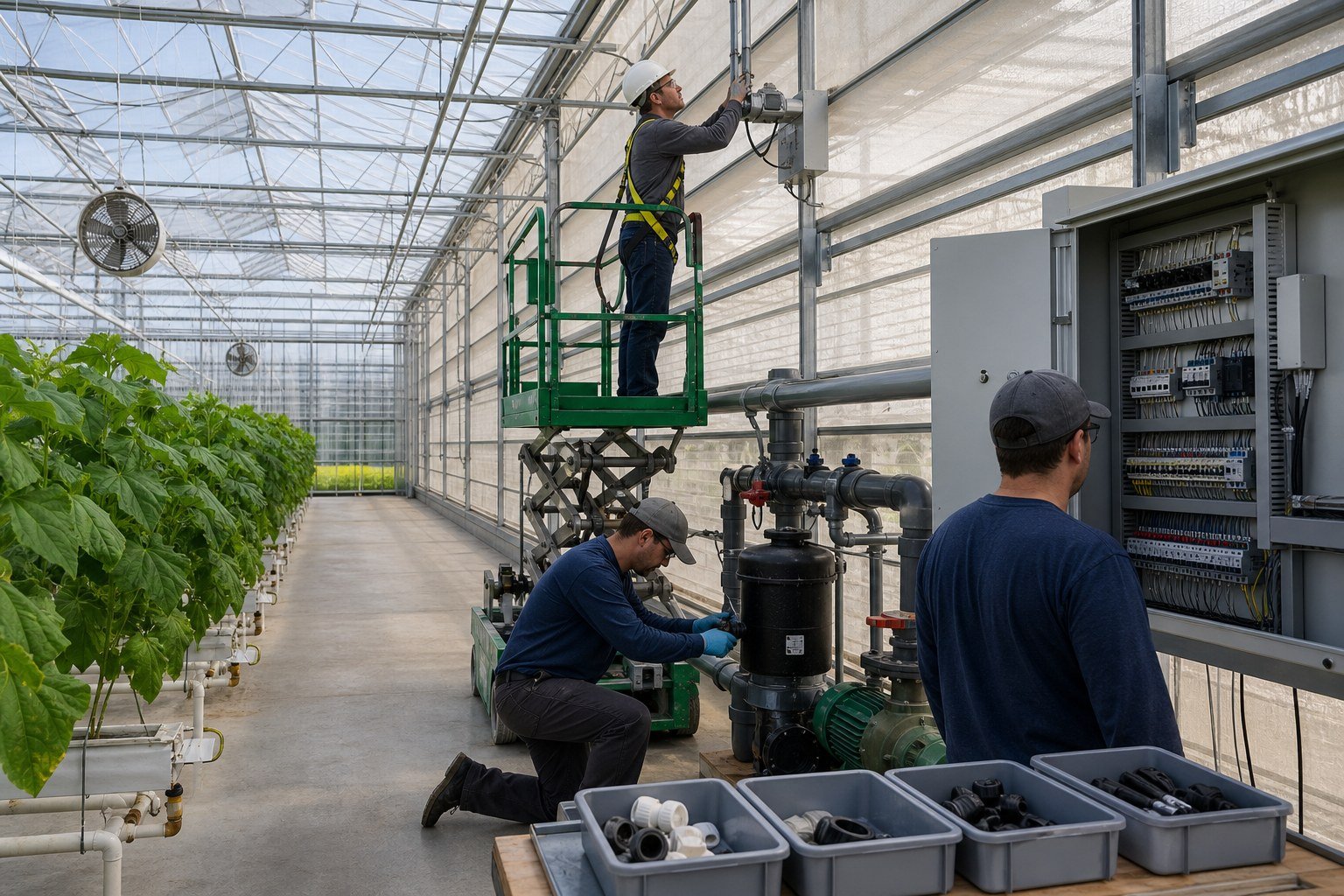
Start with the as-built asset register and commissioning baseline. Assign each asset an ID, location, system, owner, criticality, failure effect, safe isolation method, required skill, manufacturer task, site task, frequency or condition trigger, season, acceptance value, consumables, tools, spare parts, estimated time, record, escalation rule, and post-maintenance test. Schedule work around crop and weather risk, then review intervals from actual faults and performance trends.
Preventive work should reduce risk, not create routine activity with no measurable purpose. Tasks for a critical vent drive, boiler safety device, irrigation pump, climate sensor, and office fan do not deserve the same frequency or escalation. Criticality helps allocate limited labor and spares where failure affects crop survival, worker safety, environmental compliance, or long recovery.
Calendar maintenance is only one approach. Operating hours, cycles, pressure difference, vibration, current, temperature, leakage, water quality, alarm history, and condition inspection may provide better triggers for some equipment. The plan should state which trigger governs and who reviews the data.
This planning guide supports procurement and coordination. Project-specific values and safety decisions remain with the grower, qualified designers, equipment manufacturers, contractors, and authorities responsible for the installation.
Inputs that should be fixed before supplier selection
| Input group | Record | Decision supported |
|---|---|---|
| Asset identity | Tag, description, system, manufacturer, model, serial number, location, drawing, supplier, warranty, and responsible owner. | Connects work and parts to the correct installed equipment. |
| Risk and duty | Function, operating season, criticality, failure effect, allowable outage, redundancy, alarm, safe state, and temporary workaround. | Sets priority, response, and spare strategy. |
| Task definition | Inspection or service action, safe isolation, permits, required skill, tools, consumables, parts, access, environmental conditions, acceptance value, and restart test. | Makes work repeatable and auditable. |
| Timing | Calendar interval, operating hours, cycles, condition threshold, pre-season window, weather constraint, crop access, downtime, and coordination. | Places work when risk and disruption are controlled. |
| Evidence and improvement | As-found condition, readings, work performed, parts, as-left result, photos, technician, date, fault code, follow-up, cost, downtime, and interval review. | Turns records into better decisions. |
Identify each provisional item and the date by which it must be closed. A supplier can offer alternatives, but each alternative should state which input changed and how that change affects capacity, layout, utilities, controls, maintenance, and price.
A practical design and review sequence
1. Build the register from handover and a field walk
Reconcile drawings, manuals, panel schedules, equipment tags, spare lists, warranties, and commissioning records with what is physically installed. Include small dependencies such as sensor aspirator fans, routers, UPS batteries, valve actuators, limit switches, drain heaters, and alarm gateways. A major system can fail because an inexpensive dependency was omitted.
2. Rank assets by consequence and detectability
Consider worker safety, crop time to damage, environmental release, fire, water loss, production interruption, replacement lead time, redundancy, and whether deterioration is visible before failure. Use the ranking to set inspection depth, monitoring, spare stock, response time, and escalation. Do not use criticality to bypass statutory or manufacturer requirements.
3. Write safe tasks with acceptance values
Replace vague instructions such as check fan with a defined inspection, isolation, cleaning or service action, measurement, acceptable condition, and post-work functional test. Refer to manufacturer limits and qualified procedures. Record current, vibration, pressure, flow, temperature, calibration error, leakage, travel time, or another useful indicator where it supports a decision.
4. Plan seasonal readiness and learning
Complete heating, generator, envelope, and alarm work before cold risk; cooling pads, fans, shade, pumps, and drains before hot weather; and storm preparation before the relevant season. Review failures, repeated alarms, emergency work, spare use, and performance drift. Adjust tasks and intervals through controlled approval rather than silently changing the schedule.
Keep the assumptions with the calculation or equipment schedule. When the crop plan, source condition, greenhouse geometry, or operating sequence changes, the responsible designer can then identify which result must be recalculated instead of relying on an obsolete approval.
Divide responsibilities at the interfaces
Owner and grower
Provide crop, operating hours, acceptable risk, local practices, staff capability, utilities, expansion plan, and approval priorities.
Greenhouse supplier
Provide structure, envelope, equipment, layout, loading, utility, control, installation, and commissioning interface data within the contracted scope.
Specialist designer
Apply local climate, codes, calculation methods, safety duties, equipment selection, system integration, and professional approval.
Contractor and operator
Confirm site conditions, installation, access, testing, records, training, safe operation, inspection, and maintenance.
Use a responsibility matrix for supply, design, installation, power, water, drainage, controls, network, civil works, testing, permits, consumables, spares, training, and warranty response. Phrases such as complete system are not enough when the interfaces cross several contracts.
Common specification failures
| Failure | Why it matters and what to do |
|---|---|
| Only large machines are listed | Controls, sensors, communications, valves, shutters, drains, filters, and small power supplies can stop essential systems. Register dependencies and their failure effects. |
| Every task uses the same frequency | Risk, run time, environment, manufacturer guidance, measured condition, and season differ. Select and justify the trigger for each asset. |
| Completion means a box was ticked | Without as-found data and acceptance criteria, the record cannot show whether condition changed or work restored performance. Capture readings and as-left tests. |
| Maintenance history does not change the plan | Repeated faults, emergency labor, parts consumption, and drift are evidence. Review root causes, task quality, interval, design, training, and spare strategy. |
Record every accepted deviation. A verbal clarification during a meeting should be transferred to the controlled drawing, schedule, calculation, or specification that governs manufacture and site work.
Plan acceptance before equipment is ordered
Agree on document review, factory checks where appropriate, delivery inspection, installation inspection, pre-start checks, calibration, functional tests, representative operating tests, abnormal-mode tests, training, and handover. State the instruments, conditions, tolerances, data format, witnesses, and corrective-action process.
Use the greenhouse commissioning checklist to connect design intent to field evidence. Where continuity matters, coordinate power, alarms, operator response, and recovery through the site resilience plan. Keep final settings, test results, and approved changes with the equipment record so maintenance staff have a usable baseline.
Acceptance is not a substitute for ongoing observation. Trend the measurements that reveal deterioration, compare them with the commissioned condition, and define who investigates a sustained change. This is particularly important where crop damage can begin before a component reaches complete failure.
Questions the project team should answer
Which assets can cause crop damage before staff respond? Which statutory and manufacturer tasks are mandatory? What safe isolation and access are required? Which values from commissioning form the baseline? What work must occur before winter, summer, storms, or planting? Which spares have long lead times? How are alarms converted into work orders? Who can close a task, approve deferral, change an interval, and verify return to service?
Frequently asked questions
How often should greenhouse equipment be serviced?
Use manufacturer instructions, statutory requirements, operating hours or cycles, environment, criticality, condition trends, and seasonal risk. There is no safe universal interval for all greenhouse equipment.
What is the difference between preventive and predictive maintenance?
Preventive maintenance is commonly performed at a planned time or usage interval. Predictive work uses measured condition or performance to identify developing failure. A practical program can combine both with corrective and reliability-centered decisions.
Should operators or specialists perform the work?
Assign tasks by competence, risk, tools, and legal requirements. Operators can perform suitable observations and basic care, while electrical, combustion, pressure, lifting, chemical, refrigeration, and safety-critical work may require qualified specialists.
What should a maintenance record contain?
Record asset ID, date, operating hours or cycles, as-found condition, readings, isolation, work, parts, as-left result, functional test, technician, faults, photos where useful, downtime, follow-up, and approval.
Prepare the input schedule before requesting a fixed offer
Send the asset list, as-built drawings, manuals, commissioning results, seasonal crop calendar, alarm history, failure records, staff skills, spares, and local safety requirements. Chengfei Greenhouse can help organize greenhouse equipment information for the owner maintenance program.
Contact Chengfei GreenhouseReferences
- Maintenance Guide for Greenhouse Ventilation, Evaporative Cooling Heating Systems. Maintenance Guide for Greenhouse Ventilation, Evaporative Cooling Heating Systems.
- Greenhouse Heating Checklist. Greenhouse Heating Checklist.
- Operations and Maintenance Challenges and Solutions. Operations and Maintenance Challenges and Solutions.