
The short answer
Identify the clogging mechanism before choosing equipment. Test the source and treated water, inspect deposits, obtain emitter filtration requirements, define peak and backwash flows, then coordinate pretreatment, media, disc or screen filtration, chemical or biological control, pressure monitoring, line flushing, drainage, sampling, and maintenance. Verify the result through pressure, discharge uniformity, and deposit records.
A finer filter does not solve every problem. It may remove particles while dissolved minerals precipitate downstream. Algae and microbes can form biofilm after the filter. An undersized backwash supply can leave a filter partially dirty. Treatment chemicals can create precipitates when mixed in the wrong order.
Water treatment and chemical dosing must be designed by qualified professionals using current laboratory results, crop requirements, emitter manufacturer instructions, worker safety controls, and local discharge rules.
Separate physical, biological, and chemical clogging
| Category | Possible signs | Evidence to collect |
|---|---|---|
| Physical | Sand, silt, clay, rust, plastic fragments, organic debris, or media particles. | Source sampling over time, particle or turbidity data, filter residue, tank and pipe inspection. |
| Biological | Slime, algae, bacterial growth, organic films, or recurring blockage after cleaning. | Microbiological advice, source and tank conditions, temperature, nutrient exposure, biofilm samples. |
| Chemical | Mineral scale, iron or manganese deposits, fertilizer precipitate, or deposits after pH change. | Laboratory chemistry, treatment sequence, concentrate compatibility, deposit analysis, and injector records. |
Problems can overlap. Surface water may carry algae and sediment. Well water may contain dissolved constituents that oxidize or precipitate. Recycled drainage can introduce roots, media, microbes, fertilizer salts, and cleaning residues.
Begin with the water tests required before greenhouse irrigation design. Sample in more than one season where the source varies and record whether the sample was taken before or after storage and treatment.
Match the filtration train to the hazard
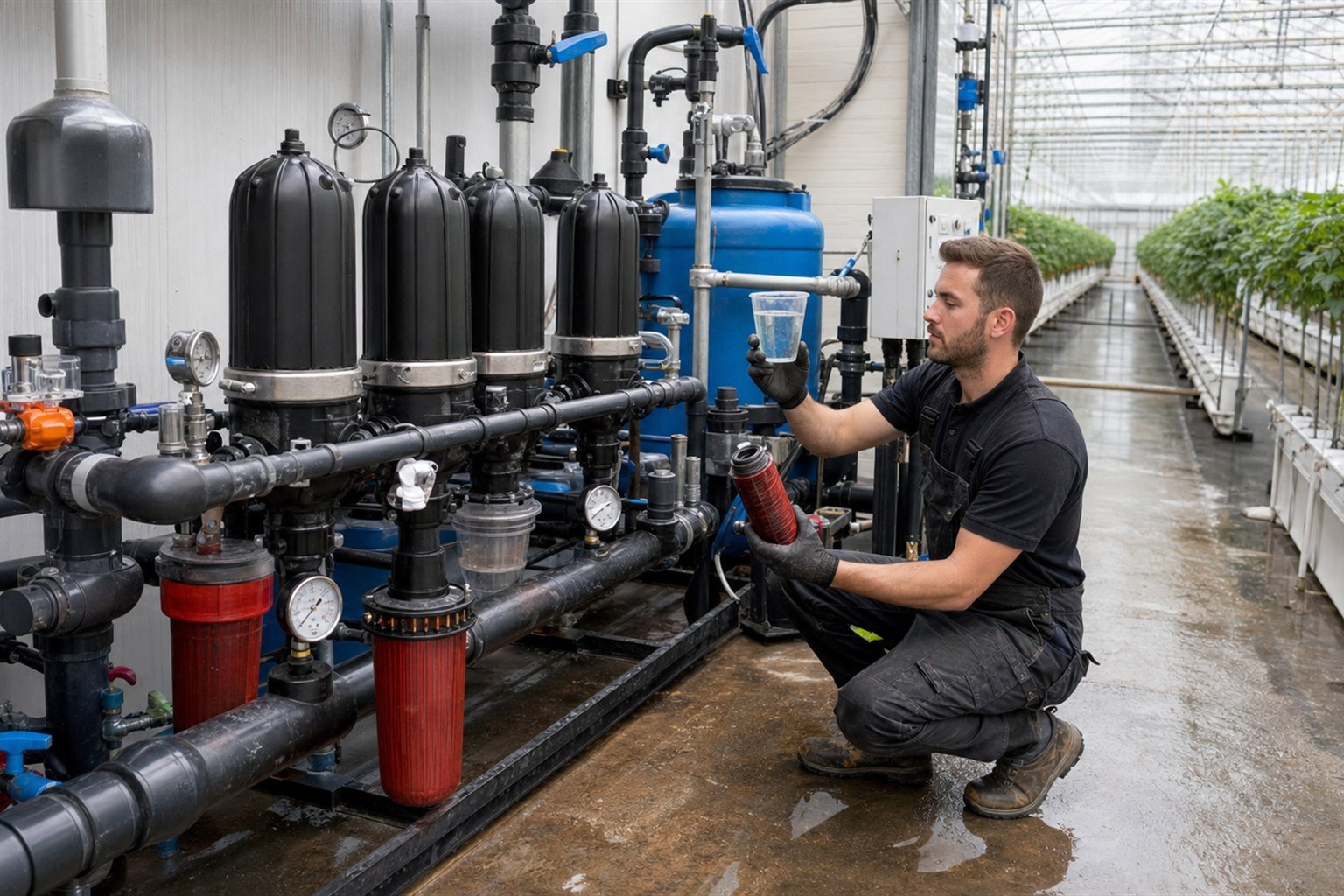
Settling or separation may remove heavy particles before fine filtration. Media filters are often considered where organic loads or algae are important. Disc and screen filters can provide defined mechanical separation, but their suitability depends on particle character, required filtration, cleaning method, and operating flow.
Use the emitter manufacturer's required filtration and water-quality limits. State whether the rating is nominal or absolute and how it is measured. Confirm the smallest flow pathway in the entire system, including valves, pressure regulators, fog nozzles, injectors, and sensors.
Size for peak irrigation demand plus any simultaneous backwash or process flow. Check clean and dirty pressure loss, minimum backwash pressure, backwash source, waste route, automatic valve operation, manual isolation, redundancy, and access for element removal.
Coordinate filtration with treatment and fertigation
The order of aeration, settling, oxidation, pH adjustment, disinfection, filtration, storage, and fertilizer injection changes the result. A treatment step can convert dissolved material into particles that the downstream filter must capture. An incompatible fertilizer mix can form a deposit after filtration.
Provide safe chemical storage, secondary containment, ventilation, injection interlocks, backflow prevention, mixing controls, sample points, calibration, and operator training. Confirm compatibility of seals, pumps, meters, and pipe materials with the selected treatment.
When drainage is reused, define source segregation, collection tanks, debris removal, disinfection, nutrient correction, blending, and reject water. See the greenhouse drainage and water-reuse inputs guide.
Monitor pressure, flow, and water condition
Across filters
Trend inlet, outlet, differential pressure, flow, backwash frequency, duration, and completion.
Across zones
Check operating pressure at representative near and far points, not only in the equipment room.
At emitters
Measure representative discharge and uniformity using an agreed field method.
In water
Sample before and after key treatment steps and investigate filter residue or deposits.
Alarm on useful conditions such as high differential pressure, low zone pressure, failed backwash, abnormal flow, empty chemical tank, dosing fault, or treatment parameter outside the approved range. Set delays and escalation so operators can act without nuisance alarms.
Design flushing as part of the pipe network
Provide adequate velocity and a safe discharge route at main, submain, manifold, lateral, and emitter-line ends as required by the designer and manufacturer. Avoid dead ends that cannot be flushed. Make valves accessible and identify the sequence.
Flushing water may contain fertilizer, disinfectant, sediment, or pathogens. Capture or discharge it according to the reuse plan and local rules. Do not route it where it can re-enter a clean tank or create a worker exposure.
Record flush frequency based on evidence, not a calendar alone. Rising pressure loss, deposit observations, emitter uniformity, source changes, and seasonal biology can justify adjustment.
Commission and train before crop dependence
Flush construction debris before installing or exposing sensitive emitters. Confirm filter orientation, element type, valves, gauges, sensors, drain routes, backwash sequence, treatment interlocks, and controller alarms. Test at minimum and maximum intended flow conditions.
Collect baseline pressure, flow, differential pressure, water samples, and emitter discharge. Demonstrate element removal and cleaning, safe chemical handling, manual backwash, bypass restrictions, alarm response, and winter or shutdown procedures. Record these in the greenhouse commissioning checklist.
Filtration and clogging questions
Should the finest available filter be selected?
No. Filtration must meet the most restrictive emitter or device requirement and match the particle hazard, flow, pressure, cleaning method, and maintenance capacity. Excessively fine filtration can increase pressure loss and backwash without solving biological growth or dissolved mineral precipitation.
Why do emitters clog when filters look clean?
The cause may be downstream biofilm, mineral precipitation, fertilizer incompatibility, pipe debris, root intrusion, or an element or seal that allows bypass. Compare deposits, laboratory chemistry, treatment sequence, pressure trends, and the location of affected emitters.
Where should sample points be installed?
Provide safe, representative points at the raw source, after important pretreatment or storage stages, after final filtration and treatment, and at selected distribution zones. Avoid stagnant taps that do not represent operating water. Label and document sampling and flushing procedures.
How often should filters and lines be cleaned?
Use manufacturer requirements and operating evidence. Differential pressure, backwash frequency, source condition, deposit inspection, pressure at remote points, and emitter uniformity are more useful than an arbitrary calendar alone. Record changes so the team can see a developing problem.
Can recycled drainage use the same filtration without review?
Not safely assumed. Recycled water can add roots, growing-media particles, microbes, treatment residues, and concentrated salts. Define segregation, capture, storage, disinfection, blending, nutrient correction, reject water, and monitoring before reusing it.
What must a comparable quotation state?
Use one duty point and ask for filtration definition, clean and dirty pressure loss, backwash flow and pressure, waste quantity, automation, instruments, materials, replacement elements, excluded pretreatment, commissioning, and maintenance access. Clarify all pump, tank, cable, drain, chemical, foundation, and control boundaries.
Send water evidence before selecting filters
Share laboratory results, source variation, storage and reuse plan, peak flow, emitter data, fertigation recipe, treatment goals, backwash water and waste constraints, monitoring needs, and maintenance capability. Chengfei Greenhouse can use these inputs to coordinate the greenhouse irrigation equipment scope.
Contact Chengfei GreenhouseReferences
- USDA Natural Resources Conservation Service. National Engineering Handbook Part 623, Chapter 7 Microirrigation.
- USDA Natural Resources Conservation Service. National Engineering Handbook Part 652, Irrigation Guide.
- USDA Natural Resources Conservation Service. Irrigation System, Microirrigation Conservation Practice.