
The short answer
Build the response around measured crop-zone exposure and the failure mode. Confirm whether the problem is power, controller, sensor, vent, fan, shutter, screen, pad, pump, water supply or a capacity limit under current weather. Use a grower-approved warning and action matrix that includes temperature, radiation, humidity, crop stage and duration rather than one universal high-temperature number. Pre-authorize safe manual actions such as opening accessible vents or doors, moving a screen to the approved position, shedding nonessential electrical load, changing irrigation timing, consolidating vulnerable batches or deploying approved temporary airflow. State which actions are forbidden without electrical, roof, structural or other specialist access. Record the hottest zones and exposure time before releasing crops.
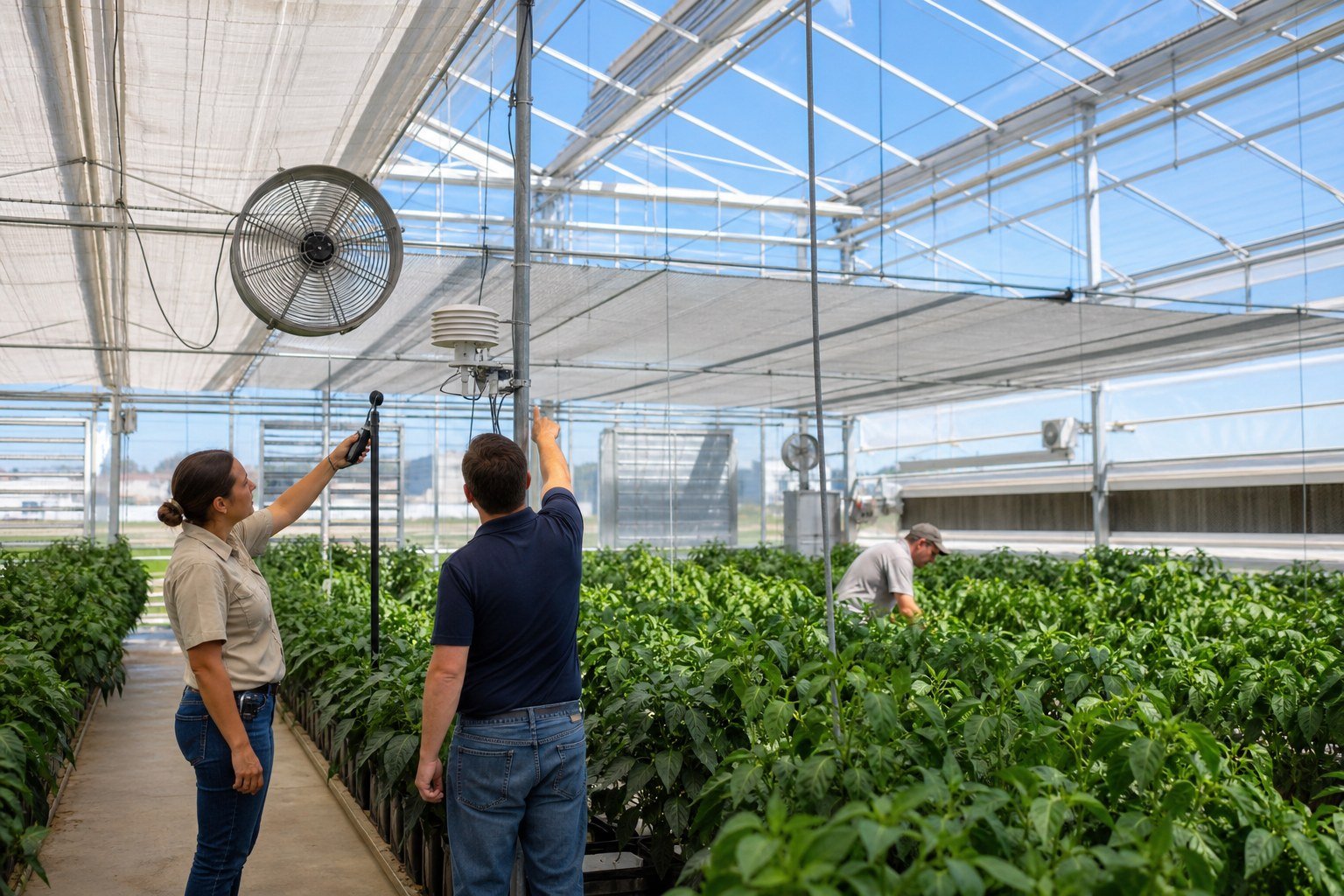
A controller can say that cooling is on while the greenhouse remains hot. A fan may run with a loose belt, blocked inlet or shutter that does not open. A vent command may fail at one bay. An evaporative pad may be dry because the pump, filter, distribution pipe or water source failed. Heat-response checks therefore need both command status and physical effect at crop level.
More irrigation is not a universal heat treatment. A stressed root system, saturated substrate, poor water quality or long leaf-wetness period can turn an emergency response into a second crop problem. The grower should define when irrigation helps, which zones receive it, and how drainage, nutrient concentration and disease risk will be checked afterward.
This guide is an operating-control framework. The approved design, crop plan, product labels, manufacturer instructions, site safety procedures, local law and directions from competent local professionals govern the actual work.
What the buyer should control
| Control point | Required record or action | Release evidence |
|---|---|---|
| Crop heat limit | Define warning, action and crop-disposition decisions using crop, stage, zone, radiation, humidity and exposure duration. | Grower-approved matrix linked to verified crop-height sensors and the response time. |
| Detection | Monitor representative and known hot zones, power, fan or vent status, pad-water flow, screen position, controller health and communications. | Alarm test and mapped sensor comparison show that the event will be detected early. |
| Failure identification | Separate loss of power, command, actuator, airflow, shade, water or capacity. Provide safe external observations for operators. | Response card gives likely evidence and the correct qualified service route for each fault. |
| Immediate safe actions | List accessible vents or doors, approved manual modes, load shed, shade position, irrigation adjustment, crop movement and temporary airflow in priority order. | Timed drill confirms staff, tools, access and effect without bypassing protection. |
| Water and drainage | Confirm cooling and irrigation demand, source, storage, pumps, treatment, filters, drainage capacity and the response to poor or unavailable water. | Water-readiness record and alternate plan state usable capacity and quality release. |
| Repair and access | Keep fan, motor, belt, actuator, pump, controller and sensor information available; define electrical, roof and work-at-height restrictions. | Service contacts, spares, access permit and isolation procedure are current. |
| Recovery and crop release | Restore automatic stages, compare zones, check irrigation and drainage, scout heat injury and record affected batches and time. | Climate trend, work order and crop assessment support separate system and crop release. |
Every open item needs an owner, due date, status and effect on safety, production, cost and recovery time. A note that something was discussed or is being handled does not prove closure.
A practical workflow
1. Map where heat accumulates
Review sensor data and conduct a spatial survey during normal hot weather. Check leeward zones, closed bays, dense canopies, propagation areas, high solar-load edges and areas where screens or airflow differ. Put alarms where a failure affects crops, not only where wiring is convenient.
2. Write the response by failure mode
For each fan, vent, screen, pad, pump, water and control failure, list the safe observation, authorized manual action, specialist call and expected effect. Include loss of several systems through a shared power or controller fault.
3. Set an early decision point
The action threshold must allow enough time for staff to verify the event and act before crop exposure becomes unacceptable. Use rate of rise and current radiation as well as the measured condition. The grower should revise it when crop stage or occupied zones change.
4. Prove manual actions
Test accessible manual modes, vent or door actions, backup power blocks and temporary equipment during a controlled window. Confirm the action actually improves the affected zone. Do not rely on roof access or removal of guards during an emergency.
5. Control irrigation choices
Estimate available flow when cooling and irrigation compete. Define the crops and zones that receive water first and check the fertilizer or treatment state. Prevent an automatic schedule from adding water after staff have already applied an emergency cycle.
6. Recover in stages
After repair, return fan, vent, pad and screen stages one at a time and compare commanded position with physical response. Check alarms and controller schedules. Mark exposed batches and watch for delayed quality or disease effects before normal dispatch.
Preserve the event sequence and earlier versions of records. The team should be able to reconstruct what was observed, which condition applied, who decided, what changed, how the result was tested and which limitation remained.
Who owns each decision
Head grower
Defines crop exposure limits, irrigation choices, shade and crop-movement priorities, then owns scouting and disposition after the event.
Controls and maintenance team
Diagnoses command, sensor, actuator, fan, pump and network faults within its authorization and records the real response of each stage.
Qualified electrical or access specialist
Controls internal electrical work, temporary power, roof access, work at height and repair of equipment that cannot be reached safely from normal operating areas.
Duty operator
Confirms alarms from safe points, applies only pre-approved actions, records zone and time, and escalates early enough for help to arrive.
Release evidence before the next step
Release the cooling system after the repaired stage responds correctly in automatic and approved manual modes, the sensor map is plausible, water and drainage are available, and alarms reach the duty team. Release the crop separately. Use actual exposure by zone, crop condition and follow-up scouting. Keep any temporary fan, manual vent or altered irrigation schedule on a written time limit so it does not quietly become normal operation.
Common failure modes
| Failure | Buyer response |
|---|---|
| The screen is closed further without checking the design | Use the approved hot-weather position. Screen movement can affect heat, airflow, wind response and fire or control strategy. |
| The fan run signal is treated as airflow proof | Check shutters, belt, blades, inlet, direction and crop-zone effect through safe observations and planned maintenance. |
| Every zone receives extra irrigation | Use crop and substrate evidence, available water, drainage and disease risk. Prevent duplicate automatic cycles. |
| Staff plan to climb onto the roof | Keep emergency actions accessible from safe operating areas and reserve roof or height work for trained authorized people under permit. |
| The alarm is set close to crop damage | Set warning and action points from response time and rate of rise so the team has time to intervene. |
Buyer decision questions
Which greenhouse zone heats fastest after fan or vent loss? How will staff distinguish a false sensor from a real spatial problem? Which safe action creates the largest verified improvement? Do cooling and irrigation compete for the same water or backup power? Can the duty operator reach the manual control without electrical or height exposure? Which crops lose quality first, and can they be moved? How will automatic schedules be reconciled after manual intervention? What evidence proves airflow, water and alarms are all restored?
Keep these decisions connected to the greenhouse climate data troubleshooting, the greenhouse maintenance plan, the greenhouse water balance audit. The emergency plan, equipment evidence and crop plan should describe the same operating reality.
Frequently asked questions
What high-temperature alarm should we use?
Set it from the crop and stage, sensor location, radiation, humidity, expected rate of rise and response time. Review it as production changes.
Should doors always be opened during a cooling failure?
Only the site response plan can decide. Doors affect security, pests, airflow and wind exposure, and may not help when outside conditions are unfavorable.
Can misting or fogging be added temporarily?
Only with accepted water quality, electrical safety, pressure, drainage, crop, hygiene and worker controls. An improvised system can create uneven wetting and disease risk.
How can we tell whether a pad wall is working?
Check water distribution, pump and filter condition, pad wetting, inlet air path, fan operation and the measured air change across the intended system.
What should happen to heat-exposed crops?
Identify batches and zones, preserve the climate history, inspect crop-specific symptoms and hold uncertain product until the grower accepts quality and plant-health risk.
Turn the requirement into a controlled deliverable
Share the crop-zone layout, summer design conditions, ventilation and cooling equipment, sensor map, water capacity, alarm list and recent climate trends. Chengfei Greenhouse can help trace dependencies in supplied systems while the grower and qualified local specialists set action limits and repair controls.
Contact Chengfei Greenhouse