
The short answer
Write the problem as a crop, zone, time and consequence statement before changing a setpoint. Inspect the crop and physical equipment. Verify the suspect sensor against a suitable independent instrument at the same location and time; check siting, shielding, airflow, cleanliness, calibration, unit and clock. Export trends for weather, setpoint, measured value, command, equipment feedback, mode, alarm, manual override, irrigation and relevant energy or water. Align timestamps and mark operational events. Form a testable hypothesis, change one controlled factor or run a safe functional test, observe the physical result and preserve the before-and-after evidence.
A high-temperature trend can represent real heat, direct sun on a sensor, lost aspiration, a stuck vent, a wind override, open door, changed crop canopy, wrong time zone or a data-scaling error. Changing the target before identifying the cause may increase energy use or move the problem to another zone.
Use the shortest trend interval that shows the sequence without creating unmanageable noise. Minutes may be needed for vent hunting or irrigation response. Hourly and daily summaries can reveal recurring solar, shift or weather patterns. Keep raw high-resolution data for the event even if management uses a summary. Add a short spatial survey when one fixed sensor represents a large bay. Measurements at crop height along the inlet-to-outlet path can reveal a local air-movement, heating or shading problem that a centrally placed point averages away.
This guide is an operating-control framework, not a substitute for the approved design, crop protection plan, product labels, manufacturer instructions, employment and safety procedures, local law, or advice from qualified growers, engineers, water-treatment specialists, plant-health advisers, and safety professionals.
What the buyer should control
| Control point | Required record or action | Release evidence |
|---|---|---|
| Problem statement | Identify crop, bay, location, date and time, symptom, expected range, measured condition, duration, pattern, consequence and person reporting. | The issue can be reproduced or bounded without assuming a cause. |
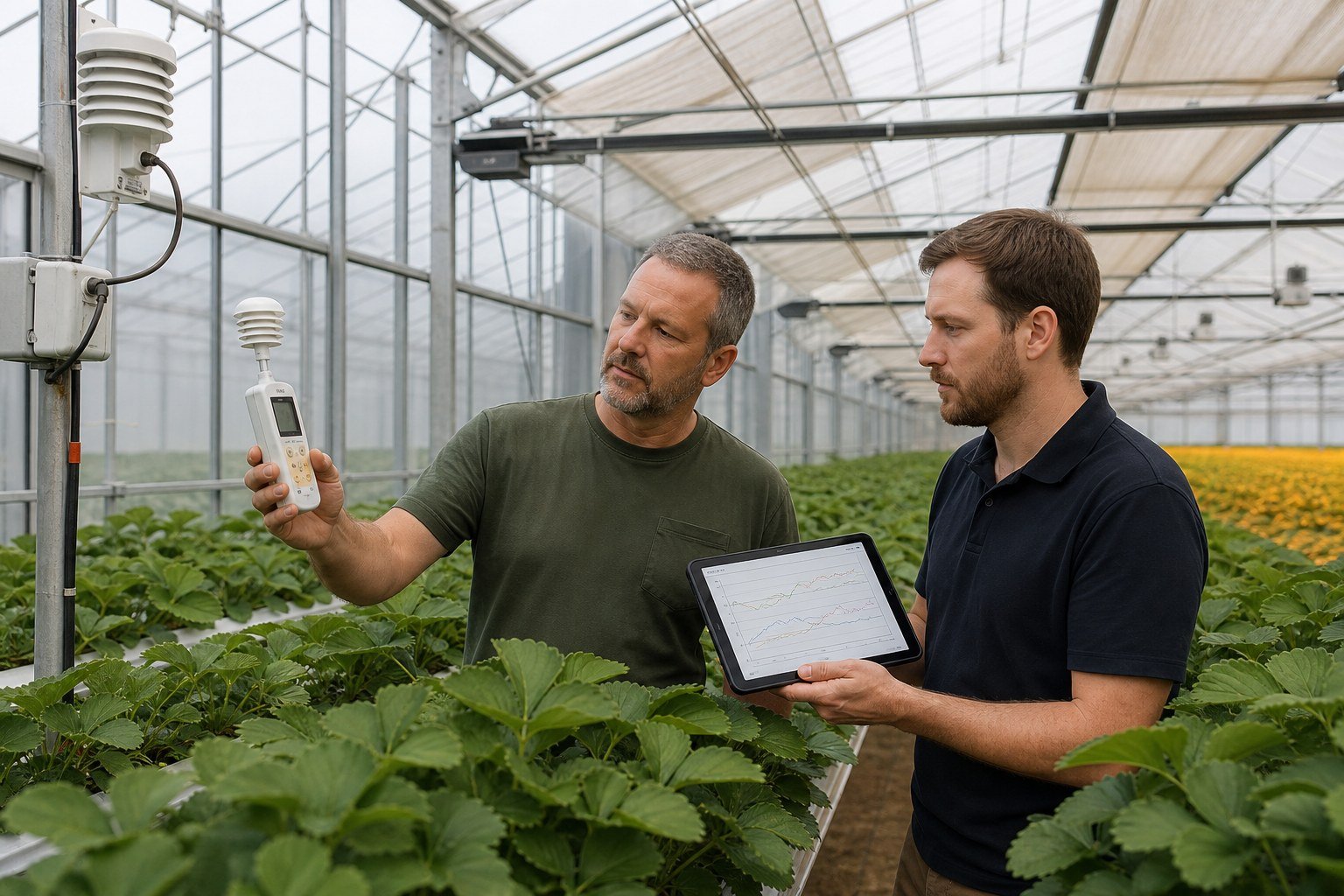
| Sensor confidence | Check identity, unit, calibration, comparison instrument, position relative to crop, radiation, airflow, wetting, dust, wiring, signal quality and clock. | Comparison result states uncertainty and whether the point may be used. |
| Control context | Export active setpoint, strategy, stage, mode, priority, deadband, delay, override, alarm suppression, software version and recent change. | Current configuration and change history match the event period. |
| Command and feedback | Compare commanded vent, fan, screen, valve, pump, heater, cooling or lighting state with feedback and direct physical observation. | Signal path shows where intended response stopped or differed. |
| External and crop drivers | Record weather, doors, work activity, irrigation, crop density and height, leaf area, lighting, carbon dioxide, screens and neighboring-zone influence. | Event review accounts for material disturbances. |
| Hypothesis and test | State predicted evidence, safe test method, competent authority, abort rule, one controlled change and required measurements. | Test result supports, rejects or narrows the cause. |
| Correction and verification | Restore approved settings, repair or relocate, update calibration and documentation, watch a comparable period and record crop response. | Problem remains closed through the defined recurrence window. |
Give every open item an owner, due date, status, related drawing or package, and effect on cost, time, quality, safety, and performance. “Discussed,” “in progress,” or “by others” is not a closure record.
A practical workflow
1. Start with the crop and the room
Look for spatial pattern, condensation, wilting, leaf temperature, air movement, pipe temperature, vent position, pad wetting and other physical evidence before opening the trend screen.
2. Prove the measurement path
Compare at the same place and time. Check sensor power, wiring, scaling, network quality, time zone, sample interval and data substitution or averaging.
3. Build a sequence of events
Place weather change, setpoint, command, feedback, alarm, manual action, irrigation and crop symptom on one time line. Cause must precede effect.
4. Test one explanation safely
Choose a period and area that protect the crop. Observe actual movement and measured response. Avoid several simultaneous tuning changes that make the result impossible to interpret.
5. Verify under a comparable condition
A repair that appears successful on a mild afternoon may fail during the original load. Set a recurrence watch and connect unresolved seasonal performance to commissioning.
Use one controlled register and preserve superseded records. The team should be able to reconstruct which instruction, setting, role and asset condition applied when an event was observed, adjusted, maintained, tested, restored and accepted.
Roles at the operating interfaces
Owner and operations manager
Set the crop, safety, production and business priorities; assign authority; approve operating limits; and make sure urgent decisions can be made outside normal hours.
Grower and plant-health lead
Define crop-sensitive conditions, hygiene zones, scouting evidence, water-quality needs, permitted treatments, release criteria and the response to suspected pests or disease.
Maintenance and controls team
Keep assets, sensors, software, backups, alarms, isolations, spares and work records usable. Report degraded functions before they turn into crop or safety events.
Suppliers and local specialists
Provide scope-specific instructions, competent service, replacement parts and technical evidence. Local professionals must control regulated electrical, pressure, chemical, fire and environmental work.
Use evidence before releasing the next step
Before people, water, chemicals, crops or equipment enter a released area, confirm that the approved method is current, the responsible person has checked the work, exceptions are controlled, affected teams have been informed, and the record can be retrieved. If a condition is not met, state what may continue, what remains on hold, who owns the action, and when it will be checked again. This is more useful than a general statement that the greenhouse is ready.
Common failure modes
| Failure | Buyer response |
|---|---|
| The setpoint is changed before the sensor is checked | Verify measurement and equipment response first, then approve any operating change. |
| Only temperature and humidity are exported | Add setpoint, mode, commands, feedback, weather, irrigation, alarms and overrides needed to explain the sequence. |
| Different clocks are compared as if synchronized | Align controller, meter, alarm, camera and shift-log time before judging cause. |
| A temporary manual override becomes permanent | Record owner, reason, protection, expiry and restoration test. |
Buyer decision questions
What did the crop and physical equipment show? Is the sensor measuring the intended crop environment? Are clocks and units aligned? Which strategy and override were active? Did the command reach the equipment, and did the equipment move or deliver? What other event happened first? Which safe test can distinguish the leading explanations?
Link the answer to the greenhouse climate control system guide, the greenhouse automation system guide, the greenhouse seasonal commissioning guide, so operating decisions remain connected across the crop, equipment, maintenance and evidence.
Frequently asked questions
How much trend data should be retained?
Keep enough resolution and duration to investigate expected dynamics and seasonal recurrence. Storage policy should preserve critical event data and configuration context.
Can two nearby sensors be compared directly?
Only after considering calibration, height, radiation, airflow, crop canopy and response time. A difference may be physically real.
What is control hunting?
Repeated over-correction or stage cycling around a target. Confirm sensor quality, delays, deadbands, actuator response and interacting systems before tuning.
When should the supplier be contacted?
Send the problem statement, configuration, trend window, commands and feedback, physical observations, independent measurements and recent changes. Protect the crop under approved local procedures.
Turn the requirement into a controlled deliverable
Share the crop and zone, trend export, controller and software version, sensor locations, weather data, alarms, overrides and photographs of physical equipment. Chengfei Greenhouse can help trace its supplied control path while the grower approves crop strategy.
Contact Chengfei Greenhouse