
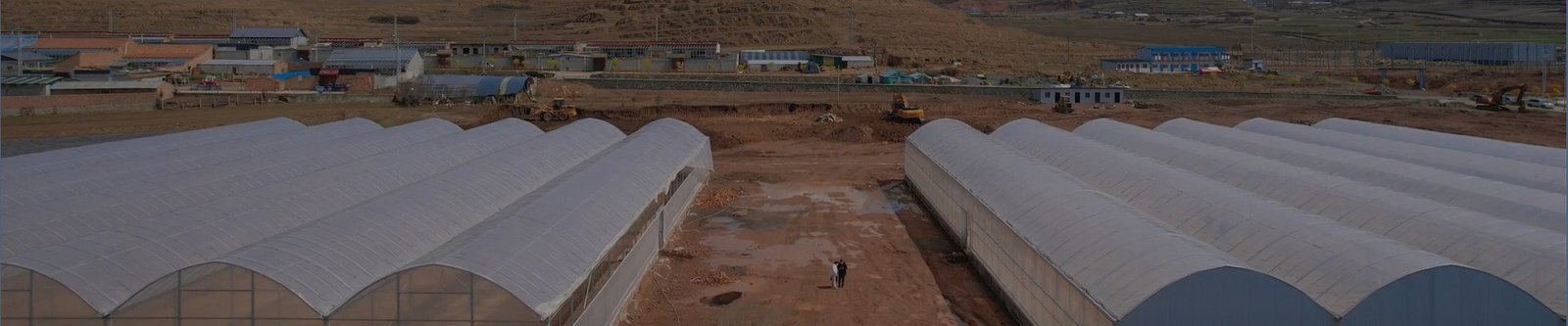
A moving lettuce line can increase the distance between whole gutters as the crop develops. That does not necessarily increase the distance between plants along each gutter. Before ordering, establish which spacing changes the offered system actually makes and follow a gutter all the way back to its next use.
Choose the arrangement whose crop spacing, movement route and supply states are documented for the intended crop. Keep a fixed-channel arrangement as the comparison. A drawing filled with plants cannot establish harvest capacity, saleable output or a workable return path.
Two spacing directions answer different questions
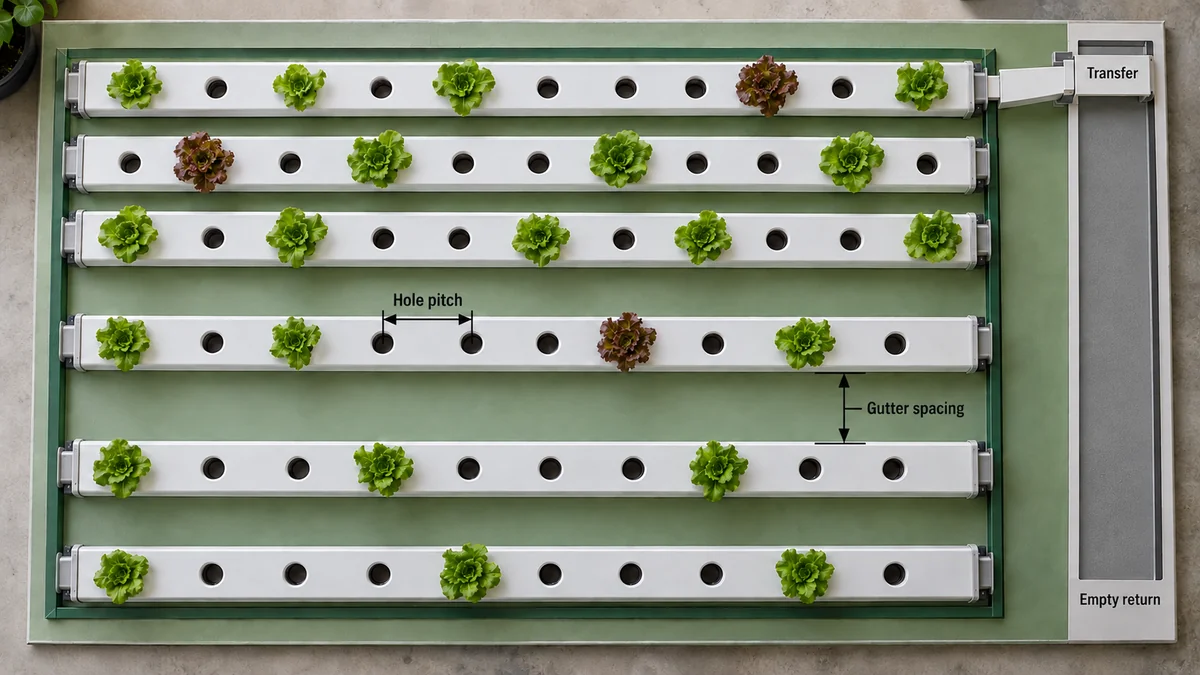
On a channel with a fixed planting-hole pattern, the hole pitch is the distance along the channel between successive planting positions. Gutter spacing is the transverse distance between adjacent channels. Moving whole channels farther apart changes the second dimension. It does not move the holes in their lids.
Ask the supplier to mark both directions on the layout, with the actual gutter and lid identifiers. If the proposed system also changes plant positions along a channel, require that mechanism and its handling step to be described separately. Do not infer it from the phrase “automatic spacing.”
The LUBING GreenTec AGS description separately mentions cover-hole contours and increasing the spacing of gutters. Its two-track transfer is a particular architecture, not a definition of every moving NFT system. NFT means nutrient film technique; the crop is supplied through its channel, so the channel's location and supply connection matter together.
Start from the crop and product requirements in the commercial greenhouse lettuce planning guide. Have the grower define the crop envelope needed at each relevant stage. That includes the plant's occupied space and the conditions under which the planned stage is expected to be reached.
Follow one gutter through the proposed route
Use the gutter itinerary worksheet with the supplier's actual layout. Give one representative gutter an identifier and record each location or transition in sequence. Mark whether the gutter contains young plants, a growing crop, harvest-ready plants or no crop.
| Route point | Question to resolve |
|---|---|
| Entry | Which gutter, lid, plug and crop state enter the line, and from which station? |
| Growing position | Which spacing direction changes here, and what crop condition and dwell assumption support it? |
| Transfer | How does the gutter pass to the next track or station, and what happens to supply, return and access? |
| Harvest | Where is the crop removed, and which gutter state leaves the station? |
| Empty return | What route takes the empty gutter through the required cleaning and buffer stages? |
| Re-entry | Who confirms that the gutter is ready and that the starting position is available? |
A return growing track and an empty-gutter return are not necessarily the same route. The LUBING USA example describes an outward run and a return run, linked by a transfer at the far end, with planting and harvest at the front. The buyer still needs to identify the post-harvest route and responsibilities in the offered layout.
Record any manual handover, trolley movement or separately supplied station. An arrow crossing an aisle on a sales drawing should have an identifiable handling arrangement behind it. Ask who owns that interface, rather than assuming the main line supplier includes it.
Record nutrient supply for each movement state
Ask for the nutrient inlet and return state at a growing stop, during indexing, at transfer, at harvest and during an extended stop. Preserve the distinction between a documented feature and a condition still awaiting design.
LUBING USA states that its described indexing arrangement maintains nutrient flow. That is a product-specific claim. Hortilife's lettuce-line description identifies sectional water supply and separate drives for its lines. These examples show why the actual configuration must be checked; they do not establish water continuity for every moving gutter.
Have the supplier and crop adviser resolve the relevant stopped-state restrictions. The worksheet should point to their approved information, not invent a universal time that lettuce can remain without supply. Ask how the physical return arrangement is maintained through each state and which parts of that answer belong to the fertigation package.
This is a purchasing review. It is not an instruction to disconnect hoses, move a loaded gutter manually or stop irrigation to test a limit.
Challenge the route with a delayed harvest
Consider a hypothetical proposal with young plants entering one end of a line and mature gutters arriving at a shared harvest station. The buyer's intended harvest is delayed. The next scheduled gutter movement would enter a position that is still occupied.
The useful question is not how to force the next index. Ask the supplier to explain the documented hold state, the affected crop supply and the conditions for resuming the planned sequence. Record whether the delay affects only that line or another shared transfer or station. The grower must also assess the crop's condition during the delay.
A second hypothetical issue is crowding along a fixed-hole lid. If the proposed response is simply to widen the distance between gutters, the original along-gutter constraint remains unresolved. The supplier and grower need to revisit the selected crop, lid format or explicitly proposed handling arrangement. More transverse space is not evidence that both spacing requirements are met.
Compare the fixed-channel baseline honestly
Put the fixed arrangement through the same crop and handling review. Record where planting, growing, harvest, empty handling and cleaning happen. Identify the movements people or other equipment would perform. Do not assume that fixed channels have no handling requirements, or that automation removes every manual task.
Use three outcomes for each proposal: supported for detailed design, missing specific evidence, or incompatible with a stated requirement. Do not rank options by a headline number of heads, a generic density increase or an advertised labor percentage.
The final order should refer to one agreed crop format, spacing-axis definition, route drawing and movement-state description. Have the crop adviser and machinery, hydraulic and layout specialists close their own interfaces. Then the choice between fixed and moving channels rests on a line the business can actually describe and review.