
The short answer
Design from hourly weather data and the crop moisture balance. Reduce solar gain, provide large and controllable ventilation openings, keep screens and crop canopies from choking airflow, move air through the crop zone, drain water quickly, and size any mechanical cooling from outside dry-bulb and wet-bulb conditions. In humid weather, evaporative cooling cannot be treated as a universal solution.
Hot and humid is not one climate. Coastal sites, tropical highlands, monsoon regions, and humid subtropical areas have different night temperatures, wind patterns, solar loads, rain intensity, and seasonal humidity. Use a representative weather file and identify the hours when outside air is already close to saturation.
This article helps with early design and procurement. Crop targets, structural openings, electrical systems, water treatment, worker safety, and local code compliance require qualified professionals and project-specific calculations.
Start with dry-bulb, wet-bulb, dew point, and solar data
Dry-bulb temperature alone cannot describe cooling opportunity. Wet-bulb temperature indicates the lower limit approached by direct evaporative cooling, while dew point helps explain how much moisture the air already contains. When the difference between dry-bulb and wet-bulb temperature is small, water evaporation produces limited temperature reduction.
Collect hourly temperature, relative humidity or dew point, solar radiation, wind speed and direction, rainfall, cloud conditions, and extreme weather. Review daytime and nighttime separately. A site may have a useful afternoon breeze but still experience warm, nearly saturated nights when condensation and disease risk are difficult to manage.
Record the crop, planting density, canopy height, transpiration, irrigation method, production season, and allowable stress periods. Dense hanging baskets, tall crops, screens, interior partitions, and equipment can create airflow resistance that a floor-area calculation does not show.
Reduce heat before trying to remove it
Solar radiation entering the greenhouse becomes heat at the crop, floor, structure, and equipment. Shade can reduce the load, but it also reduces photosynthetically useful light. Select shade level and control strategy from crop requirements and measured radiation, not from climate category alone.
External shade intercepts radiation before it enters the enclosure and can be effective where wind, rain, maintenance, and structural design permit. Internal screens are protected from weather and may provide multiple functions, but they can trap hot air or restrict the path to roof vents if poorly positioned. Coordinate screen porosity, opening sequence, drive layout, and maintenance access with ventilation.
Glazing selection affects light transmission, heat transfer, condensation behavior, durability, cleaning, and storm performance. A material promoted as cool or diffused still needs project-specific spectral and structural information.
Create a low-resistance ventilation path
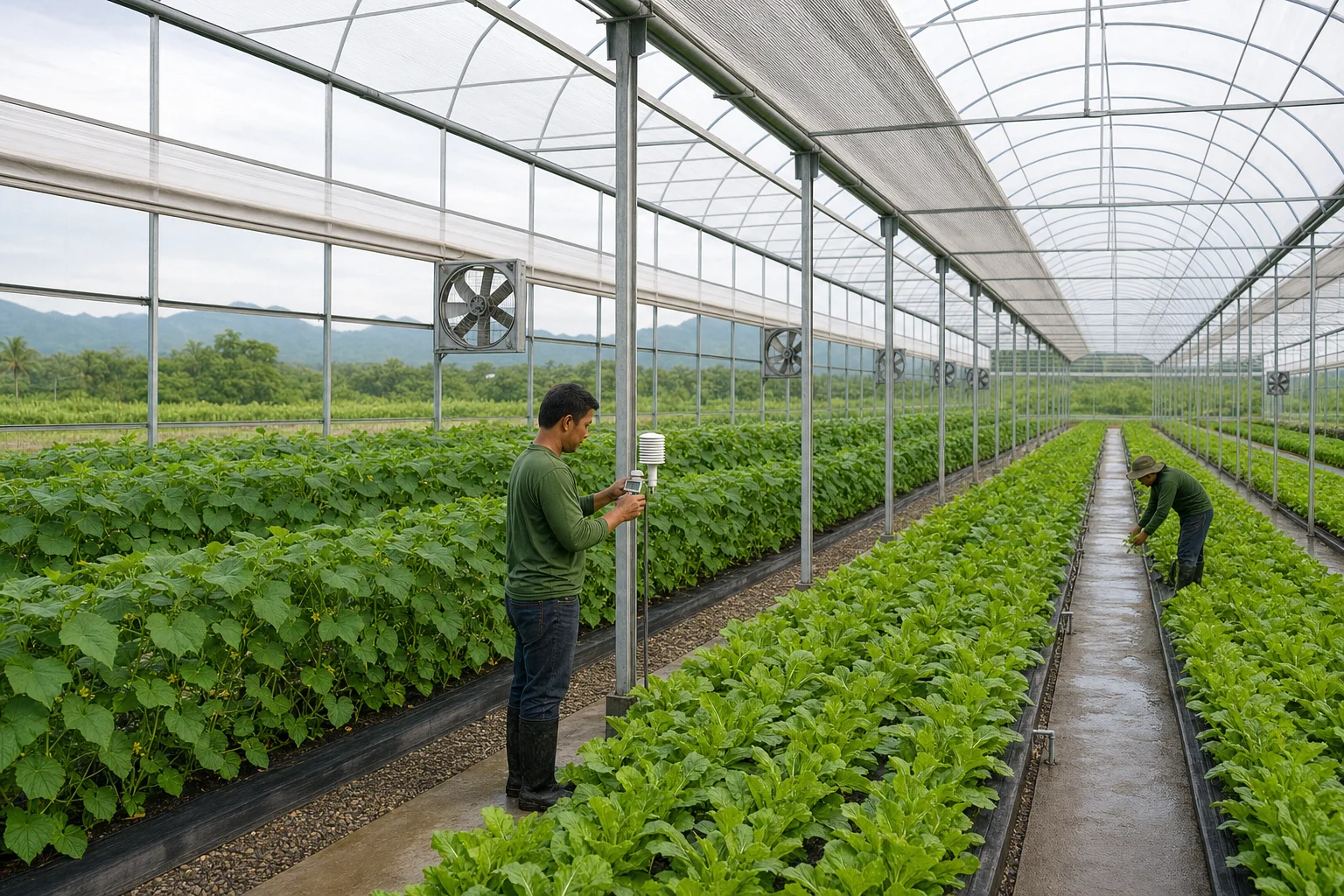
Natural ventilation depends on wind, buoyancy, opening area, opening position, insect screens, greenhouse geometry, and surrounding obstructions. Roof openings allow hot air to escape, while side openings admit outside air near the crop. The effective opening is reduced by screens, framing, partially open mechanisms, and unfavorable wind.
UConn Extension notes that proper sizing, orientation, and operation are essential for natural ventilation. UF/IFAS describes ventilation as replacing inside air with outside air to control heat, humidity, and gas concentration. Neither source supports choosing a greenhouse from vent percentage alone without considering layout and resistance.
Mechanical exhaust can provide more predictable air movement when wind is weak, but inlet size and distribution remain critical. Undersized inlets raise static pressure, reduce fan delivery, and create uneven velocity. Long houses can develop temperature and humidity gradients if air picks up heat across the crop.
| Question | Why it matters | Evidence to request |
|---|---|---|
| What is the net free opening? | Frames and screens reduce the clear airflow area. | Drawings showing dimensions, opening angle, and screen pressure data. |
| What drives airflow during calm weather? | Natural ventilation may weaken when wind and temperature difference are small. | Hourly weather review and mechanical backup concept. |
| How does air pass through the crop? | Canopies and benches can short-circuit air above plants. | Crop-zone airflow layout and representative measurements. |
| How are openings protected in storms? | Large openings interact with wind, rain, and structural loads. | Control sequence, wind criteria, drainage, and structural review. |
Treat insect screens as ventilation components
Fine mesh can reduce pest entry but increases airflow resistance. The effect depends on mesh, porosity, cleanliness, wind, vent arrangement, and required flow. Ask for pressure-drop or airflow information at relevant conditions and include dirt accumulation in the maintenance plan.
Increasing screen area, using screen houses or plenums, and avoiding sharp flow turns can reduce resistance. The pest-exclusion requirement should be set by crop and local pest pressure. A screen selected only by hole size may create excessive heat stress or fail to exclude the target pest.
Provide safe cleaning and replacement access. A blocked screen changes the climate system and can overload fans or reduce natural ventilation without creating an obvious controller alarm.
Use evaporative cooling only within psychrometric limits
Fan-and-pad and fog systems cool by evaporating water, so performance depends on the difference between outside dry-bulb and wet-bulb temperature, system efficiency, airflow, and water quality. UF/IFAS states that evaporative cooling has limitations in hot, humid conditions. A catalogue claim made at dry conditions cannot be transferred to a humid site.
Request hourly estimates of supply-air temperature and humidity at the project design conditions. Then model heat gain across the greenhouse and conditions at the far end. Confirm pad area, airflow, pressure, water distribution, bleed or treatment, sump hygiene, controls, and maintenance.
Fog can provide local or distributed cooling when droplets evaporate before wetting crops and surfaces. In humid air, evaporation slows and condensation risk increases. Droplet size, nozzle pressure, water quality, ventilation, sensor location, and control logic all matter.
Procurement warning: Do not accept a statement such as “reduces temperature by 10 degrees” without the outside dry-bulb, wet-bulb, airflow, solar load, measurement location, and system efficiency used for the claim.
Manage nighttime humidity and condensation
Humidity problems often peak after irrigation, after sunset, during rain, and before sunrise. Crop transpiration and wet surfaces add moisture while the cover cools. When a surface falls below the air dew point, condensation forms.
Use irrigation timing, drainage, crop spacing, internal circulation, controlled ventilation, and where appropriate heating to manage moisture. UF/IFAS explains that ventilation can remove moisture-laden air, but heating demand rises when outside air must be warmed. In tropical sites where outside dew point remains high, ventilation alone may not reach the crop target.
High-pressure dehumidification or air conditioning may be considered for valuable crops or sealed facilities, but capacity, condensate removal, energy, redundancy, and envelope leakage require careful analysis. The business case should use hourly loads and local electricity conditions.
Design drainage for intense rain and daily production
Humid climates may combine high rainfall with heavy irrigation and frequent washdown. Separate roof runoff, site stormwater, sanitary flows, and production drainage. Keep floors and paths free of standing water, protect foundations, and route roof discharge to storage or an approved outlet.
Closed irrigation or reuse systems need source-water and return-water treatment matched to crop hygiene. Warm stored water can support algae and biofilm, so tank shading, circulation, access, cleaning, and monitoring belong in the design.
Control from crop-zone measurements
Place representative temperature and humidity sensors at crop height and protect them from direct radiation and water. Large ranges may need multiple zones or reference sensors near intake and exhaust ends. Maintain sensors and compare them periodically with a trusted instrument.
Coordinate shade, vents, screens, circulation fans, exhaust, pads, fog, irrigation, and alarms. Poor sequencing can close vents while fogging, run pads when outside air offers no useful evaporation, or create rapid cycling. Commission normal, storm, power-failure, and sensor-failure modes before planting.
Information to include in the supplier request
- Project coordinates, elevation, hourly weather file, wind exposure, rainfall, and extreme-event requirements.
- Crop, production season, canopy, planting density, target conditions, and acceptable stress periods.
- Required pest screen, shade strategy, vent arrangement, airflow zones, and mechanical backup.
- Water analysis, available volume, drainage and discharge rules, power reliability, and backup requirements.
- Requested calculations, control description, sensor layout, performance test, maintenance access, and exclusions.
Structural criteria for large openings should follow the greenhouse wind and snow load specification. Site drainage and utilities should be confirmed using the site assessment checklist.
Send hourly climate data with the crop brief
Provide the location, weather file, crop, production period, structure size, pest-screen requirement, water analysis, power conditions, and climate targets. Chengfei Greenhouse can use that information to compare ventilation, shade, airflow, and cooling concepts without relying on a generic tropical design.
Contact Chengfei GreenhouseReferences
- University of Florida IFAS Extension. Greenhouse Ventilation.
- University of Florida IFAS Extension. Fan and Pad Greenhouse Evaporative Cooling Systems.
- University of Connecticut Extension. Natural Ventilation in Greenhouses.