
The short answer
Use hourly dry-bulb and wet-bulb temperatures to calculate cooling opportunity, then reduce solar load and size the air and water systems together. Confirm water chemistry, reliable volume, treatment, storage, dust load, wind, power quality, nighttime temperature, and backup. Do not select a fan-and-pad system from daytime temperature alone.
Evaporative cooling can be effective in dry air because water absorbs heat as it evaporates. The achievable supply-air temperature is limited by outside wet-bulb temperature and system efficiency. The crop-zone result is warmer than the pad outlet because solar energy and equipment add heat as air crosses the greenhouse.
Final design requires crop targets, local climate data, water analysis, structural criteria, electrical design, chemical safety, and local approvals. This article explains the information a buyer should request rather than providing universal equipment sizes.
Read the full arid climate, not only the maximum temperature
Collect hourly dry-bulb temperature, wet-bulb temperature or humidity, solar radiation, wind, dust events, nighttime temperature, rainfall, and seasonal extremes. Arid sites can have very hot days and cool nights, so the structure may need strong cooling, controlled ventilation, and heating or heat retention in the same production season.
Review the hours when wet-bulb temperature rises during monsoon or coastal influence. A system sized from the driest design day may disappoint during humid periods. Identify acceptable crop stress duration and whether production continues through the most difficult season.
Windblown dust affects pads, filters, screens, sensors, cladding, motors, and crop hygiene. Record prevailing wind, nearby bare ground, roads, quarries, salt exposure, and agricultural operations. Site access and perimeter treatment can be part of climate performance.
Lower solar load before increasing cooling capacity
Shade reduces the sensible heat that the ventilation and evaporation systems must remove. Select external or internal screens from crop light requirements, solar intensity, wind, control needs, maintenance, and structure. External screens stop more radiation before it enters but face weather and dust. Internal screens can trap hot air if they obstruct roof ventilation.
Diffusing or selective glazing can change light distribution and heat gain, but request measured product data and consider aging, cleaning, condensation, and structural requirements. Whitewash or seasonal coatings may suit some operations if application, light transmission, rain durability, and removal are controlled.
Reduce unwanted heat from pumps, transformers, lighting, and other equipment in the production zone where practical. Keep service equipment accessible and shaded without blocking ventilation.
Calculate evaporative performance from wet-bulb temperature
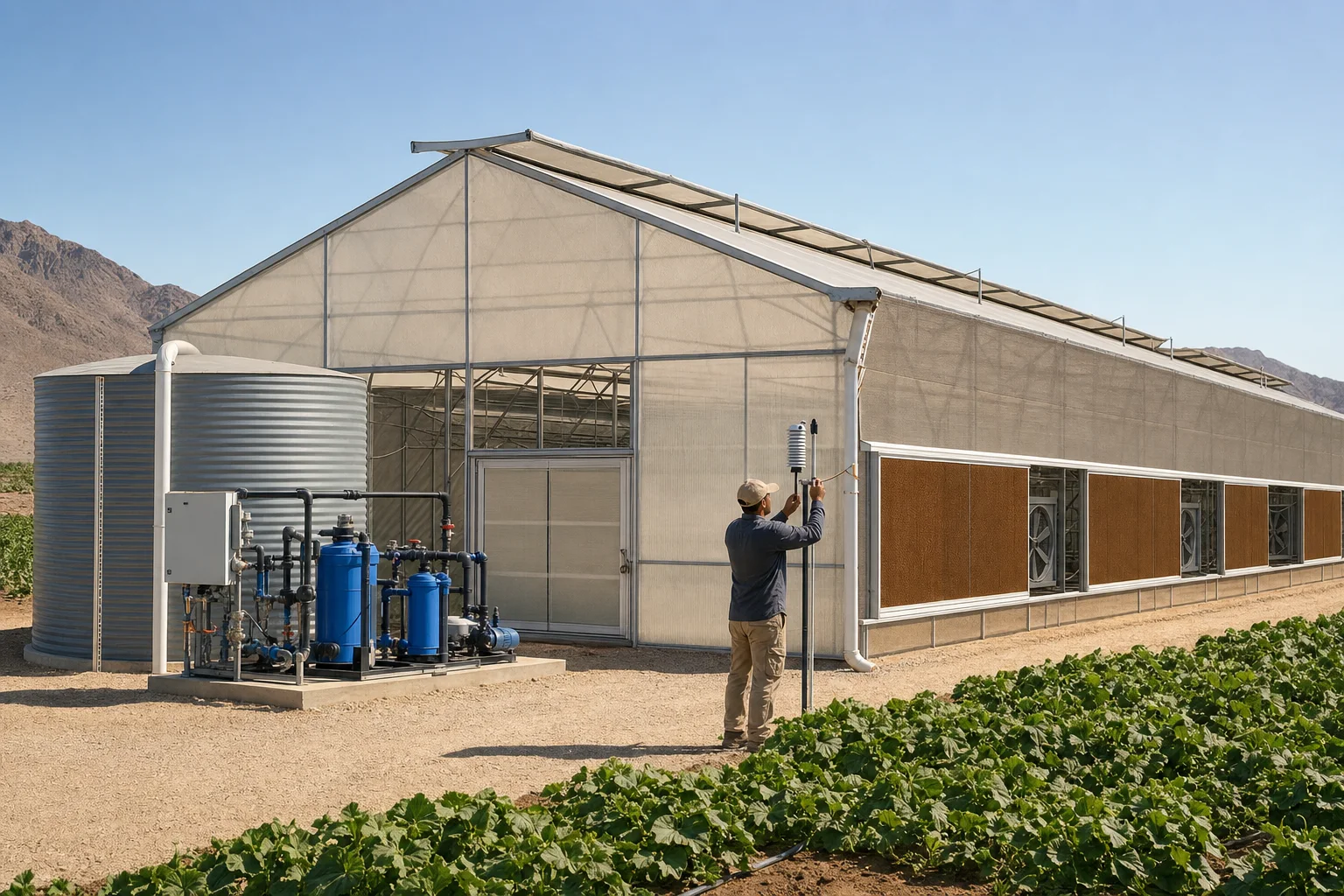
The temperature depression available from direct evaporation is the difference between outside dry-bulb and wet-bulb temperature. Actual equipment reaches a portion of that difference. FAO and extension guidance describe this relationship and note that design also depends on airflow and greenhouse volume.
Ask the supplier to calculate pad-leaving temperature at stated design conditions, then estimate the rise to the exhaust end under stated solar and crop loads. Request assumptions for pad efficiency, air volume, static pressure, screen and pad resistance, leakage, elevation, fan condition, and equipment degradation.
| Input | Required question | Why it matters |
|---|---|---|
| Dry-bulb and wet-bulb design points | Which hourly conditions and return period were used? | Defines the available evaporative temperature difference. |
| Airflow and static pressure | Does fan duty include pads, screens, louvers, ducts, and dirty condition? | Actual airflow can fall below catalogue free-air capacity. |
| Greenhouse length and heat gain | What crop-zone gradient is expected from pad to fan? | Air warms as it absorbs solar and internal heat. |
| Water quality and bleed | How are salts, scale, algae, suspended material, and discharge managed? | Pad wetting and life depend on water and maintenance. |
| Power and backup | What happens during outage, fan failure, pump failure, or blocked pad? | Crop temperature can rise rapidly during peak sun. |
Design the air path, not only fan quantity
Pad area must keep face velocity and pressure within the selected product limits. Water distribution should wet the pad evenly without dry channels. Fans should draw air through the intended path rather than through open doors, gaps, or unused vents.
Long structures can develop large temperature gradients. Consider house length, crop resistance, bench arrangement, internal partitions, doors, insect screens, and the location of pad and exhaust walls. Air should pass through the crop zone, not mainly above it.
Horizontal air circulation fans can reduce local stagnation but do not replace outside-air exchange or cooling capacity. Their placement should avoid damaging plants and interfering with spray, screens, or work routes.
Treat cooling water as a design resource
Cooling can use substantial water at the hottest time, when source availability may be most constrained. Calculate evaporation, bleed, cleaning, drift, leaks, irrigation demand, domestic use, and storage losses. Confirm reliable peak supply and the duration storage must cover.
Analyze pH, alkalinity, EC, hardness, calcium, magnesium, sodium, chloride, iron, manganese, silica, and suspended material as relevant. Scaling can block pad passages and reduce wetting. High salt concentration can damage pads, equipment, nearby soil, or crops if discharge is poorly managed.
The scheduled guide on water tests required before greenhouse irrigation design explains how laboratory evidence affects filtration and treatment. Cooling water and irrigation water may share a source but have different treatment and monitoring needs.
Specify accessible sumps, filtration, level control, overflow, drain, cleaning, safe chemical handling, and a legal route for bleed water. Avoid stagnant warm water and uncontrolled aerosol exposure.
Choose fog or pad cooling from the operating concept
Fan-and-pad systems establish a defined inlet and exhaust path. Fog systems distribute small droplets within the greenhouse and depend on sufficient evaporation and air exchange. Both can work in dry conditions when designed and maintained correctly.
Fog requires water quality suitable for small nozzles, pressure equipment, zone design, droplet control, sensors, and safeguards against wetting crops or electrical equipment. Pad systems require uniform wetting, fan coordination, clean water distribution, and control of mineral concentration.
Hybrid or staged systems may combine shade, natural ventilation, mechanical ventilation, pads, fog, or nighttime flushing. The control sequence should prevent opposing modes and use the lowest-resource method that meets the current conditions.
Plan for dust, sand, and maintenance access
Dust can reduce light transmission, clog screens and pads, erode moving parts, contaminate water, and cause sensor drift. Provide accessible intake surfaces, washable or replaceable filters where appropriate, protected electrical enclosures, cleaning water, safe cladding access, and a maintenance interval based on site observations.
Air intakes should avoid direct exposure to unpaved traffic, exhaust, chemical storage, and concentrated dust sources. Windbreaks or site surfaces may help but must be reviewed for shade, snow where relevant, airflow, and maintenance.
Use nighttime temperature swing carefully
Cool desert nights can support natural or mechanical flushing and reduce stored heat. They can also produce cold stress or condensation if warm, moist greenhouse air contacts a rapidly cooling cover. Coordinate venting, screens, thermal storage, heating, and irrigation timing.
Do not assume daytime cooling equipment can provide winter heating or freeze protection. Establish minimum design temperature, crop requirement, fuel or electrical availability, heat-loss calculation, and emergency response separately.
Commission controls under real weather
Use shaded and aspirated outside sensors where appropriate, representative crop-zone sensors, pad and sump status, water pressure, filter pressure, fan proof, and alarm feedback. Control decisions may use dry-bulb, humidity or wet-bulb logic, solar radiation, wind, and crop stage.
Test loss of power, water, fan, pump, sensor, communication, and generator. Define which vents or doors open, which loads restart, and who receives the alarm. The control narrative and test results should be part of handover.
Documents to request from bidders
- Hourly weather source and selected dry-bulb and wet-bulb design conditions.
- Solar and crop assumptions, shade performance, airflow, static pressure, and predicted crop-zone gradient.
- Cooling-water balance, laboratory basis, treatment, bleed, storage, and waste route.
- Fan, pad, fog, vent, screen, sensor, control, backup, and maintenance specifications.
- Structural criteria for shade, vents, cladding, fans, equipment support, anchors, and foundations.
Use the greenhouse wind and snow load specification to coordinate large openings and external screens with the structural basis.
Compare cooling concepts with the same climate and water data
Send the location, hourly weather file, elevation, crop, production season, water analysis, available volume, power conditions, house dimensions, and temperature targets. Chengfei Greenhouse can use the same inputs to compare shade, ventilation, pad, and fog concepts.
Contact Chengfei GreenhouseReferences
- UMass Extension. Ventilation for Greenhouses.
- University of Florida IFAS Extension. Fan and Pad Greenhouse Evaporative Cooling Systems.
- Food and Agriculture Organization of the United Nations. Good Agricultural Practices for Greenhouse Vegetable Crops.