
A sodium-cycle water softener can reduce calcium and magnesium hardness by exchanging those ions for sodium. That is a change in ionic composition, not proof that the water has been demineralized. A lower hardness result does not, by itself, establish suitable irrigation water for a greenhouse crop.
Ask which problem the softener solves and which water stream reaches the plants. The outlet may be an intermediate feed to a designed treatment train rather than the final crop-water supply. Those are different assessment boundaries.
Follow the ions and name the water stream
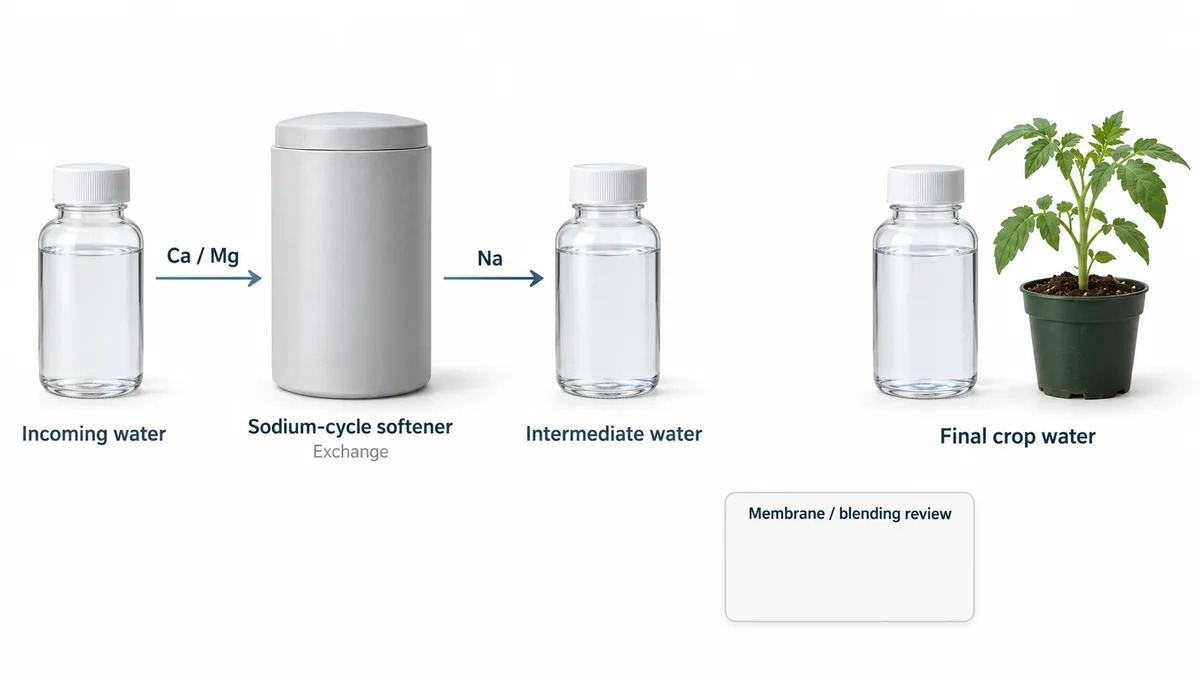
DuPont’s sodium-cycle softening explanation describes calcium and magnesium ions being exchanged for sodium on the resin. It also identifies softening as a possible pretreatment before reverse osmosis. This explains both the exchange mechanism and a legitimate equipment-protection role.
The key distinction is exchange versus removal of the overall dissolved-ion load. When hardness ions are replaced by sodium, their disappearance from the hardness result does not mean the water contains no dissolved salts. Nor does a standard sodium-cycle softener establish that alkalinity has been removed. Different water properties need different evidence.
Do not turn that distinction into a claim that EC or gravimetric total dissolved solids must remain numerically identical across every softener. The useful conclusion is narrower: hardness reduction is not evidence of desalination or crop acceptance.
| Stream | Question to answer | Claim to avoid |
|---|---|---|
| Incoming source | What ions and equipment-scale concerns are present? | Hard water is automatically unusable for the crop |
| Softened intermediate water | How did the exchange change hardness and sodium? | Low hardness means purified irrigation water |
| Membrane product, if present | What does the designed next stage actually deliver? | The softener outlet describes the membrane product |
| Final crop water after relevant blending or feed additions | What composition reaches the intended crop? | An upstream improvement establishes final suitability |
A hardness improvement can answer the wrong question
Consider a hypothetical supplier report showing a large drop in hardness after a sodium-cycle softener. The quotation calls that output purified water and proposes sending it directly to irrigation. The report does not include sodium or identify any subsequent treatment.
The next question is what replaced the calcium and magnesium and what composition the crop would receive. Ask for evidence covering the actual softened outlet, then have the crop adviser interpret it for the intended use. The hardness change may be real while the irrigation-suitability claim remains unsupported.
Now consider a separate proposal in which the softener precedes a designed RO unit. Here the softener may have an equipment-scale objective. The crop-water decision concerns the verified final stream after the relevant membrane, blending and fertilizer stages. Rejecting that whole architecture merely because its intermediate water contains sodium would confuse the stages just as much as accepting irrigation water from hardness alone.
The same type of component can therefore appear in two different proposals without justifying the same conclusion. Follow its duty and outlet destination before judging the offer.
Keep calcium, magnesium, sodium and potassium visible
UMass water-quality guidance discusses sodium- and potassium-based exchange and the resulting crop-nutrition concerns. Removing hardness ions also changes the calcium and magnesium contribution from the water. Replacing sodium regeneration with potassium changes the contribution again; it is not an automatic nutrient-balanced solution.
For procurement, retain the actual process description and the relevant analyses. This is not an instruction to change regenerants, add nutrients or alter a treatment unit. Ask the crop and water-treatment specialists to reconcile the composition and the equipment duty together.
Keep hardness, individual calcium and magnesium, sodium or potassium, EC and alkalinity in separate fields. They answer different questions. Clear-looking water supplies none of those results, and one acceptable-looking EC number cannot establish that the ionic composition fits the crop.
Identify the endpoint of every claimed improvement
A useful supplier response names the stream and the duty: for example, scale-control evidence at an equipment inlet, or a documented final-water analysis for crop review. “Improved water” is too broad if the proposal contains several chemically different streams.
Use sample identities that stay attached to the actual diagram. A source sample, softener-outlet sample and final-blend sample should not be filed under one undifferentiated heading. Record when the samples were taken and which operating or blending condition they represent.
If a bypass, source or blend changes, ask which previous conclusions still apply. Do not assume a downstream result collected under one arrangement automatically describes another. This is evidence reconciliation, not a direction to operate a bypass or select treatment settings.
Use the purpose map to resolve the purchase
Download the softener-purpose and water-stream map. It is a manual record with no ion-balance, resin, dose or treatment-sizing formulas. Open it as UTF-8 comma-separated data and identify the scale-control objective separately from the crop-water endpoint.
Complete the source, intermediate and final-stream records using actual analysis references. Then record who accepts the equipment duty and who assesses crop suitability. The greenhouse water-test guide can support that wider analysis review.
End with a bounded conclusion: the scale-control purpose is documented, the final crop stream still needs assessment, or the offered treatment is being credited with removal it has not demonstrated. The word soft describes only part of the water question.