
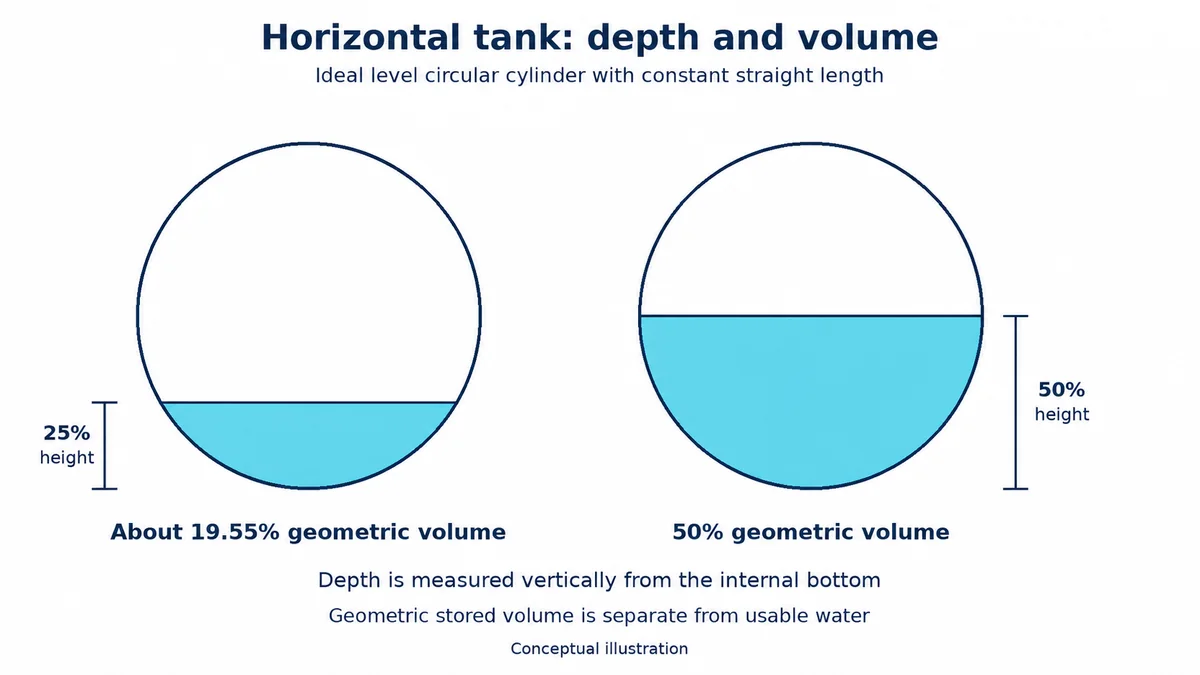
A tank display reading 25% may describe liquid height, a configured measurement span or an already-converted volume. Those meanings are different. In an ideal level horizontal circular cylinder, liquid at 25% of the internal diameter occupies only about 19.55% of the full geometric volume. At half-height, however, the tank really is half full geometrically.
Before turning a percentage into an irrigation-water commitment, identify what the display reports and how the tank's geometry connects level to volume.
Read the tank as a stack of horizontal slices
In a vertical cylinder with a flat base and constant horizontal area, an equal increase in height adds an equal volume. Over that geometry, volume is proportional to height.
Turn a circular cylinder on its side and the relationship changes. A thin horizontal band near the bottom is narrow. An equally tall band near the middle is wider, so it contains more water over the same tank length. Equal height changes therefore represent unequal volume changes.
The midpoint remains a useful symmetry check: a horizontal water surface through the circle's centre divides the cross-section into equal areas. With a level, straight cylinder, half the internal height means half the geometric volume. The quarter-height point has no equivalent quarter-volume symmetry.
Work through an explicitly fictional tank
Assume an ideal level horizontal circular cylinder with internal radius R = 1 m and straight internal length L = 2 m. Its ends are flat, with no dished or conical volume, internal obstructions or tilt. Measure liquid depth h vertically from the internal bottom. The full geometric volume is πR²L, about 6.283 m³.
The circular-segment area relationship described by Wolfram MathWorld, multiplied by length, gives the stored volume:
V = L [R² arccos((R − h)/R) − (R − h) √(2Rh − h²)]
Here R, L and h use the same length unit, arccos is evaluated in radians, and h runs from 0 to 2R. Using metres gives V in cubic metres. These dimensions and results are a teaching example, not a real tank's calibration.
| Depth from bottom, m | Fraction of full internal height | Geometric stored volume, m³ | Fraction of full geometric volume |
|---|---|---|---|
| 0.5 | 25% | About 1.228 | About 19.55% |
| 1.0 | 50% | About 3.142 | 50% |
| 1.5 | 75% | About 5.055 | About 80.45% |
At the first point, multiplying the full tank volume by 25% would give about 1.571 m³. The geometry gives about 1.228 m³ instead. The difference comes from the circular cross-section, even if the depth measurement itself is correct.
Check whether conversion has already happened
Level instruments can convert a measured level into a tank-volume output. The Liquicap M FMI51/FMI52 operating instructions, printed pages 64–66, distinguish shape-specific conversion and level–volume tables. This is an example of the reporting distinction, not a recommendation to change a device's settings.
Ask the responsible operator or supplier to identify the displayed quantity from the approved configuration record. If it already represents linearized volume, applying a second height-to-volume conversion would corrupt the interpretation.
If it represents a percentage of level span, identify both endpoints. A zero above the internal bottom or a span covering only part of the tank does not make 25% on the display equal to 25% of the full internal diameter. The example table applies only after that depth reference has been established.
Make a defensible handover from the reading
For a fictional handover, imagine the team reports “25% water left” from a horizontal tank's screen, but the display definition and tank calibration are missing. The useful immediate conclusion is that stored volume remains unresolved. Ask for the tank identity and orientation, the display's quantity and span, and the approved geometry or level–volume record that connects them.
For a tank with dished ends, a cone, tilt or internal displacement, use its appropriate documented conversion. Do not force the ideal cylinder table onto it. This review can use existing records; it does not require tank entry, dipping, a filling trial or live configuration changes.
Finally, geometric water present is different from water available for planned withdrawal. Operating limits and reserved or inaccessible water still belong to the separate greenhouse storage assessment. Use a supported change in stored volume in the water-balance audit, rather than subtracting two unexplained display percentages.
Download the display-evidence card
Download the tank level-to-volume evidence CSV. This manual worksheet retains the fixed fictional height/volume comparisons and provides separate fields for the actual display, zero/span, tank geometry and approved conversion evidence. It contains no formulas or live tank calculator. Import as UTF-8, comma-separated text, widen and wrap the columns, and save a spreadsheet copy. Complete the stored-volume interpretation before making a separate usable-water assessment.