
The short answer
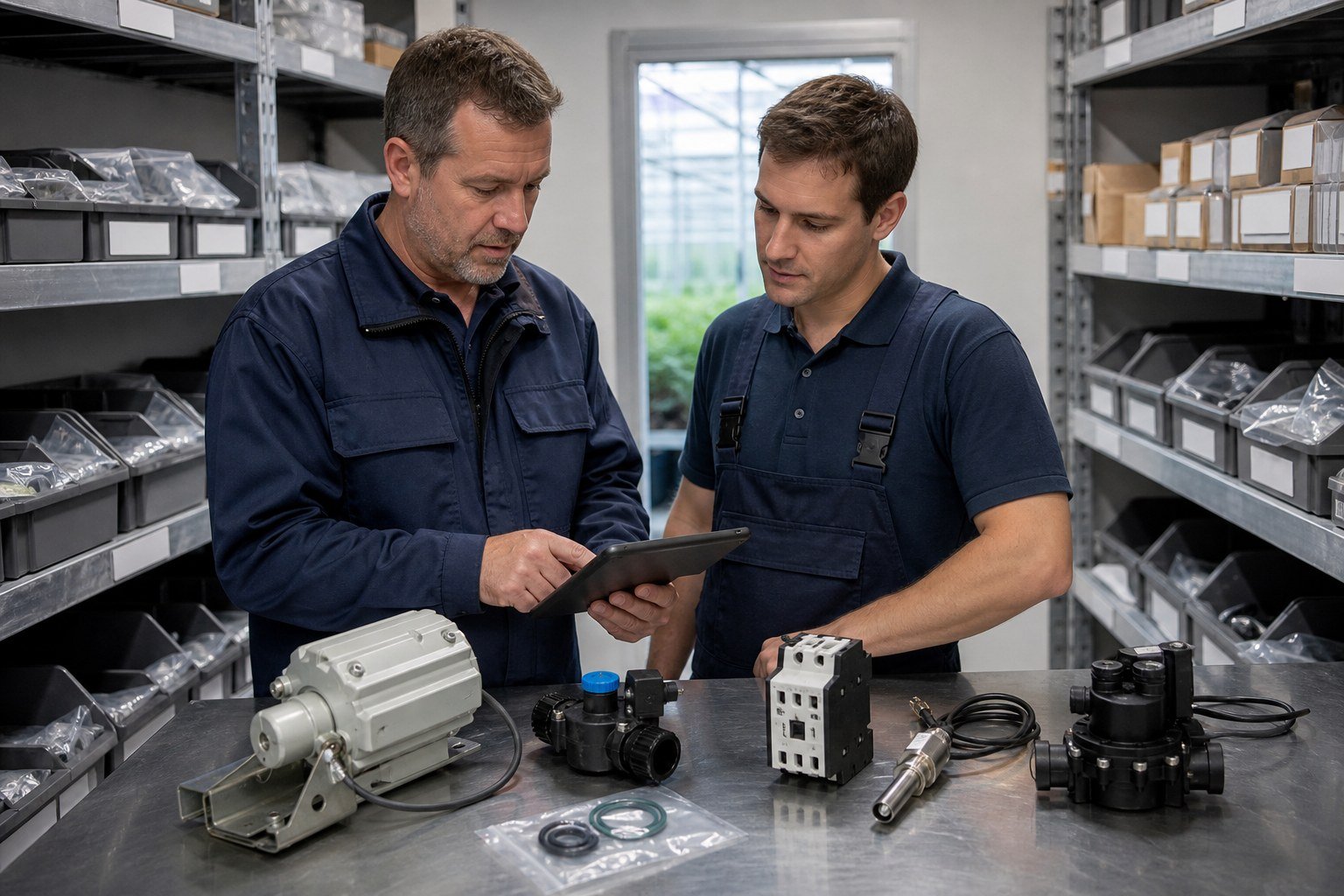
Start with the installed asset list and failure modes. Rank each part by consequence to people, crop, production, asset protection and environment; time before harm; available redundancy or manual control; diagnosis and replacement time; supplier lead time; installed population; commonality; shelf life and repair options. Verify manufacturer part number, revision, electrical and mechanical ratings, connectors, software or firmware and required accessories against the installed equipment. Set minimum and reorder levels from expected demand and replenishment exposure, then count, preserve, test and rotate stock under named ownership.
Purchase price alone is a poor stocking rule. A low-cost contactor that stops a heater may deserve more attention than an expensive panel with strong local support and redundant operation. Conversely, buying one of every proprietary part can waste cash if shelf life expires or the model changes before use.
Separate operating consumables, routine maintenance kits, emergency replacement units, repairable rotables, insurance spares and supplier-held parts. Each category needs a different replenishment and storage rule. Record whether the site has the people, tools, lifting access, configuration and safe isolation needed to use the part. Create an obsolescence watch for controllers, drives, sensors and proprietary boards. When a manufacturer announces an end-of-life date, decide whether to buy a final quantity, qualify a controlled substitute, upgrade a complete equipment group or accept a documented recovery risk. Do not wait for the first unsupported failure.
This guide is an operating-control framework, not a substitute for the approved design, crop protection plan, product labels, manufacturer instructions, employment and safety procedures, local law, or advice from qualified growers, engineers, water-treatment specialists, plant-health advisers, and safety professionals.
What the buyer should control
| Control point | Required record or action | Release evidence |
|---|---|---|
| Asset and exact identity | Link site, greenhouse, system, equipment tag, manufacturer, model, serial range, drawing, installed revision, compatible part number and current supplier contact. | Fit and function verified against the installed configuration, not only a catalog image. |
| Consequence and exposure | State safety, crop, environmental, production and secondary-damage outcomes; time to harm; season; affected area; and detection method. | Approved criticality rationale reflects actual operating conditions. |
| Recovery options | Record redundancy, manual mode, cannibalization restrictions, temporary equipment, repair capability, supplier support, local equivalent and required authorization. | Practical recovery time is tested or supported by a current plan. |
| Demand and lead time | Use installed quantity, failure history, preventive usage, minimum order, supplier stock, manufacture, transport, customs and internal approval time. | Replenishment lead time includes variability and is reviewed periodically. |
| Stock policy | Set on-hand minimum, reorder point, order quantity, reserved project stock, issue approval, substitution control and emergency purchase route. | System generates action before exposure exceeds available inventory. |
| Storage and preservation | Control temperature, humidity, dust, light, battery charge, seals, corrosion, packaging, electrostatic protection, rotation and inspection. | Condition checks and expiry dates prove the part remains usable. |
| Issue and learning | Record asset, failure case, quantity, installer, removed part, warranty, test, remaining balance, reorder and any changed criticality. | Inventory and asset history update together after every issue. |
Give every open item an owner, due date, status, related drawing or package, and effect on cost, time, quality, safety, and performance. “Discussed,” “in progress,” or “by others” is not a closure record.
A practical workflow
1. Create the list from systems and failure modes
Walk heating, ventilation, screens, irrigation, fertigation, water treatment, electrical, controls and backup systems. Include small accessories required to fit or configure a replacement.
2. Estimate crop exposure before replenishment
Compare time to harmful condition with detection, diagnosis, mobilization, replacement, testing and supplier delivery. Use seasonal and after-hours assumptions.
3. Challenge compatibility with physical evidence
Check ratings, mounting, shaft, connector, seal material, firmware, language, license and parameter backup. Photograph the installed nameplate and stored item.
4. Set stock using demand and uncertainty
Use preventive consumption and failure history where available. Add justified protection for long or variable lead times; do not disguise obsolete stock as resilience.
5. Audit usability, not only quantity
Open selected packages, inspect preservation, confirm location, test batteries or configurable units where appropriate and practice retrieval during a drill.
Use one controlled register and preserve superseded records. The team should be able to reconstruct which instruction, setting, role and asset condition applied when an event was observed, adjusted, maintained, tested, restored and accepted.
Roles at the operating interfaces
Owner and operations manager
Set the crop, safety, production and business priorities; assign authority; approve operating limits; and make sure urgent decisions can be made outside normal hours.
Grower and plant-health lead
Define crop-sensitive conditions, hygiene zones, scouting evidence, water-quality needs, permitted treatments, release criteria and the response to suspected pests or disease.
Maintenance and controls team
Keep assets, sensors, software, backups, alarms, isolations, spares and work records usable. Report degraded functions before they turn into crop or safety events.
Suppliers and local specialists
Provide scope-specific instructions, competent service, replacement parts and technical evidence. Local professionals must control regulated electrical, pressure, chemical, fire and environmental work.
Use evidence before releasing the next step
Before people, water, chemicals, crops or equipment enter a released area, confirm that the approved method is current, the responsible person has checked the work, exceptions are controlled, affected teams have been informed, and the record can be retrieved. If a condition is not met, state what may continue, what remains on hold, who owns the action, and when it will be checked again. This is more useful than a general statement that the greenhouse is ready.
Common failure modes
| Failure | Buyer response |
|---|---|
| The handover list becomes the permanent stock policy | Update it for actual failures, lead times, installed changes and crop consequence. |
| A similar-looking part is assumed compatible | Verify full ratings, revision, connection, materials, software and accessories. |
| Parts are counted but not preserved | Inspect packaging, corrosion, batteries, seals, temperature and shelf life. |
| A part is used but reorder waits for month-end | Trigger replenishment at issue or when the defined reorder point is reached. |
Buyer decision questions
Which single failure can expose the largest crop before a replacement arrives? Is there a tested manual or redundant mode? Does the stored item match the installed revision and include every fitting, cable, seal or license? What is the real end-to-end replenishment time? Can the responsible technician retrieve, install, configure and test it on the worst shift?
Link the answer to the greenhouse spare parts handover list, the greenhouse preventive maintenance plan, the greenhouse warranty defect service log, so operating decisions remain connected across the crop, equipment, maintenance and evidence.
Frequently asked questions
Should every critical asset have a complete spare?
Not always. Redundancy, repair, rental, supplier stock and temporary operation may reduce the need. Document the recovery path and timing.
How is a reorder point calculated?
Use expected demand during replenishment plus protection for variability and consequence. Adapt the method to intermittent, low-volume critical items.
Can parts be shared between greenhouse sites?
Yes if compatibility, transport time, ownership, customs, emergency priority and stock visibility are controlled.
What about software and settings?
Treat licenses, firmware, configuration backups, passwords and restore instructions as recovery resources, with secure access and version control.
Turn the requirement into a controlled deliverable
Share the asset list, installed part numbers, failure and issue history, supplier lead times, current stock and recovery options. Chengfei Greenhouse can help verify spares for its supplied equipment while the owner sets site-wide criticality and purchasing policy.
Contact Chengfei Greenhouse