
Compare a greenhouse seeder by correctly placed seeds in the intended cells, using the actual seed form and tray pattern. A tray-per-hour claim describes throughput only after its counting unit and machine boundary are clear. A total seed count can look correct while individual cells are wrong.
Define the product first. One seed per cell and an intentional multi-seed group are different placement specifications. Then ask for a supplier-controlled demonstration that records the output rather than assuming that a fast machine cycle produces an acceptable tray.
Separate seed pickup from correctly sown cells
In a vacuum pickup system, seeds are held at pickup positions and released toward target positions in the tray. The machine's pattern, the seed's physical form and the tray orientation determine what a pickup cycle is intended to accomplish. A row machine then advances through successive sowing rows.
Hamilton's Handy Seeder description documents vacuum pickup and release, row indexing and optional clump sowing. It illustrates the mechanism, not an adjustment procedure for another machine. Urbinati's seeder range also distinguishes several architectures and publishes capacities in unlike units, including rows, trays and pots per hour.
Keep machine cycles, sowing rows, trays, deposited seeds and target-correct cells separate. None automatically equals the number of seedlings that later emerge.
Convert rows only after defining the tray pattern
In a fictional offer, a seeder is described as processing 1,200 rows per hour. The actual tray orientation requires 12 sowing rows per tray. The arithmetic ceiling is 1,200 ÷ 12 = 100 trays per hour before other constraints. It is not 1,200 trays per hour.
That conversion is valid only if the quoted “row” and the 12 counted rows refer to the same sowing operation. A physical tray can be presented in different orientations, and a machine cycle may not equal one row. Ask the supplier to identify the counting boundary rather than selecting a divisor from the tray's appearance.
Also identify what the elapsed demonstration includes. A seeder-only rate does not establish the output of a line that must fill, sow, cover, water and stack trays. Record included handling and stoppages with the demonstrated time; do not silently compare it with a different supplier's continuous machine-only maximum.
One hundred seeds can leave eight cells incorrect
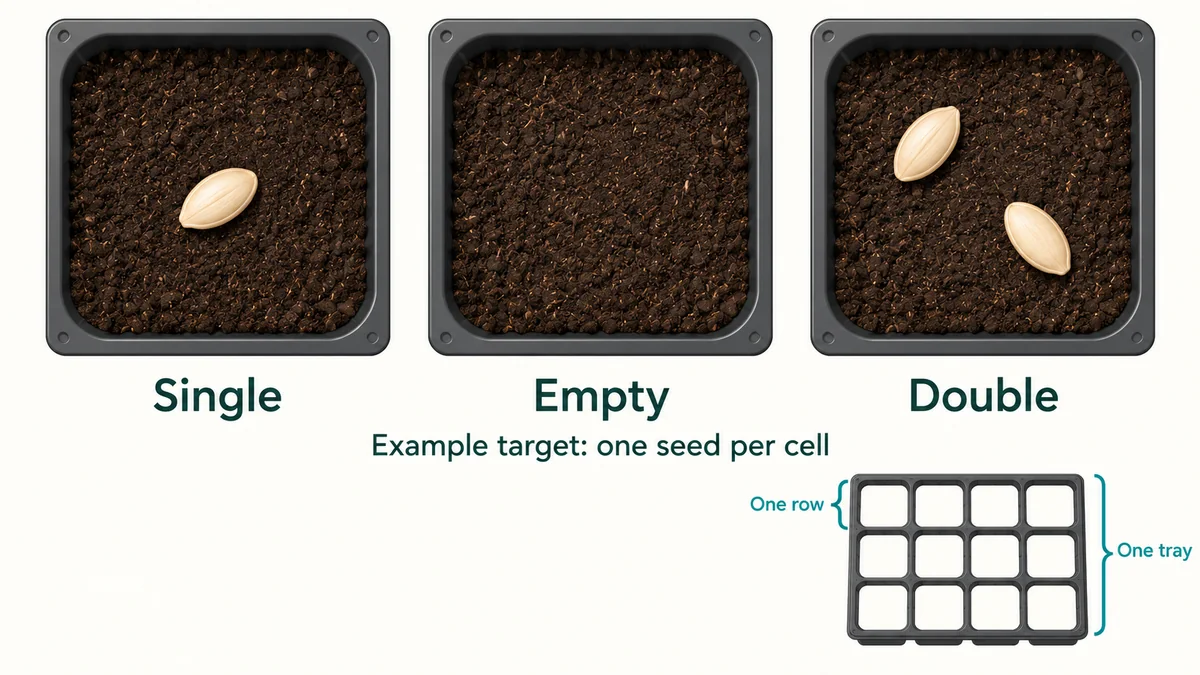
Consider a separate, invented 100-cell output sample intended for one seed per cell. It contains 92 single-filled cells, four empty cells and four double-filled cells.
| Observed category | Cells | Seeds in those cells |
|---|---|---|
| Single placement | 92 | 92 |
| Empty | 4 | 0 |
| Double placement | 4 | 8 |
| Total | 100 | 100 |
The total seed count matches the cell count, but only 92 cells meet the one-seed target. The four missing seeds and four extra seeds cancel in the aggregate. Counting seeds alone conceals the placement error.
This is not an expected defect rate, a statistical acceptance plan or a prediction of 92 saleable plants. If the intended product uses multiple seeds per cell, its correct category must be defined differently. Do not apply the single-seed example as a rejection rule for a clump-sown crop.
Preserve positions and uncertain observations
Have the OEM demonstrate the exact machine and tooling with the offered seed form and actual tray. Review a safely stopped or discharged output sample under its procedure. Do not reach into moving equipment, defeat guards or change vacuum settings to reproduce an example.
Preserve cell positions and photographs so an empty, excess or misplaced deposit can be investigated in context. Use an unclassifiable category where the observation is uncertain. A seed outside its intended cell should not be counted as successful placement merely because it remains somewhere in the tray.
Keep later emergence observations in a separate record. They help assess the biological result but cannot retroactively prove where every seed was deposited. This separation lets the supplier and nursery discuss mechanical placement without treating every missing seedling as a machine fault.
Download the demonstration and counting sheet
Download the seeder placement worksheet (CSV). It combines manual demonstration fields with formulas for a documented rows-to-trays conversion and the bounded single-seed counting example. Import as UTF-8, comma-separated text with formulas enabled. Keep the row order unchanged and fill only blank “Your case” input cells and manual fields. Enter explicit zeros for observed zero categories. The example does not cover other excess placements, including three or more seeds, or misplaced or unclassifiable cells; if any exists, leave that calculation unresolved and use the manual record. Save a native spreadsheet copy after adjusting wrapping.
Use the result to agree what an acceptable demonstration must show, without inventing a universal pass percentage. For later stages, see germination-chamber transfer timing and nursery propagation flow.