
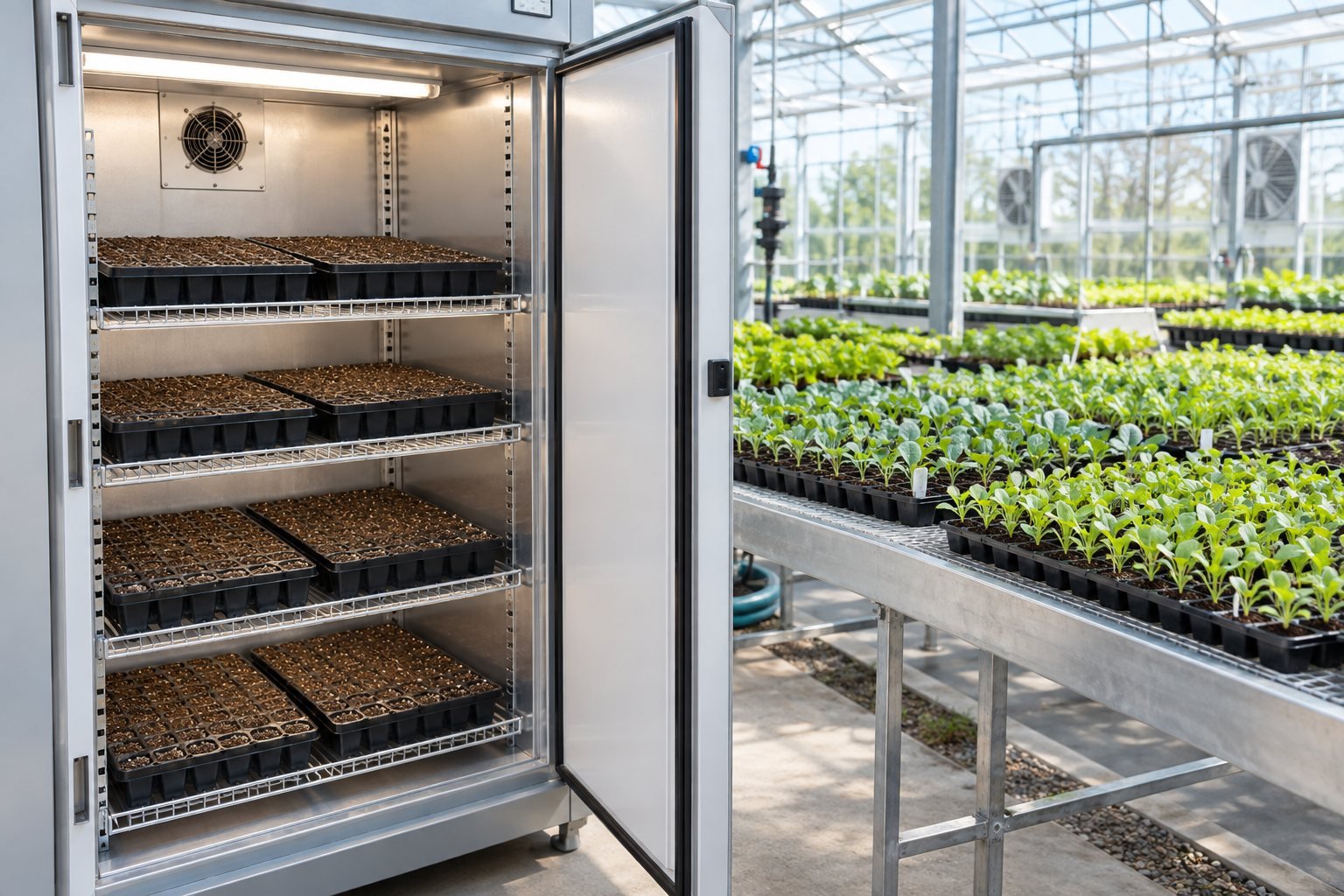
The chamber gives uniform warmth, so the trays stay inside until every seed has emerged. By then the earliest seedlings may have spent too long without suitable light. Waiting for the last seed can reduce the quality of the first plants.
Set transfer timing from the crop's propagation protocol and observed development, not one fixed number of days for every tray. A dark germination chamber and an illuminated propagation room are different environments and may require different transfer rules.
Distinguish germination from nursery growth
Germination begins before a shoot is visible above the substrate. A chamber may be intended only to provide controlled conditions during that early stage, while the nursery provides the light and space for subsequent growth. Confirm which role the equipment is designed to perform.
Utah State's vegetable transplant guidance treats chamber use as part of a crop-specific propagation process rather than a permanent growing environment. Its transfer guidance should be read with the chamber type and crop in mind; it is not a universal instruction to wait for a particular percentage of visible shoots.
Make an inspection plan for each lot
| Record | Why it changes the decision | Practical action |
|---|---|---|
| Crop, cultivar and seed lot | Development timing and uniformity can differ | Keep lots identifiable rather than mixing trays by sowing day alone |
| Sowing time and substrate condition | Calendar days omit the actual starting point and moisture variation | Record preparation and inspect representative cells |
| Measured chamber and tray conditions | A controller reading may not represent every shelf | Check upper, lower and edge positions |
| Development observed | The first developing seeds can signal an approaching transfer window | Use the crop protocol's defined stage, not an improvised average |
| Destination readiness | A ready tray can deteriorate while waiting for bench space | Reserve the receiving area before sowing |
Do not let the work calendar set the biology
A batch that becomes ready on Sunday still needs the appropriate observation and response. Assign responsibility for weekends and holidays. As a lot approaches its expected transfer window, increase attention according to the crop protocol rather than leaving it unchecked until the next scheduled irrigation round.
If emergence is uneven, determine whether the pattern follows seed lot, substrate moisture or chamber position. Moving the whole mixed lot later may protect lagging cells at the expense of advanced ones. Ask the propagation adviser whether sorting or a revised sowing and inspection sequence is appropriate.
Prepare the destination before opening the door
Check light, temperature, irrigation availability and tray support in the receiving nursery. The move should not create a large unmanaged change in drying demand. Follow the crop-specific transition procedure and inspect plants after transfer, especially at exposed edges.
Record transfer time, receiving location and any stress. If a problem appears, this distinguishes a chamber-stage issue from one that began after movement. A chamber upgrade cannot solve a receiving bench that lacks enough light or consistent watering.
Capacity is a flow problem
Suppose a hypothetical operation transfers 120 trays on a busy morning, but the receiving benches have room for only 80. The missing 40 positions are a nursery-capacity constraint, not a reason to keep ready trays in the chamber. Model overlapping batches, cleaning time and delayed dispatch before buying a larger cabinet.
Use the greenhouse humidity-management guide for the surrounding nursery environment. For a CFGET propagation layout, provide sowing volumes by day, expected transfer windows and tray dimensions. Ask for a flow plan that connects sowing, chamber use, nursery growth and dispatch. A larger chamber is useful only when the rest of that route can receive its output.