
The short answer
Define handover by system and evidence. Complete inspections and functional tests; categorize punch items by safety, operation, performance, protection, documentation, and appearance; close blockers before use; assign permitted residual items with owner, due date, access and risk controls; deliver approved as-builts, calculations, certificates, software backups, settings, manuals, maintenance plans, training records, spare parts, tools, keys and accounts; transfer permits and operating authority; issue a warranty register with start, end, exclusions, required maintenance, response route, and contacts; then verify seasonal and deferred tests and close the final issues.
One master punch list containing thousands of mixed comments is difficult to operate. Organize walkdowns by system and area, and distinguish incomplete contracted work from defects, damage, commissioning issues, document gaps, owner enhancements, and future phases. Each item needs a precise location, requirement, responsible party, target, status, evidence, and acceptance authority.
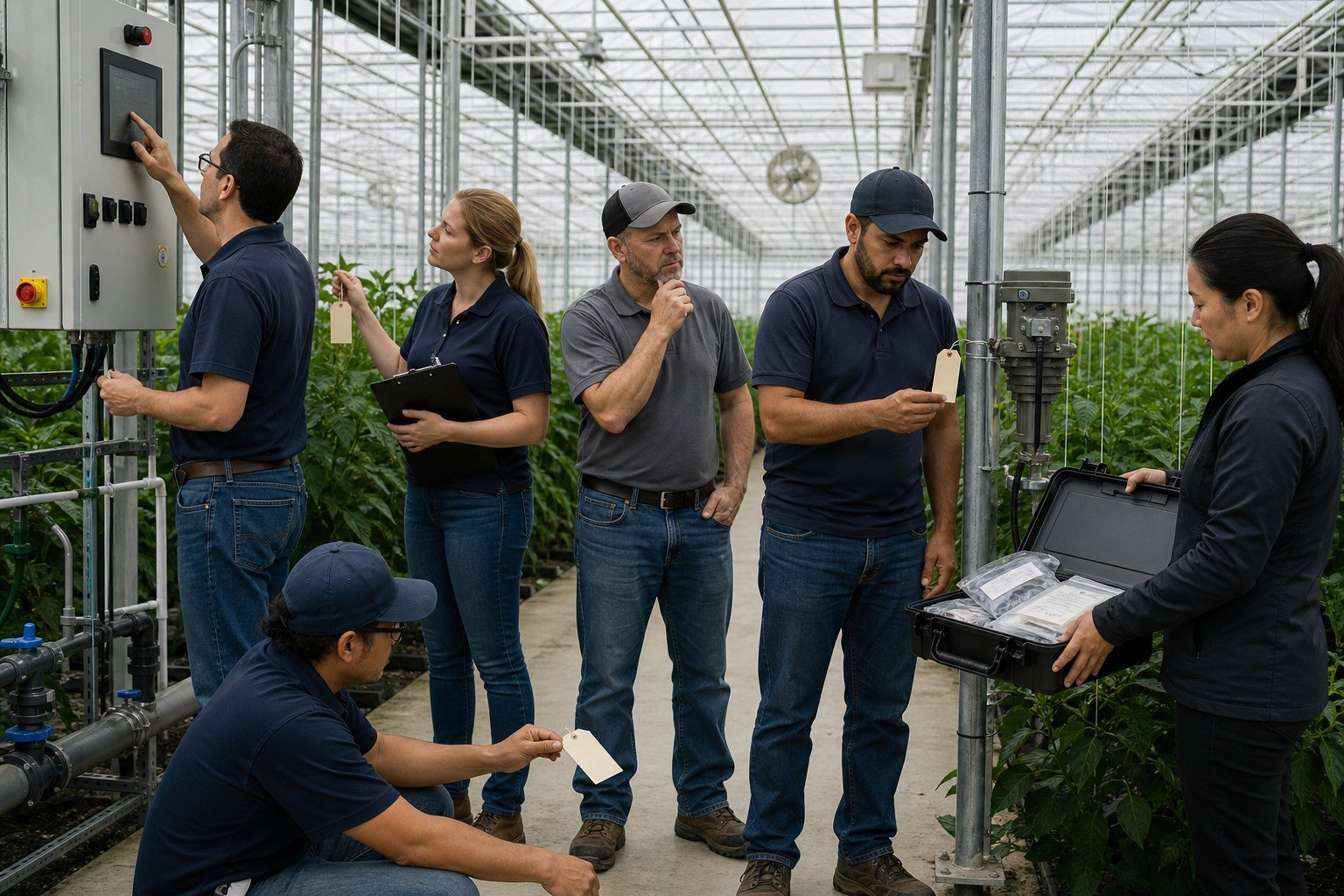
The operations team should join before final testing. Operators must understand normal sequences, setpoints, alarms, manual overrides, emergency response, water treatment, fertigation, ventilation, heating, cooling, screens, backup power, cleaning, calibration, seasonal changeover, and escalation. Training is not complete merely because someone signed attendance.
This guide is a project-control framework, not a substitute for the contract, approved design, manufacturer instructions, carrier terms, local law, or advice from qualified engineers, contractors, insurers, customs specialists, and safety professionals.
What the buyer should control
| Control point | Required record or action | Release evidence |
|---|---|---|
| Physical completion | Structure, cladding, drainage, vents, screens, equipment, guards, access, piping, electrical, sensors, labels, cleaning, protection, and site interfaces complete to approved documents. | Signed system walkdowns and closed installation records, with permitted residual work explicitly listed. |
| Testing and performance | Pre-commissioning, safety checks, pressure and electrical tests, calibration, point-to-point, sequences, interlocks, alarms, integrated modes, backup, fail-safe response, and agreed performance demonstrations. | Accepted test sheets, trend or measurement evidence, issue closure, software version, and settings baseline. |
| Punch and residual items | Unique number, system, location, description, category, requirement, responsible party, due date, access need, temporary protection, operational restriction, retest, photo, and acceptance. | No safety or operational blocker remains; each permitted residual item has written risk and completion control. |
| Documents and configuration | As-built drawings, calculations, equipment and asset lists, bills of materials, certificates, manuals, data sheets, software and backups, network and user administration, parameters, calibration, inspection and test records. | Indexed, searchable, current files matched to the installed revision and securely transferred credentials. |
| People, spares, and maintenance | Role-based training, practical demonstration, emergency drill, attendance and competence, spare parts, special tools, consumables, keys, warranties, preventive maintenance, lubricants, service providers, and reorder data. | Operators can perform agreed tasks, locate resources, and meet maintenance and warranty conditions. |
| Acceptance and aftercare | Completion and acceptance certificates, custody and risk date, utility readings, warranty register, defect contact, response targets, seasonal tests, performance monitoring, post-occupancy review, final account inputs, and record retention. | Authorized signatures define effective dates, remaining obligations, communication route, and final closure criteria. |
Give every open item an owner, due date, status, related drawing or package, and effect on cost, time, quality, safety, and performance. “Discussed,” “in progress,” or “by others” is not a closure record.
A practical workflow
1. Agree completion definitions early
Before installation peaks, define mechanical completion, ready for energization, ready for commissioning, substantial or practical completion where applicable, operational acceptance, and final completion. Link payment and warranty events to objective evidence under the contract.
2. Walk down by system with operations
Use approved drawings and ITP records, not visual impression alone. Inspect access, maintainability, cleaning, protection, labels, safe isolation, drains, spare capacity, software, alarms, and interfaces. Record exact locations and avoid duplicate or vague punch items.
3. Commission and train on the final configuration
Close installation blockers, test individual and integrated modes, capture settings and software, demonstrate failure responses, and train operators with the actual equipment. Repeat training where seasonal modes or late changes were unavailable.
4. Transfer an indexed handover package
Use a document index with required, submitted, reviewed, accepted, and not-applicable status. Verify that manuals describe the installed options, drawings reflect field changes, certificates are valid, and spare parts and tools are physically counted and stored.
5. Manage warranty as an operating process
Register coverage by supplier and component, dates, exclusions, response contacts, evidence required, preventive maintenance, consumables, remote access, travel, labor, freight, and emergency mitigation. Review recurring defects and complete deferred or seasonal tests before final closure.
Use one controlled register and preserve superseded records. The team should be able to reconstruct which information was current when a component was approved, manufactured, shipped, installed, tested, accepted, and handed over.
Roles at the interfaces
Owner and project manager
Set acceptance authority, priorities, contractual notice routes, decision dates, local advisers, and the evidence required before payment or release.
Greenhouse supplier
Provide controlled drawings, component data, manufacturing and packing records, installation requirements, tests, manuals, deviations, and technical responses for its scope.
Local contractor and specialists
Control site labor, safety, temporary works, civil and utility interfaces, local inspections, installation records, testing, protection, and legally required approvals.
Logistics and operations teams
Control transport documents, receipt evidence, storage conditions, preservation, spares, training, operating readiness, defects, and warranty communications.
Apply a release test, not a progress impression
Before the next commitment, ask whether the required input is current, the responsible reviewer has acted, stated conditions are closed, affected interfaces have been notified, the physical item matches the record, and the evidence is stored where the operations team can retrieve it. If any answer is no, classify the risk and assign a time-bound action rather than allowing an informal assumption to travel downstream. The release decision should also state what may proceed, what must remain on hold, and which later inspection, test, document, payment, or warranty event depends on closure. This discipline makes an early gap cheaper to correct and prevents apparent progress from hiding unfinished obligations.
Common failure modes
| Failure | Buyer response |
|---|---|
| Handover is a single signing meeting | Missing tests, documents, training, and spares surface after the team demobilizes. Build evidence progressively by system. |
| All punch items are treated equally | Safety and crop-critical blockers disappear among cosmetic comments. Classify priority and acceptance effect. |
| Manuals are generic brochures | They omit installed options, settings, drawings, maintenance intervals, fault response, and parts. Review against the asset list and configuration. |
| Warranty starts without a register | Different dates, duties, exclusions, and notice routes are forgotten. Capture them before acceptance and connect maintenance evidence. |
Buyer decision questions
What must be complete before crop entry, energization, water or chemical use, and operational acceptance? Which residual items are permissible and under what controls? Have all modes, alarms, interlocks, backups, and failures been demonstrated? Can operators safely run and maintain the installed configuration? Are as-builts, settings, software, certificates, spares, and credentials complete? What exactly starts each warranty and how is a defect notified and proven?
Link the answer to the commissioning checklist, the spare parts and handover list, the preventive maintenance plan, so decisions remain connected from procurement through installation and handover.
Frequently asked questions
Can a project be handed over with open punch items?
Possibly if the contract permits and none blocks safety, legality, operation, performance, protection, or required evidence. Each residual item needs written conditions, owner, date, access, and remedy.
When should the warranty start?
Use the contract and applicable law. Different equipment may have shipment, installation, commissioning, acceptance, or operating-hour triggers; record the agreed start and end for each obligation.
What is a seasonal test?
A test deferred until weather, crop load, or operating conditions allow the intended duty to be demonstrated, such as peak heating, cooling, humidity, or backup operation. Keep responsibility and acceptance open.
Who should receive training?
Operators, maintenance staff, managers, safety personnel, IT or controls administrators, and emergency responders need role-specific instruction. Verify practical competence, not only attendance.
Turn the requirement into a controlled deliverable
Send the system scope, target operating date, commissioning plan, acceptance definitions, operations team, documentation requirements, spare-parts list, and warranty terms. Chengfei Greenhouse can organize the technical turnover evidence for its supplied systems while the buyer controls complete project acceptance.
Contact Chengfei Greenhouse