
The short answer
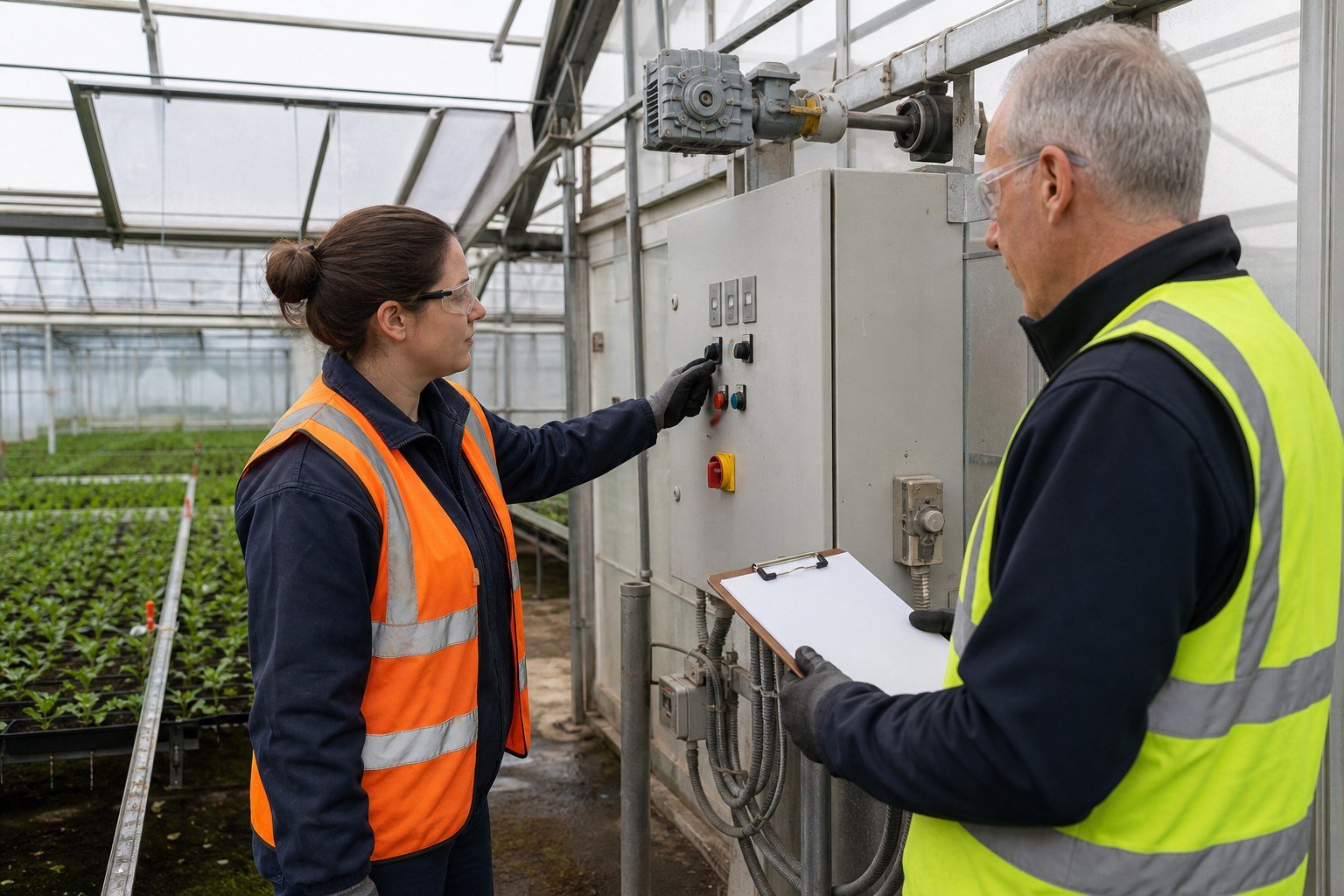
Create a role matrix before training starts. For each operator, grower, maintenance technician and supervisor, list what the person may observe, operate, adjust, isolate, maintain, approve and escalate. Teach on the final installed configuration, then assess with realistic scenarios. A competent person should explain the purpose and hazard, find the correct information, perform the task without unsafe prompting, confirm the physical result, restore normal operation, record what happened and know when to stop and call for help. Record gaps and reassess after correction.
Supplier training often occurs near project completion when software, labels or procedures are still changing. Too many people attend one presentation, but nobody is assigned to master after-hours alarms, water treatment, backups or account administration. The owner later discovers that knowledge belonged to a visiting technician rather than the shift team. Schedule protected practice time, because people rarely learn a high-consequence response while also trying to keep normal production moving.
Divide competence by role and consequence. A grower may be authorized to adjust climate targets within approved limits but not change protection parameters. An operator may acknowledge an alarm but not reset a safety trip. A technician may isolate equipment only under the site's safety procedure. Make these boundaries visible in the competency record.
This guide is an operating-control framework, not a substitute for the approved design, crop protection plan, product labels, manufacturer instructions, employment and safety procedures, local law, or advice from qualified growers, engineers, water-treatment specialists, plant-health advisers, and safety professionals.
What the buyer should control
| Control point | Required record or action | Release evidence |
|---|---|---|
| Role and authority | Name the role, shift, systems, permitted actions, prohibited actions, approvals and escalation contacts. | Signed authorization matrix matched to current staffing and local safety rules. |
| Normal operation | Start, stop and monitor assigned systems; recognize normal physical response; use trends; conduct shift checks; and hand over open issues. | Observed demonstration on representative equipment with assessor notes. |
| Climate and irrigation | Interpret crop-level conditions, operate approved modes, verify delivery, respond to blocked zones and distinguish a sensor problem from a real environmental change. | Scenario result showing correct action, confirmation and record. |
| Alarms and emergencies | Receive, prioritize, investigate, communicate, apply authorized temporary action, protect people and crops, and escalate loss of power, heat, cooling, water or control. | Timed drills for selected high-consequence scenarios and closed learning actions. |
| Maintenance and hygiene | Perform assigned inspection, cleaning and minor service; use isolation rules; protect calibration; follow clean-to-dirty movement; and report defects. | Practical task completed with correct tools, PPE, procedure and evidence. |
| Controls and records | Use individual accounts, protect passwords, identify active overrides, retrieve manuals, make approved entries, preserve software backups and avoid undocumented setpoint changes. | Account and record review plus demonstration of backup or retrieval. |
| Assessment and renewal | State assessor competence, method, pass criteria, restrictions, retraining action, reassessment date and triggers such as software or role change. | Current competency register with expired or restricted authorization clearly visible. |
Give every open item an owner, due date, status, related drawing or package, and effect on cost, time, quality, safety, and performance. “Discussed,” “in progress,” or “by others” is not a closure record.
A practical workflow
1. Start with tasks, not presentation slides
Walk through each shift and list decisions people actually make. Include rare but consequential tasks such as storm preparation, freeze response, failed pump transfer, manual vent closure and loss of communications.
2. Use the installed greenhouse as the training environment
Confirm drawings, labels, screens, passwords, setpoints and manuals are current. Demonstrate the real equipment and show where field condition can disagree with a computer display.
3. Ask the learner to explain and perform
Use teach-back and practical demonstration. The assessor should watch for safe preparation, correct sequence, physical verification, restoration and recordkeeping rather than only memorized button locations.
4. Test scenarios across shifts
Schedule drills for day, night and weekend coverage. Do not reveal every answer in advance. Use safe simulations where an actual failure could harm crops, people or equipment.
5. Maintain competence after handover
Assign refreshers, new-starter training and reassessment after an incident, long absence, major maintenance, software update, crop change or responsibility change.
Use one controlled register and preserve superseded records. The team should be able to reconstruct which instruction, setting, role and asset condition applied when an event was observed, adjusted, maintained, tested, restored and accepted.
Roles at the operating interfaces
Owner and operations manager
Set the crop, safety, production and business priorities; assign authority; approve operating limits; and make sure urgent decisions can be made outside normal hours.
Grower and plant-health lead
Define crop-sensitive conditions, hygiene zones, scouting evidence, water-quality needs, permitted treatments, release criteria and the response to suspected pests or disease.
Maintenance and controls team
Keep assets, sensors, software, backups, alarms, isolations, spares and work records usable. Report degraded functions before they turn into crop or safety events.
Suppliers and local specialists
Provide scope-specific instructions, competent service, replacement parts and technical evidence. Local professionals must control regulated electrical, pressure, chemical, fire and environmental work.
Use evidence before releasing the next step
Before people, water, chemicals, crops or equipment enter a released area, confirm that the approved method is current, the responsible person has checked the work, exceptions are controlled, affected teams have been informed, and the record can be retrieved. If a condition is not met, state what may continue, what remains on hold, who owns the action, and when it will be checked again. This is more useful than a general statement that the greenhouse is ready.
Common failure modes
| Failure | Buyer response |
|---|---|
| Everyone receives the same training | The session becomes broad and shallow. Separate grower, operator, maintenance, administrator and emergency responsibilities. |
| Attendance is recorded as competence | Add an observed task or scenario with objective criteria and assessor comments. |
| Training uses a temporary configuration | Repeat affected modules after final software, sensors, labels and operating limits are approved. |
| Only normal operation is taught | Include alarms, safe manual operation, escalation, restoration, records and the limits of authority. |
Buyer decision questions
Who is expected to make decisions on each shift? Which tasks could injure a person, damage equipment or lose a crop if performed incorrectly? What actions require a licensed or specially authorized person? Can the operator recognize when the screen and physical system disagree? Can the team respond without the supplier present? What change or incident should trigger reassessment?
Link the answer to the commissioning checklist, the preventive maintenance plan, the spare parts and handover list, so operating decisions remain connected across the crop, equipment, maintenance and evidence.
Frequently asked questions
How long should operator training take?
There is no universal duration. Base it on system complexity, role, prior experience and demonstrated competence. Rare emergency actions usually need repeated practice.
Who may assess competence?
Use a person who understands the task, the installed system, the hazards and the assessment criteria. Local law or site policy may require specific qualifications.
Should operators be allowed to change all setpoints?
No. Define normal adjustment ranges, protected parameters and approval routes. Access rights should match responsibility.
What record should be kept?
Keep the person, role, module, equipment or software version, method, date, assessor, result, restrictions, corrective training and next review.
Turn the requirement into a controlled deliverable
Send the system list, staffing plan, shift coverage, operating procedures, account structure and emergency priorities. Chengfei Greenhouse can help develop equipment-specific demonstrations for its supplied systems while the owner controls legal authorization and site-wide competence.
Contact Chengfei Greenhouse