
Match a greenhouse generator's rating to its intended operating duty before comparing nameplate power. An offer intended for occasional backup cannot be assumed to cover regular power supply merely because its printed kilowatts exceed the running load.
Describe the expected running hours, load pattern and purpose, then ask which exact OEM rating covers that use. Fuel autonomy and motor-starting capability remain important separate checks; neither defines the duty category.
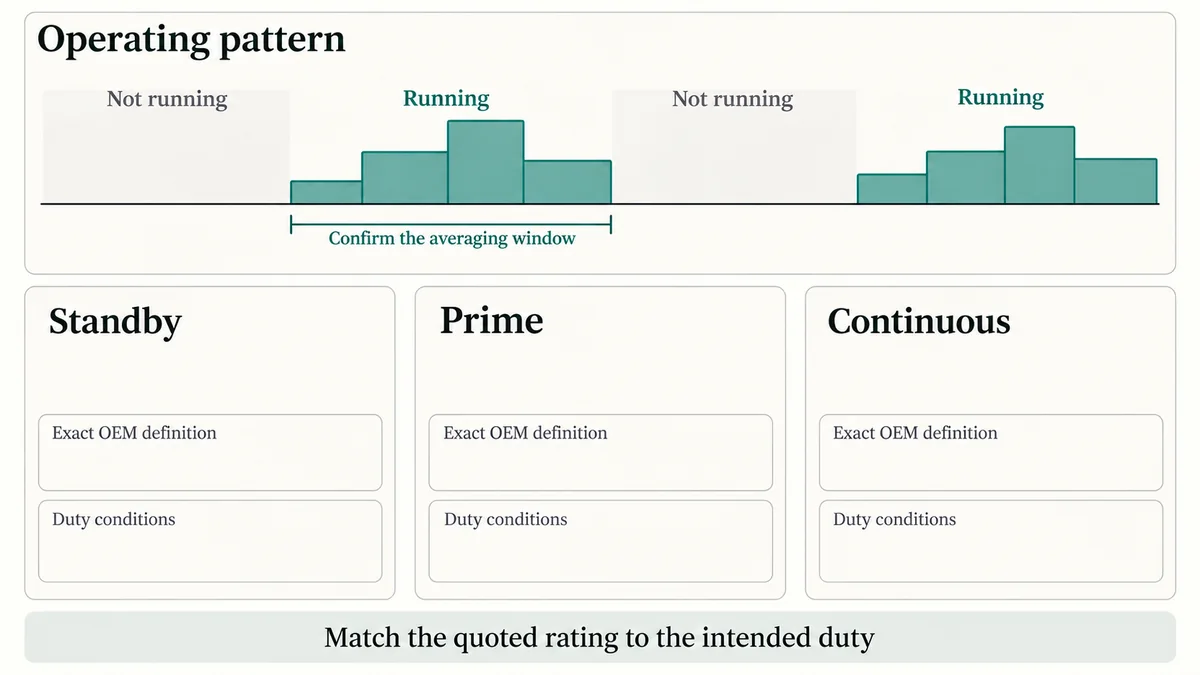
Match the rating to the operating pattern
The same engine-generator can carry different rated outputs under different operating conditions. Rating language distinguishes the work the set is expected to perform over time, including limits on average and maximum load, maintenance conditions and operating hours.
Caterpillar's generator-rating explanation distinguishes emergency standby, standby, prime and continuous applications, among others, and explicitly notes differences between its ratings and ISO terminology. Therefore, copy the rating definition for the actual offered set rather than treating the words as globally identical categories.
| Proposed duty | Question the offer must answer | Unsafe purchasing shortcut |
|---|---|---|
| Emergency interruption of normal supply | Which backup rating covers the expected hours and load pattern? | Assuming every standby label has identical limits |
| Repeated or extended variable-load supply | Which rating and average-load rule cover regular operation? | Reading unlimited annual hours as unlimited maximum-load operation |
| Sustained constant-load supply | Which exact constant-load duty is documented? | Borrowing the highest short-duration rating |
The commercial consequence is straightforward: two quoted kW values are not comparable until their duties are comparable. A larger number under a more restricted duty may not serve the proposed operation.
The average needs the correct time denominator
Consider a hypothetical operating period: 100 kW for four hours, followed by 50 kW for four hours. Energy supplied is 100 × 4 + 50 × 4 = 600 kWh. Average load across the eight running hours is 600 ÷ 8 = 75 kW.
Dividing the same energy by a 24-hour calendar day gives 25 kW. That may describe energy spread across a calendar day, but it must not replace a running-time average when the applicable rating excludes non-running time. Caterpillar specifically discusses excluding non-running time in its prime-rating example.
The OEM must define the actual averaging window and how its rule applies. The eight-hour example is arithmetic only. It does not select a model, establish an allowable load factor or authorize any overload. Do not make the duty appear lighter by adding idle calendar hours to the denominator.
Distinguish the outage plan from routine generation
A greenhouse may begin with occasional outage backup, then consider running the set regularly during unreliable supply periods. That is a change in the proposed usage scenario, even if the connected equipment stays the same.
Provide both scenarios to the supplier. Ask it to identify the documented rating covering each, the associated kW and any assumptions needing engineering review. A supplier answer limited to “enough power” leaves the duration and load-pattern question open.
Utility-parallel operation is another separate condition. A rating discussion is not permission to connect in parallel. Any such proposal needs the appropriate qualified electrical/generator review and the required utility arrangements. This article provides no switching, connection or live-test procedure.
Do not let the fuel tank answer a rating question
A larger tank changes stored fuel availability. It does not change the generator's duty definition. Similarly, demonstrating that a set can start a motor does not establish that it can sustain the proposed running pattern within its rating.
UF/IFAS discusses the need for auxiliary power in greenhouse operations and professional electrical involvement. Use that context to keep duty classification, load/starting assessment and installation responsibility visible as distinct parts of the project.
Give the reviewer the actual site conditions and the OEM's maintenance assumptions too. The quoted output may require site-specific qualification or derating. Do not import numerical limits from a generic rating table into a different engine, alternator, market or location.
Download the duty-profile comparison
Download the generator duty-profile card (CSV). This is a manual record with no formulas. Import as UTF-8, comma-separated text and describe each proposed usage scenario separately. Keep running periods and non-running periods distinct, record the applicable average-load rule, and attach the exact OEM definition. The 600 kWh, 75 kW and 25 kW examples are static illustrations, not a sizing calculator. Adjust wrapping and save a native spreadsheet copy.
The next decision is whether the offer expressly covers each intended scenario or requires a different rating and engineered review. For complementary work, see backup-power and alarm planning and generator testing and fuel readiness.