
The short answer
Build a critical-load schedule before selecting backup equipment. For every load, record function, voltage, phase, running demand, starting method and demand, operating sequence, allowable outage, minimum runtime, seasonal priority, and control dependency. Then design transfer, distribution, fuel, ventilation, exhaust, alarms, remote notification, manual procedures, testing, and maintenance as one system.
A generator can start and still fail the crop. The first large fan or pump may trip it. A control panel may have power while field devices do not. An alarm may stay on the same failed internet connection. Fuel may be stale or insufficient for the required duration.
Qualified local professionals must design and approve electrical protection, earthing, transfer, backfeed prevention, fuel storage, exhaust, ventilation, noise, emissions, fire safety, and emergency systems.
Rank loads by consequence and time
Do not begin by placing every panel total on a generator quotation. Interview the grower, climate-control designer, electrician, irrigation designer, heating specialist, and safety team. Define what happens after one minute, fifteen minutes, one hour, and several hours without power under the worst relevant season.
| Load group | Questions | Possible evidence |
|---|---|---|
| Climate protection | Which vents, fans, pumps, boilers, burner controls, inflation blowers, screens, or cooling stages prevent rapid crop or structure risk? | Seasonal operating sequence and failure consequence. |
| Water and crop | How long can irrigation, fertigation, water treatment, recirculation, and tank mixing stop? | Crop stage, substrate reserve, tank capacity, and manual fallback. |
| Controls and alarms | Which controllers, sensors, gateways, network devices, chargers, and actuators must remain active? | I/O schedule, communications diagram, and battery autonomy. |
| Safety and operations | Which emergency lighting, fire, security, access, sump, refrigeration, or worker systems are required? | Local code and facility risk assessment. |
Set priority levels. Some loads must transfer immediately, some can start after a delay, and others can remain off. Seasonal modes may change the order. UMass Extension recommends standby generation with adequate fuel for heaters, fans, and inflation blowers when preparing greenhouses for storm outages.
Record running demand and starting behavior
Motors, compressors, transformers, discharge lighting, and power electronics may draw differently during start than in steady operation. Record equipment nameplate data, manufacturer information, measured demand where available, motor starting method, variable-frequency drive behavior, power factor, harmonics where relevant, and whether loads start together.
Create a realistic sequence. On transfer, controls may reboot, ventilation stages may call at once, pumps may restart, and heaters may request circulation. Use delays and priorities only where the process can tolerate them. The electrical engineer and equipment suppliers should confirm that voltage and frequency during start remain acceptable.
Include future expansion explicitly. A spare margin is not a substitute for a documented phase plan. State which future loads are included and how the distribution will be extended.
Design transfer, generator, fuel, and controls together
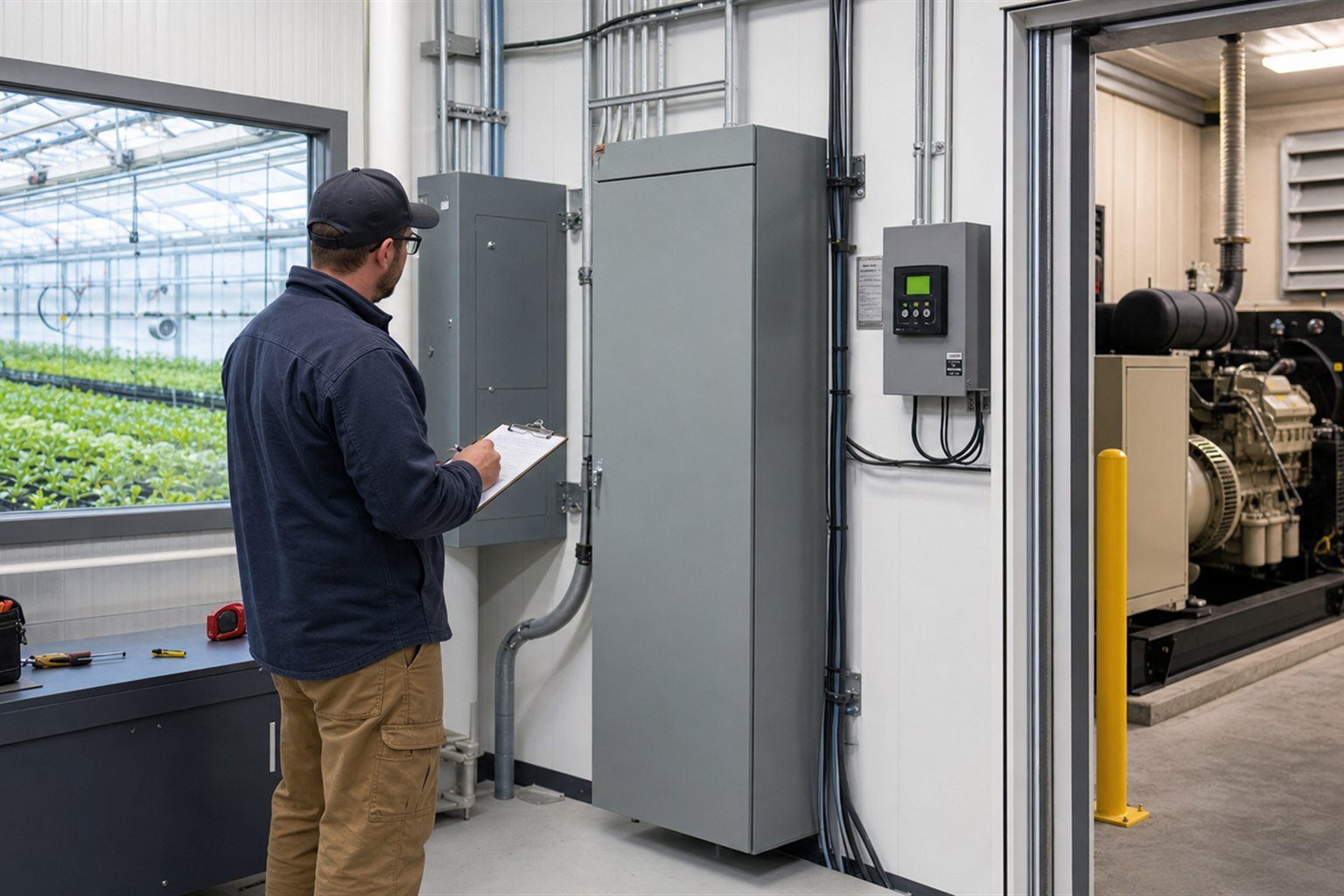
Define automatic or manual transfer, switched conductors as required, source interlocking, earthing arrangement, protection coordination, bypass needs, maintenance isolation, and the return-to-normal sequence. US Department of Energy operations summaries describe automatic transfer equipment as the interface that moves load between sources while preventing unsafe source connection.
For the generator, confirm rating basis, ambient temperature, altitude, enclosure, cooling air, exhaust, vibration, weather, service access, batteries, charger, jacket heater where applicable, and local noise and emissions rules. Locate exhaust and fuel systems away from greenhouse air intakes and occupied areas according to local requirements.
Choose runtime from outage risk and fuel logistics. Record usable tank capacity, consumption across loads, delivery access, minimum reserve, storage limits, quality checks, leak control, and who is authorized to refuel during an event.
Make alarms independent enough to be useful
Define alarms for loss of normal power, generator fail-to-start, low fuel, low battery, transfer failure, overload, controller offline, communications loss, and critical greenhouse conditions. Set recipients, escalation, acknowledgement, and expected response time.
Test the communication path during a real simulated utility failure. A cloud alarm is not independent if the router, network switch, cellular gateway, or site antenna loses power. Provide local audible or visual indication where needed and a manual call tree if communications fail.
Prevent alarm floods from hiding the cause. Group related events, preserve timestamps, and identify the first-out condition. The operations team needs a clear instruction for safe load shedding and manual ventilation or heating.
Test the complete failure sequence
Utility loss
Observe detection, start signal, generator buildup, transfer time, control reboot, and alarm delivery.
Load steps
Start required fans, pumps, heaters, screens, and controls in the intended sequence while recording response.
Fault cases
Simulate failed start, low fuel indication, communication loss, and selected device faults using an approved method.
Return
Verify stable retransfer, cooldown, automatic reset rules, event records, and no uncontrolled simultaneous restart.
Include these tests in the greenhouse commissioning checklist. A no-load weekly exercise does not replace periodic testing under representative connected load.
Handover documents and maintenance
Collect one-line diagrams, panel schedules, cable and protection records, load and start sequence, transfer settings, generator manuals, fuel plan, alarm routing, passwords under controlled custody, test reports, permits, spare filters and belts, and emergency contacts. Add critical parts to the greenhouse spare parts handover list.
Assign inspection and testing intervals based on manufacturer instructions, local rules, fuel type, environment, and risk. Record each exercise, load, fault, repair, fuel event, and change to the greenhouse electrical system. Update the load schedule whenever equipment is added or replaced.
Backup-power planning questions
Should the generator supply the whole greenhouse?
Not necessarily. Supplying selected critical loads can reduce size and fuel demand, but only if the distribution and controls support that choice. List the crop and safety consequence of every excluded load, define load-shed priorities, and check seasonal changes.
How long should backup power run?
Base runtime on outage history, credible severe events, crop sensitivity, heating or cooling demand, fuel delivery access, staffing, and recovery time. State whether the requirement is at full critical load or a documented operating profile. Include usable fuel, not only nominal tank volume.
Is an automatic transfer switch sufficient?
No. The generator, start batteries, charger, fuel, ventilation, exhaust, distribution, protection, control power, load sequence, alarms, communications, and operating procedures must also function. Transfer equipment is one link in the chain.
Can testing wait until an outage occurs?
An actual outage is the wrong first full-system test. Commission normal-source loss, automatic start, transfer, staged loads, alarms, fault response, manual controls, and stable return under an approved procedure. Repeat tests and maintenance at intervals appropriate to the equipment, code, and risk.
Who responds when the alarm arrives?
Name primary and backup responders for nights, weekends, severe weather, and communication failure. State who can shed loads, call fuel or electrical support, and protect the crop. Keep safe checks, prohibited actions, contacts, and escalation steps accessible even when the main network is unavailable.
Build the critical-load schedule first
Send the utility data, equipment list, seasonal operating sequences, allowable outage times, alarm requirements, fuel constraints, electrical drawings, and expansion plan. Chengfei Greenhouse can help identify greenhouse equipment dependencies for coordination with the project's qualified electrical designer.
Contact Chengfei GreenhouseReferences
- UMass Extension. Reducing Storm Damage to Your Greenhouses.
- US Department of Energy. Equipment Operations and Maintenance Summaries.
- Penn State Extension. Greenhouse Production.