
The short answer
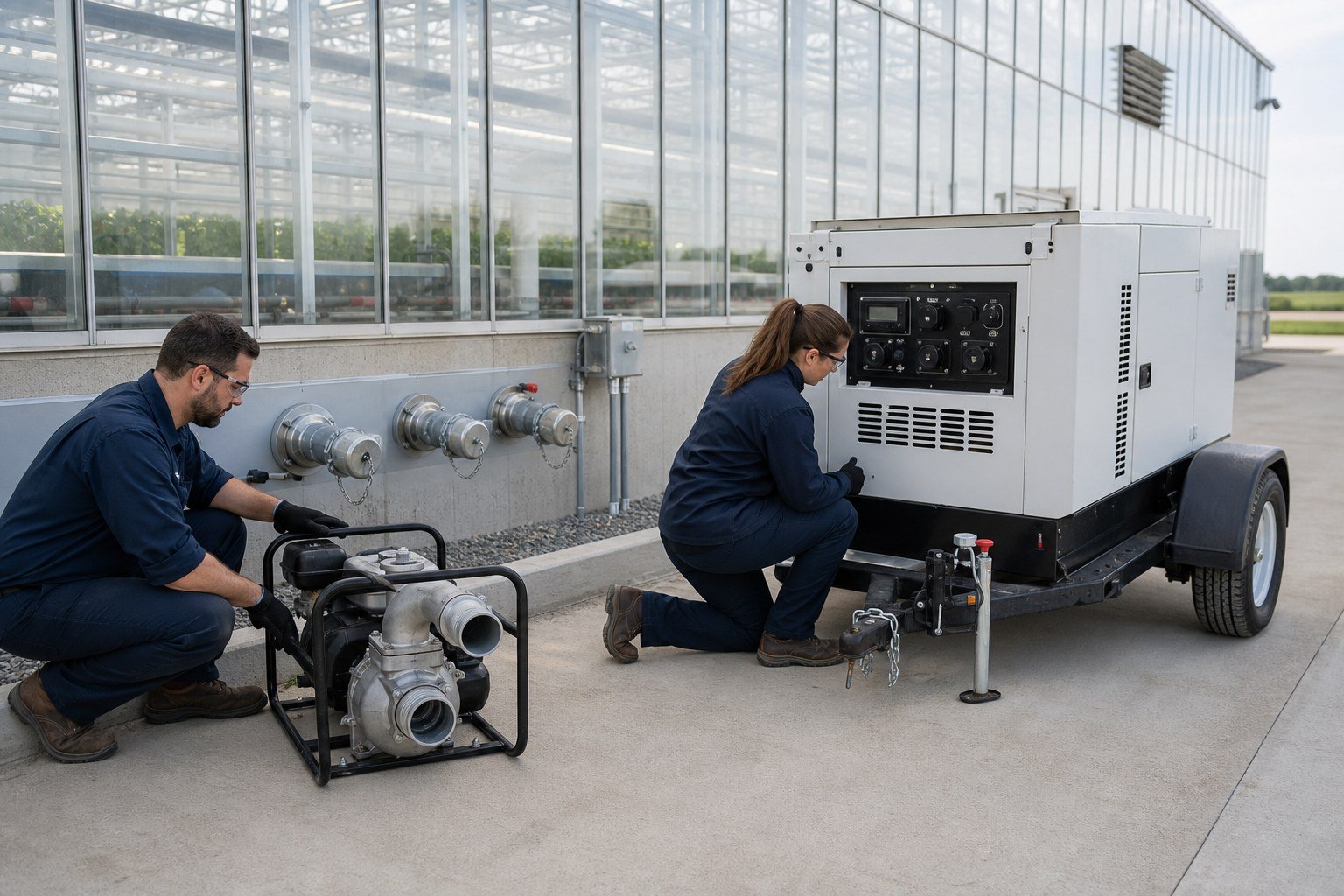
Build the plan service by service, not from a shopping list. For each critical fan, pump, heater, controller, film-inflation blower, water-treatment stage or communications system, record the required duty, starting demand, fluid or air characteristics, connection type, controls interface, access route, setup time, fuel or consumables, operating supervision and safe stop condition. Then choose one of four responses: hold a tested spare onsite, reserve compatible rental equipment under a written agreement, maintain a repair exchange arrangement, or accept a defined outage and crop consequence. Before relying on rental equipment, confirm that it can be delivered during the same weather event that caused the failure, that the site has a safe prepared connection, and that a qualified person can install and release it. A phone number for a rental company is not a contingency plan.
Greenhouse equipment is highly coupled. A temporary generator may have enough running power but still fail to start a motor, feed the wrong voltage, omit control power or leave film inflation unsupported. A pump may have the right pipe diameter but the wrong flow, pressure, water compatibility, suction arrangement or control signal. A portable heater can create combustion, clearance, moisture and air-quality hazards if the building was never designed for it.
Decide what must work before selecting the machine. The grower should define the crop service and maximum tolerable interruption for the actual season. Maintenance should define the technical duty and connection. Safety and qualified specialists should define where temporary equipment may sit, how it is isolated, protected and supervised. Procurement should secure availability, delivery, callout, fuel and replacement terms. The acceptance test must prove the complete temporary arrangement, not simply that the rented engine starts.
This guide is an operating-control framework. The approved design, crop plan, product labels, manufacturer instructions, site safety procedures, local law and directions from competent local professionals govern the actual work.
What the buyer should control
| Control point | Required record or action | Release evidence |
|---|---|---|
| Protected service | Name the crop zone, safety function or utility that needs support and the season or operating state in which it matters. | Approved service-priority entry linked to the business-continuity plan. |
| Required duty | Record voltage, phase, starting and running demand, flow, pressure, temperature, fuel, water quality, control signal and expected runtime as applicable. | Reviewed duty sheet based on current equipment and measured operating data. |
| Compatibility | Specify connectors, hose or cable length, adapters, control interface, grounding, ventilation, weather protection and physical footprint. | Connection drawing, photographs and compatibility check signed by the competent discipline. |
| Access and logistics | Check delivery vehicle route, gate width, turning space, ground bearing, lifting need, unloading point, security and severe-weather restrictions. | Trial route or documented access survey with an alternate delivery plan. |
| Supplier commitment | Record stock location, callout number, response hours, reservation priority, transport, substitutions, breakdown support and cancellation terms. | Current written agreement and a successful contact test outside normal office hours. |
| Installation and operation | Name who may isolate, connect, commission, fuel, monitor and remove the unit. Provide permits and equipment-specific instructions. | Qualified-person roster, approved method statement, permits and shift log. |
| Acceptance and return | Test the protected load, alarms, controls, runtime, leakage, exhaust, noise, restart and safe return to the permanent system. | Recorded functional test, operating limits, defect list and restoration release. |
Every open item needs an owner, due date, status and effect on safety, production, cost and recovery time. A note that something was discussed or is being handled does not prove closure.
A practical workflow
1. Start with the crop consequence
List the services whose loss can harm people, damage the structure, lose propagation material or make a crop unsaleable. Record how the consequence changes by month, weather, crop stage and occupied area. This prevents an expensive rental plan from protecting the wrong load.
2. Capture the real equipment duty
Use nameplates only as a starting point. Review drawings, settings, logged demand, pump curves, valve positions, water chemistry and actual simultaneous operation. Include starting conditions and controls power. Ask the original supplier to clarify interfaces that are not documented.
3. Prepare connection points before the incident
A qualified designer should decide whether permanent transfer equipment, bypass pipework, isolation valves, capped hose points or control provisions are justified. Label and protect them through the site's approved system. Never plan to improvise around guards, interlocks or electrical protection during an outage.
4. Test the supply chain
Call the provider during an exercise. Ask which exact unit would ship, from which depot, with which accessories and operator support. Check weekend, holiday and regional-event availability. Record what happens if the reserved model is unavailable and who approves a substitute.
5. Run a controlled deployment drill
Without creating a live hazard, rehearse site access, unloading position, documentation, isolation sequence, connector inspection, communications and acceptance records. Qualified personnel should conduct any live connection or load test under an approved procedure.
6. Control degraded operation
Issue a time-limited operating sheet stating the supported loads, excluded loads, inspection frequency, fuel or consumable status, weather limit, staffing need and stop condition. Make it visible at the equipment and in the control room.
7. Restore and learn
After the permanent system is repaired, plan the transfer back, inspect for damage, reconcile fuel and rental records, close temporary permits and capture setup problems. Update connection photographs and the supplier agreement before declaring the plan ready again.
Preserve the event sequence and earlier versions of records. The team should be able to reconstruct what was observed, which condition applied, who decided, what changed, how the result was tested and which limitation remained.
Who owns each decision
Grower
Defines which crop services matter now, acceptable interruption and the production areas that may be suspended. The grower cannot approve unsafe temporary work.
Maintenance and engineering
Defines duty and interfaces, prepares records, coordinates qualified installation and verifies that temporary equipment performs under the required load.
Procurement and logistics
Secures the exact supply terms, delivery route, accessories, fuel, callout and replacement support. It keeps alternate providers current.
Incident lead
Controls access, authorizes degraded operation within approved limits, keeps the event log and stops the arrangement if safety or operating conditions change.
Release evidence before the next step
Do not release temporary equipment for crop protection because it arrived or started. The responsible qualified person must accept its installation and protection, maintenance must verify the intended service and controls, the grower must accept the supported production scope, and the incident lead must record operating limits, monitoring and stop conditions. Return to the permanent system only through an approved transfer and post-repair test.
Common failure modes
| Failure | Buyer response |
|---|---|
| The rental unit is selected by headline capacity | Check starting demand, duty point, interfaces, derating, simultaneous loads and operating environment rather than one nominal number. |
| Adapters will be found during the emergency | Prepare and control compatible connection hardware in advance, or state that the service is not recoverable by rental equipment. |
| Delivery time ignores a regional event | Ask where stock is held and what priority applies when many customers need the same equipment. |
| Temporary operation has no time limit | Set review intervals, fuel checks, staffed monitoring and a clear stop condition for the degraded arrangement. |
| The test ends when the engine runs | Test the protected process, controls, alarms, restart behavior, leakage and the transfer back to normal operation. |
| Portable equipment bypasses site safeguards | Require approved isolation, protection, ventilation, clearances and qualified work. Crop urgency does not authorize a bypass. |
Buyer decision questions
Which single failure would create the largest crop loss before a normal repair could arrive? What exact service duty must the substitute meet? Which model and accessories can the supplier deliver at 02:00 during a regional storm? Can the delivery vehicle reach the connection point? Who is legally and technically qualified to connect it? Which loads must remain excluded? What evidence proves that the temporary arrangement is stable, and what condition requires it to stop?
Keep these decisions connected to the power outage load priority checklist, the backup generator readiness guide, the maintenance spare parts plan. The emergency plan, equipment evidence and crop plan should describe the same operating reality.
Frequently asked questions
Should every critical machine have a complete onsite spare?
No. Compare failure consequence, repair time, component availability, rental response, storage, maintenance burden and the ability to operate a smaller safe production area.
Is a generator connector enough to claim rental readiness?
No. Confirm transfer and protection, voltage and phase, starting demand, grounding, controls power, cable route, weather exposure, fuel, qualified installation and a functional load test.
Can a different pump with the same pipe size be used?
Pipe size alone does not prove compatibility. Review duty point, suction conditions, materials, water quality, motor supply, controls, seals and temporary hose losses.
How often should the plan be tested?
Use a risk-based schedule and retest after equipment, crop, utility, connection, supplier or access changes. Contact and availability checks can be more frequent than live deployment tests.
What documents should travel with the rented unit?
Keep the approved method, inspection and acceptance forms, duty sheet, connection drawing, operating limits, emergency contacts, fuel or consumable log and return-to-normal record.
Turn the requirement into a controlled deliverable
Send Chengfei Greenhouse the current equipment list, control drawings, crop priorities, utility information and proposed backup concept. We can clarify interfaces for the systems we supplied while the owner, rental provider and qualified local professionals approve the temporary installation and operating plan.
Contact Chengfei Greenhouse