

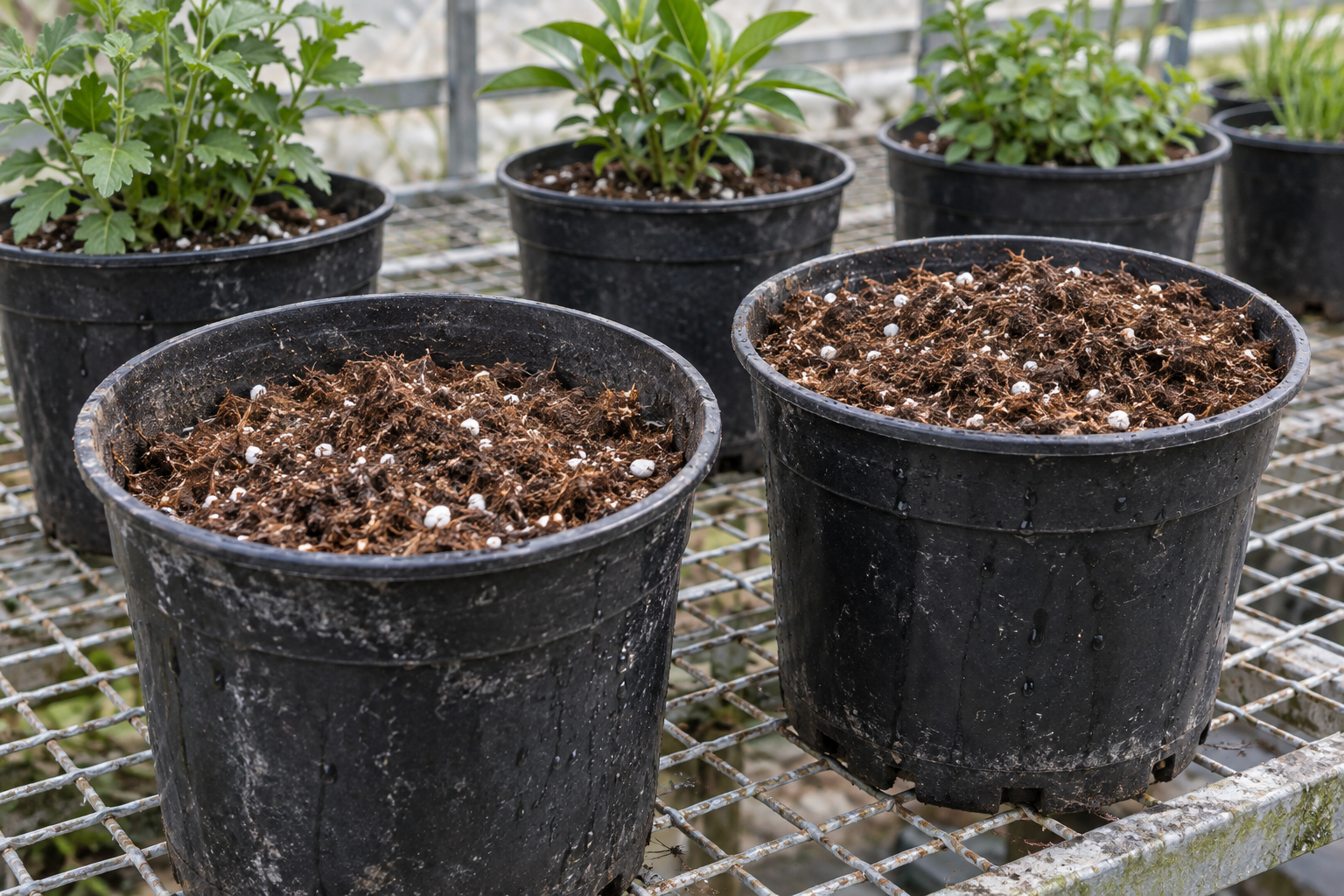
Water leaving the bottom of a pot does not prove that its root ball is evenly wet. When peat-based media have dried severely or wet unevenly, water may pass through a limited part of the container while a dry core remains. Inspect inside a few representative pots before lengthening irrigation across the whole bench.
This investigation starts after you have established that water reaches the affected pots. If emitters are blocked or delivery varies across the crop, begin with the greenhouse irrigation audit. A delivery fault and a rewetting problem can coexist, but they require different corrections.
Contents
Look beneath the dark surface
Select a few affected pots and apparently normal pots of the same size and crop stage. Compare their weight, then gently slide out a root ball where the plant and container allow it. A sacrificial sample may be worthwhile if the crop cannot be removed intact. Look for a wet outer band, dry central material or water following a gap along the pot wall.
UMass recommends combining container weight with direct examination of the root ball when deciding whether greenhouse crops need water. Surface color alone can be misleading. Root condition matters too: a plant in saturated media with damaged roots needs a different response from one surrounded by dry material. UMass: Hand Watering Greenhouse Crops
Write down what you find before another watering obscures the pattern. Include substrate batch, pot size, location and the time since the previous irrigation.
Why a familiar mix may stop wetting evenly
Peat contains organic compounds that can resist wetting. Commercial mixes commonly include a wetting agent to improve water distribution, but its performance can decline during storage. Premier Tech, a growing-media manufacturer, describes uneven wetting in aged media and notes that heat accelerates wetting-agent breakdown. These observations explain a possible mechanism; they do not establish the shelf life of every substrate on the market. Premier Tech: Substrate Handling Influences Water-Holding Capacity
Review the bag or bale label, batch age, storage conditions and whether the problem began after a mix change. Keep a sample of unused material from the same batch if available. If only one bench is affected, compare how it was filled and watered with benches that remain normal.
Recover a small group before changing the whole crop
Move a manageable set of representative pots into a clearly identified trial group. Apply water gently so the surface is not washed out. Allow time for absorption, then inspect the moisture distribution again. UMass cautions that forceful watering can damage the media surface and recommends suitable watering equipment and attention to individual containers. UMass: Hand Watering Greenhouse Crops
If the core still repels water, contact the substrate supplier about a wetting agent approved for the crop, mix and irrigation system. Use its label and application instructions. Household detergent is not a substitute with known crop compatibility. Premier Tech describes supplemental wetting agents as a way to improve rewetting; product choice and dose require the actual product instructions. Premier Tech technical guidance
Keep an untreated comparison where doing so will not cause avoidable crop loss. The useful observations are whether moisture reaches the previously dry area, whether pots drain normally and how the plants respond. Clear runoff alone does not answer any of those questions.
Return to irrigation by crop need
Once the root ball wets evenly, resume a schedule based on the crop and container's actual drying pattern. Leaving a recovery treatment in place indefinitely may overwater the pots that were already wetting normally.
For subsequent batches, record initial wet-up alongside substrate handling and storage. A brief inspection before planting can reveal uneven moisture while the material is still easy to handle. Rewetting a dry mix is a manageable task; discovering it only after roots occupy hundreds of pots makes the same task much harder.
Published: 2026-10-06


 Click to Chat