
The short answer
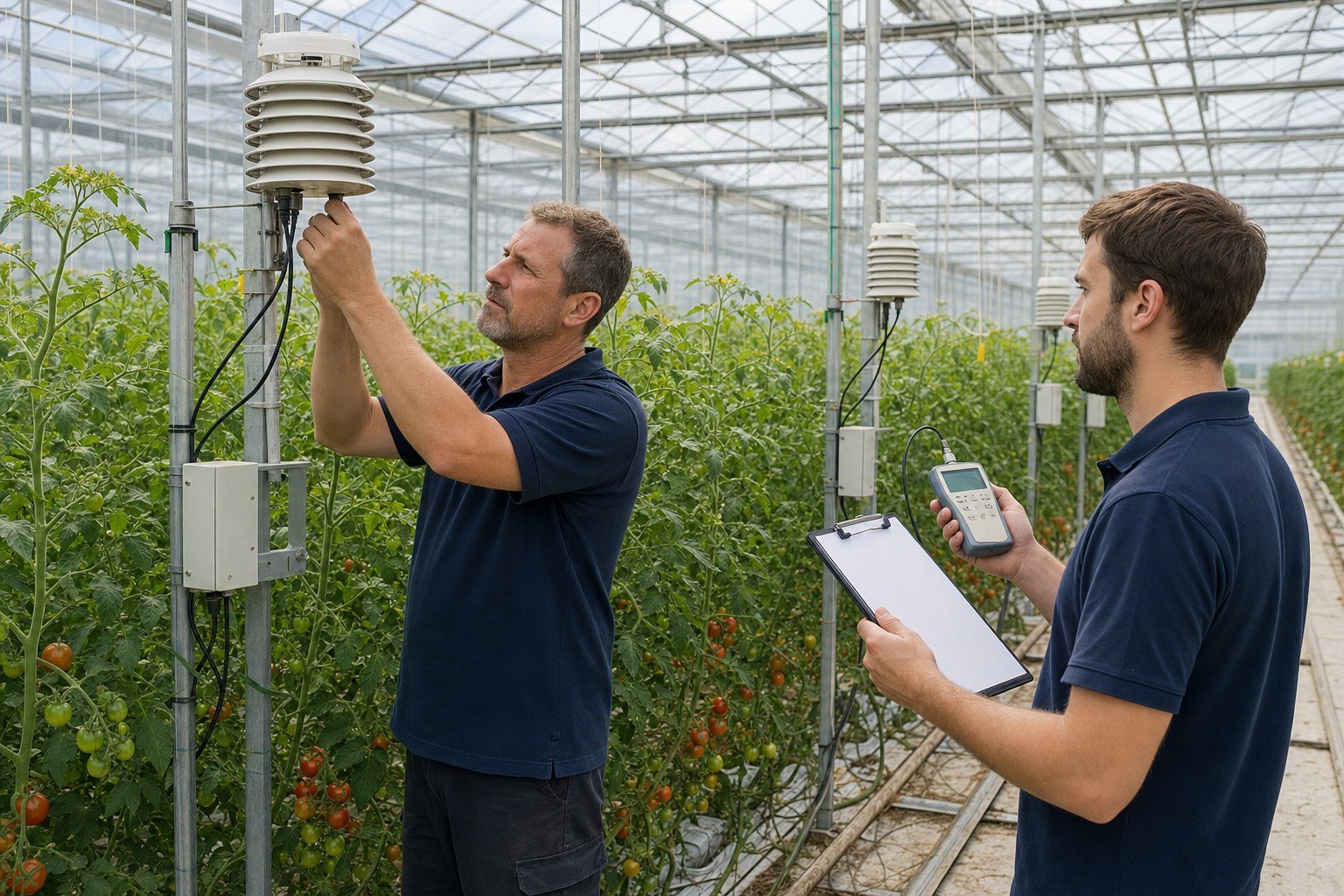
Define control zones first, then place protected and preferably aspirated temperature and humidity sensors at representative crop-canopy height in each zone. Keep them away from direct solar radiation, heaters, cooling pads, fan discharge, doors, vents, wet surfaces, and stagnant corners. Give every sensor a unique tag, location drawing, expected range, accuracy requirement, calibration method, interval, alarm behavior, spare strategy, and acceptance record.
The controller does not know whether a number is representative. It will open vents, start heat, operate cooling, or raise an alarm based on the measurement it receives. A precise sensor in the wrong place can therefore create worse control than a modest sensor in a well-chosen location.
Zone boundaries should follow real differences in crop, structure, equipment, solar exposure, irrigation, and operating schedule. One sensor in the middle of a large range may hide a hot end, a cold perimeter, or a humid bay. Adding sensors without defining how the controller will use them can create a different problem: conflicting signals with no agreed priority.
This planning guide supports procurement and coordination. Project-specific values and safety decisions remain with the grower, qualified designers, equipment manufacturers, contractors, and authorities responsible for the installation.
Inputs that should be fixed before supplier selection
| Input group | Record | Decision supported |
|---|---|---|
| Zone definition | Greenhouse span, crop block, control equipment, exposure, operating mode, and representative point. | Prevents one reading from being treated as valid for unlike areas. |
| Physical placement | Height relative to canopy, horizontal coordinates, distance from heat, vents, pads, fans, doors, pipes, lighting, and wet work. | Reduces local bias and makes the point repeatable. |
| Sensor assembly | Measured variables, stated accuracy, response time, shielding, aspiration, cable, enclosure, condensation protection, and service access. | Connects the instrument specification to greenhouse conditions. |
| Verification | Reference instrument, comparison points, stabilization time, allowable error, adjustment method, date, technician, and result. | Creates evidence that the installed channel is usable. |
| Lifecycle | Cleaning, calibration interval, drift limit, spare probe, replacement life, configuration backup, and record location. | Keeps the control point reliable after handover. |
Identify each provisional item and the date by which it must be closed. A supplier can offer alternatives, but each alternative should state which input changed and how that change affects capacity, layout, utilities, controls, maintenance, and price.
A practical design and review sequence
1. Map conditions before fixing locations
Mark crops, benches, screens, heating circuits, ventilation openings, fans, pad walls, lighting, doors, partitions, and external exposures. Identify places likely to behave differently during a cold night, hot afternoon, irrigation event, screen movement, or equipment failure. Select a representative point for each control zone and separate independent monitoring points from the sensor used for control.
2. Specify the installation, not only the probe
State whether the air sensor needs an aspirated housing, the airflow direction through that housing, mounting height, service clearance, cable route, enclosure rating, and protection from water and chemical exposure. Plan how height will be adjusted as the crop grows. A sensor left below a mature canopy may describe a different microclimate from the growing point.
3. Compare the complete measuring channel
Calibration should include the installed probe, transmitter, input channel, scaling, software value, and displayed units. Place a suitable reference close to the sensor without touching it, allow both to stabilize, and compare at more than one representative condition when practical. Record as-found and as-left values instead of simply writing pass.
4. Prove control and alarm behavior
A correct displayed value is only one part of acceptance. Simulate or safely create conditions around the decision thresholds. Confirm equipment stages in the intended order, heating and cooling do not overlap incorrectly, limits stop unsafe movement, alarms reach the assigned recipient, and loss of signal produces the agreed safe response.
Keep the assumptions with the calculation or equipment schedule. When the crop plan, source condition, greenhouse geometry, or operating sequence changes, the responsible designer can then identify which result must be recalculated instead of relying on an obsolete approval.
Divide responsibilities at the interfaces
Owner and grower
Provide crop, operating hours, acceptable risk, local practices, staff capability, utilities, expansion plan, and approval priorities.
Greenhouse supplier
Provide structure, envelope, equipment, layout, loading, utility, control, installation, and commissioning interface data within the contracted scope.
Specialist designer
Apply local climate, codes, calculation methods, safety duties, equipment selection, system integration, and professional approval.
Contractor and operator
Confirm site conditions, installation, access, testing, records, training, safe operation, inspection, and maintenance.
Use a responsibility matrix for supply, design, installation, power, water, drainage, controls, network, civil works, testing, permits, consumables, spares, training, and warranty response. Phrases such as complete system are not enough when the interfaces cross several contracts.
Common specification failures
| Failure | Why it matters and what to do |
|---|---|
| Direct radiation | Sunlight or a nearby hot pipe warms the sensing body, so the reported air temperature is too high. Use shielding and aspiration, then verify at the installed location. |
| Localized airflow | A sensor near a pad, door, fan, heater outlet, vent, or draft reports that local stream rather than the crop zone. Move the point or define it as a specific equipment-monitoring sensor. |
| Condensation and contamination | Near-saturation air, spray, dust, fertilizer residue, and cleaning chemicals can change response or shorten probe life. Select protection that does not stop representative airflow and include cleaning in maintenance. |
| Uncontrolled replacement | A new probe with different scaling, range, or response is fitted without updating the controller. Require compatible parts, configuration records, and a post-replacement channel check. |
Record every accepted deviation. A verbal clarification during a meeting should be transferred to the controlled drawing, schedule, calculation, or specification that governs manufacture and site work.
Plan acceptance before equipment is ordered
Agree on document review, factory checks where appropriate, delivery inspection, installation inspection, pre-start checks, calibration, functional tests, representative operating tests, abnormal-mode tests, training, and handover. State the instruments, conditions, tolerances, data format, witnesses, and corrective-action process.
Use the greenhouse commissioning checklist to connect design intent to field evidence. Where continuity matters, coordinate power, alarms, operator response, and recovery through the backup power and alarm planning. Keep final settings, test results, and approved changes with the equipment record so maintenance staff have a usable baseline.
Acceptance is not a substitute for ongoing observation. Trend the measurements that reveal deterioration, compare them with the commissioned condition, and define who investigates a sustained change. This is particularly important where crop damage can begin before a component reaches complete failure.
Questions the project team should answer
Which zones are independently controlled? Which crop height is representative today and after growth? What conditions can bias each point? What accuracy is required for control rather than general monitoring? Which reference is used, who owns it, and how is traceability recorded? What is the response to an implausible value, communication loss, power loss, or two sensors that disagree? Who moves, cleans, checks, and replaces each sensor?
Frequently asked questions
How many climate sensors does a greenhouse need?
There is no reliable area-only rule. Use at least one representative control point for each genuinely separate climate zone, then add independent monitoring where crop risk or verification justifies it. Zones are defined by crop and equipment behavior, not by sensor convenience.
Should the temperature sensor be mounted above the crop?
Place it at or near the part of the canopy whose air conditions the control system must manage. The mounting should be adjustable as the crop changes. Shield it from radiation and use aspiration where accurate air measurement is required.
Is factory calibration enough?
Factory calibration does not prove the installed channel, scaling, location, wiring, controller value, and control response. Commission the complete point after installation and keep periodic comparison records.
Can one sensor control heating and cooling?
It can when the zone and control strategy support that arrangement, but the staging and dead band must be reviewed so heating and cooling do not operate against each other. Critical systems may also need an independent limit or alarm sensor.
Prepare the input schedule before requesting a fixed offer
Send the greenhouse zoning plan, crop heights, equipment locations, control sequence, required variables, local climate, alarm priorities, and maintenance capability. Chengfei Greenhouse can coordinate greenhouse sensor locations and interfaces with the project controls and commissioning teams.
Contact Chengfei GreenhouseReferences
- Dealing with the High Cost of Energy for Greenhouse Operations. Dealing with the High Cost of Energy for Greenhouse Operations.
- Controlling the Greenhouse Environment. Controlling the Greenhouse Environment.
- Heating Greenhouses. Heating Greenhouses.