
The most useful pots-per-bale figure comes from a representative, reconciled filling result for the exact substrate, container, incoming plant and accepted fill process. The outside dimensions of a compressed package cannot supply that number. Nor should every compressed product be assigned the same expansion multiplier.
Before ordering, separate the supplier's quantity declaration from the output your filling process actually produces. Use each number for the question it can answer.
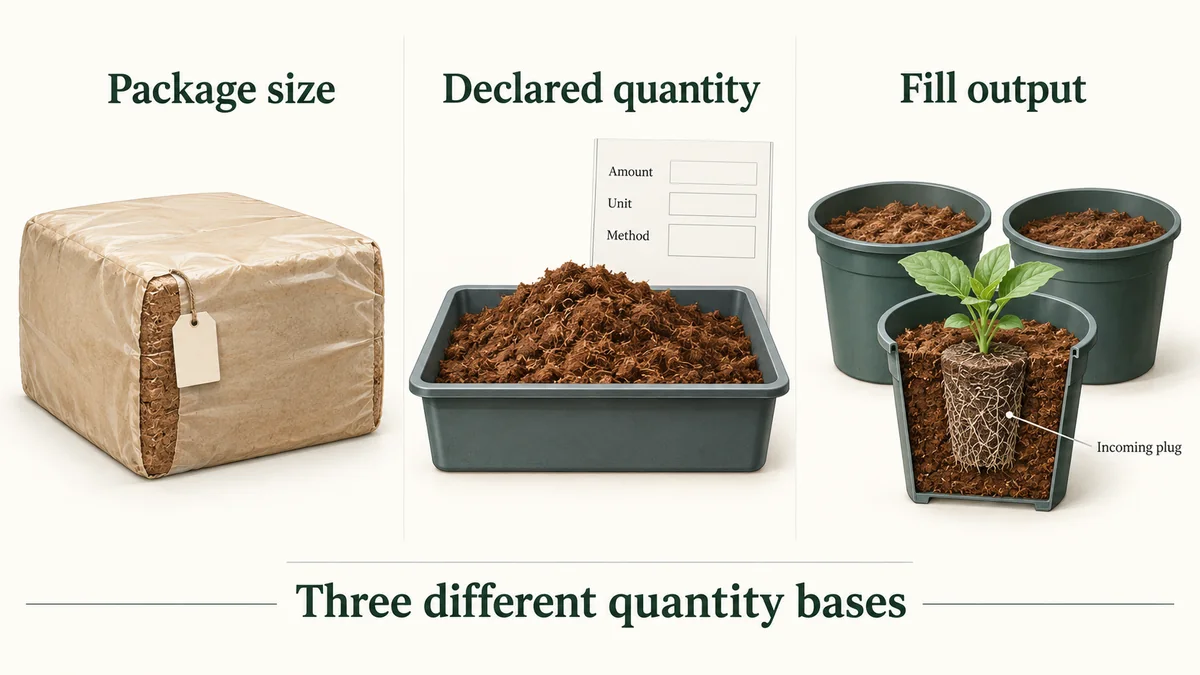
Keep package size, declared quantity and fill output separate
| Quantity basis | Useful purchasing question | Limit |
|---|---|---|
| Physical shipping/package size | What must be transported and handled? | Does not independently establish declared loose quantity |
| Supplier-declared substrate amount | What amount, unit and measurement method are offered? | Does not specify output for every potting process |
| Acceptably filled pots per package | What did this defined production process produce? | Applies only to represented conditions |
Sun Gro offers compressed and loose-fill formats within its professional Sunshine product family. That confirms why the form of supply belongs on an order; it does not establish a universal relationship between exterior package size and usable output.
Klasmann-Deilmann's January 2018 Easy Growing brochure, printed page 9, describes volume reporting under EN 12580 and identifies factors affecting pot consumption. This is a named manufacturer's historical explanation. Confirm the current order's declared quantity and method rather than treating the brochure as a current independent reading of the standard.
Why the same package can fill a different number of pots
The exact pot geometry and intended fill level determine the space being filled. An incoming plug or root ball occupies some of that space. Moisture condition and packing during the accepted filling process can also change consumption. A pots-per-package result without those conditions leaves the next buyer guessing what was counted.
Sun Gro's potting calculator and tables present a real bag-to-container planning question and caution that estimates vary with the pot manufacturer and handling. No result from that calculator is used here.
Increasing the apparent volume through more aggressive processing is not a free productivity gain. Premier Tech's substrate-handling article explains how particle damage changes physical properties. Preserve the approved preparation and root-zone condition. Do not keep processing or lighten the fill simply to hit an advertised pot count.
Reconcile a run before using its output rate
Identify full packages used, accepted pots produced and material still available. Keep usable leftovers separate from spills or material rejected during rework. Otherwise, a low apparent output may reflect unfinished material rather than irreversible loss.
For a repeatable purchasing observation, use a representative run with a clear start and finish and the same accepted filling method. If meaningful leftovers remain, close or explicitly account for that boundary before treating the simple pots-per-complete-package ratio as transferable.
This accounting does not certify legal quantity compliance. A suspected discrepancy in declared quantity needs its own supplier and applicable measurement review; an exterior bag measurement alone is not evidence of a shortage.
Five packages, six hundred pots, then a larger order
In an invented trial, five complete packages produce 600 acceptably filled pots under one defined process. Leftovers and losses have already been reconciled, so the example's package-to-output boundary is closed.
The observed rate is 600 ÷ 5 = 120 pots per package. For a later 1,000-pot run under unchanged conditions, 1,000 ÷ 120 = 8.333… packages, approximately 8.33. If purchasing whole packages, round upward to nine packages before any separately justified reserve.
The ninth package follows from whole-package rounding. It is not a measured loss allowance. If a reserve is needed, document its reason and quantity separately rather than adding an unexplained percentage or rounding twice.
Change the pot, incoming root-ball size or filling process and the 120 figure needs renewed evidence. It is neither a guaranteed output for future lots nor a claim about a named supplier's volume.
Download the package-to-pot reconciliation
Download the package-to-pot worksheet (CSV). It contains formulas for the bounded observed rate and whole-package planning, plus manual fields for the quantity declaration and filling conditions. Import as UTF-8, comma-separated text with formulas enabled. Keep row order unchanged. Fill the blank “Your case” inputs, use an explicit zero if no additional whole-package reserve is planned, and leave calculated rows intact. Do not use the ratio until leftovers and losses are reconciled. Adjust wrapping and save a native spreadsheet copy.
Bring the conditions and reconciliation to the supplier when discussing the next order. For the separate effect of pot geometry on root-zone behaviour, see container height and water–air balance.