
The substrate worked in a tall nursery pot, so it should work in a shallow tray. That assumption can leave the next crop wetter around its roots even when the substrate supplier and irrigation water have not changed.
Container height influences the balance between water-filled and air-filled pores after drainage. Evaluate the pot, substrate and irrigation method together. Choosing by liters alone misses a physical difference that can change how the root zone behaves.
Why the same mix behaves differently
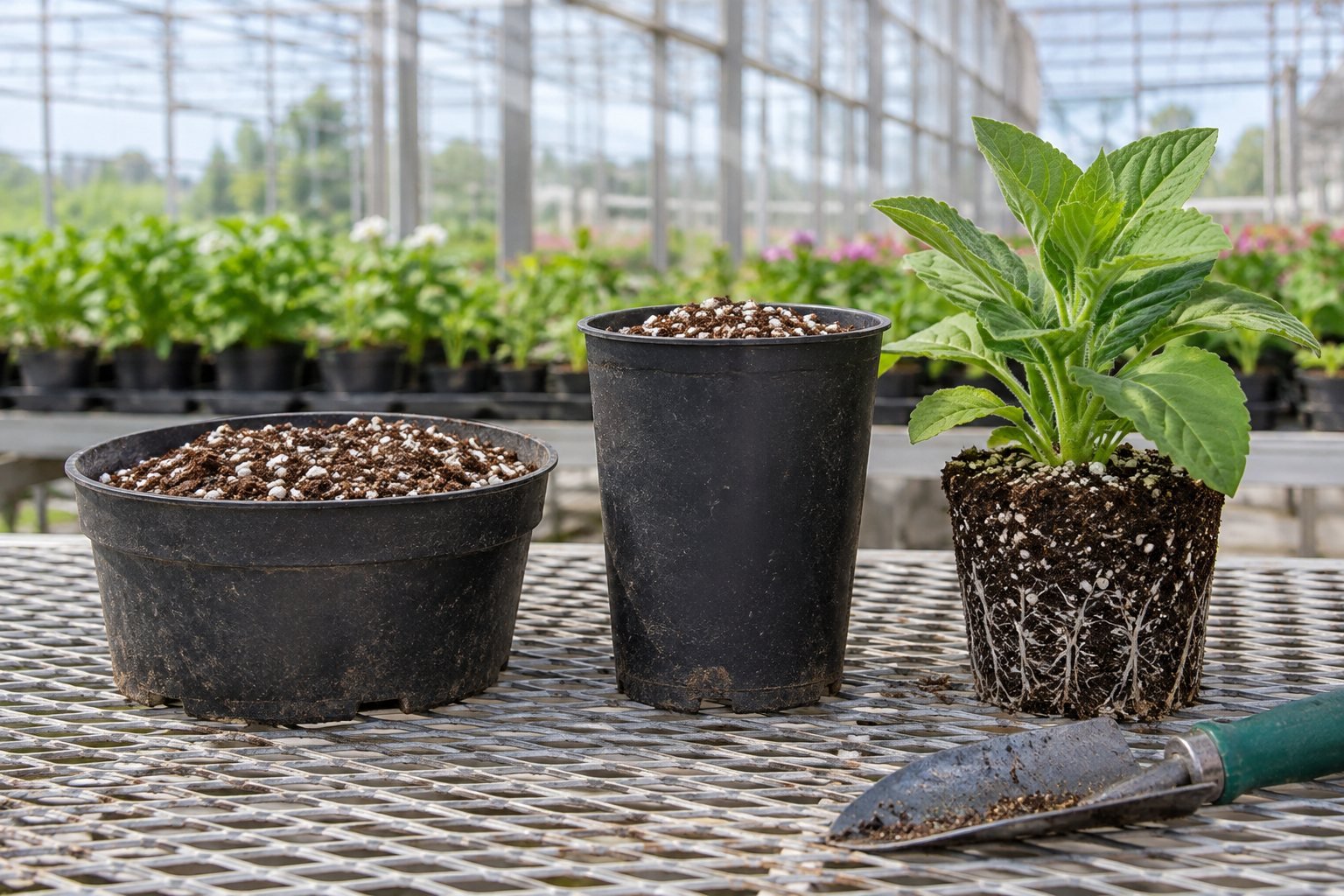
Water held in small pores does not all drain out when irrigation stops. The balance between capillary retention and gravity depends partly on the height of the substrate column. University of Arkansas substrate guidance explains that the same substrate generally has a higher water-filled fraction and lower air-filled fraction in a shorter container after drainage. Its numerical examples are tied to specific mixes and containers, not universal specifications.
This does not mean that a tall pot is always better. It may have different stability, irrigation coverage, handling and crop-support requirements. Nor does retained water equal water that the plant can readily use. The decision is whether the complete system supports the crop through an irrigation cycle.
Compare geometry before changing the recipe
| Record for each candidate | Why it matters | Check under production conditions |
|---|---|---|
| Filled substrate height and internal shape | Nominal volume does not describe the vertical water distribution | Measure the actual fill depth, not the exterior rim height |
| Drain opening position and support surface | A pot standing in retained water is not freely draining | Inspect the bench, gutter or floor after an event |
| Mix, packing and pre-wetting | Compaction and uneven wetting can confound a container comparison | Use the same prepared batch and filling method |
| Emitter or flood contact arrangement | Water must reach the intended root volume | Observe wetting and drainage at several positions |
A small comparison that can answer a practical question
Set up several pots of each candidate shape with the same substrate batch and a documented filling method. Place examples across representative bench positions rather than putting every tall pot near the fan. Apply the intended irrigation method and record the event volume or flood cycle, drainage period and container mass at repeatable times.
For an illustrative weighing check, a pot that loses 0.4 kg between two measurements has lost approximately 0.4 L of water if changes in plant mass and other material are negligible. That does not identify whether the water left through drainage, evaporation or transpiration; record when drainage ends and interpret the interval accordingly. It also does not measure air-filled porosity. A substrate laboratory can provide a controlled physical-property assessment.
Follow root distribution and crop response as well as container mass. A healthy-looking top at the end of one afternoon cannot establish that a new pot is suitable for a full crop cycle.
Do not correct every wet pot by shortening all irrigation
If only one bench stays wet, inspect slope, blocked outlets and standing water first. If every new shallow container dries more slowly than the previous tall format, the container change becomes a plausible contributor. If individual pots vary widely, check emitter delivery and filling consistency before blaming geometry.
A house-wide timer adjustment can make the already dry containers worse. Where formats or crop stages have different water-use patterns, separate irrigation management may be more useful than searching for one compromise schedule.
Specify the growing system as a combination
For a quotation, provide the actual container dimensions, filled height, wet operating mass, substrate specification and intended irrigation method. Ask how the support system permits drainage and access for inspection. A bench selected only for nominal pot count can overlook both wet load and the route by which water leaves the crop.
The hydroponic system comparison covers broader production choices. Before expanding a container-based CFGET layout, use a small comparison to establish whether the proposed pot and substrate combination works with your irrigation and handling process. Record the result as local evidence, not a universal container ranking.