
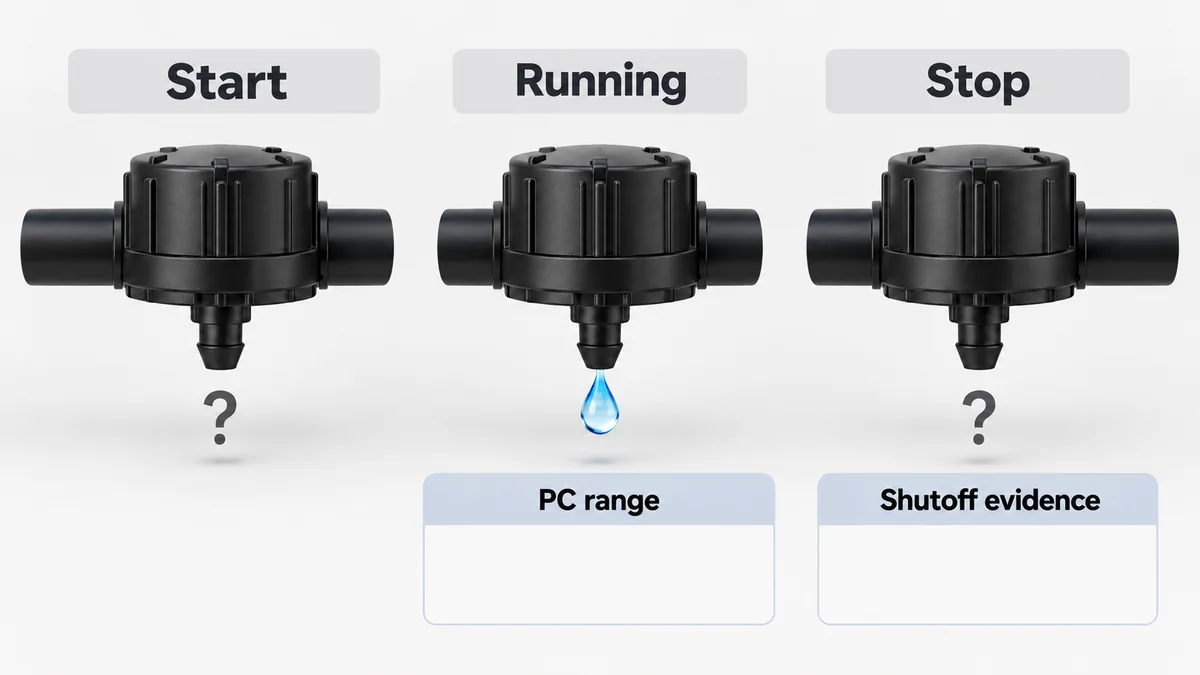
A pressure-compensating dripper and an anti-drain dripper describe different functions. Pressure compensation regulates discharge within the model’s stated running range. Anti-drain or non-leakage features concern what happens as pressure rises at startup and falls at shutdown. A product may combine both, but the letters PC alone do not establish that it does.
Compare start, established running and stop as three separate states. Before accepting a replacement with the same nominal flow, ask whether its full pressure and outlet-assembly specification fits the hydraulic design of the actual zone.
Separate running regulation from start and stop
Grodan’s January 2024 dripper comparison distinguishes pressure compensation, anti-drain designations such as CNL or ND, and self-flushing. These labels should lead to different questions. The compensation range describes established operation. Opening and closing behavior describe transitions. Self-flushing is another product feature, not evidence that all of those functions are present.
| State | Question for the offered model | What a flow label cannot establish |
|---|---|---|
| Pressure rising at start | What opening behavior and threshold does the manufacturer specify? | When this emitter begins delivering in the actual zone |
| Established running | What published pressure range supports the nominal discharge? | Equivalent regulation outside that range |
| Pressure falling at stop | Is a shutoff function provided, and what closing threshold is specified? | Whether or when drainage stops |
Do not substitute the lower end of a running range for an opening or closing threshold unless the manufacturer explicitly defines that relationship. Those entries can describe different events. A blank threshold field is an unanswered question, not a zero-pressure value.
Read an actual CNL and non-CNL comparison
The Netafim USA pressure-compensating dripper page, checked October 3, 2026, lists recommended operating pressure separately for PC/WPC non-CNL products and WPC with CNL. The CNL entry also supplies a shutoff, or closing-pressure, specification. The public entries therefore distinguish a running range from an additional stop-state property.
The useful lesson is how to read the fields, not which listed pressure to set on a greenhouse regulator. Obtain the current specification for the exact regional product code. Ask the designer to connect that specification with the intended zone’s pressures and elevations.
Netafim’s separate PCJ product page similarly lists pressure compensation and an anti-drain mechanism as separate features. It also describes a spider assembly feeding multiple outlets. That makes the component boundary important: an emitter’s nominal flow should not be confused with an unsupported flow claim for every downstream stake.
Follow the product code through the outlet assembly
Imagine a hypothetical replacement quotation for one irrigation zone. Both the original and proposed emitters have the same nominal litres-per-hour label and both are described as PC. The proposed sheet gives a compensation range, but its opening and closing behavior are absent. It also shows a different outlet arrangement.
The evidence supports only a partial comparison. Ask the supplier to identify whether the proposed model has an anti-drain function, provide any published transition specifications and identify the downstream assembly included in the offer. Then ask the irrigation designer which differences affect the zone. Equal flow labels have not established like-for-like start and stop behavior.
Suppose the missing information later arrives. The designer may now compare the two models against the same elevation and operating cases. That does not mean the model with a higher closing-pressure entry is automatically better. The relevant question is whether the complete component and assembly meet the requirements of the particular design.
Retain both the emitter code and the outlet or spider configuration in the order. A quotation that identifies only the visible stake can leave the regulating component unspecified. Conversely, a correct emitter code does not identify every downstream part.
Keep nearby functions separate
Anti-drain describes an emitter’s drainage or non-leakage function. It should not be treated as source-water backflow protection or assumed to provide every anti-siphon function. Ask for the actual function claimed by the manufacturer rather than extending a familiar abbreviation to a different duty.
Likewise, a self-flushing description does not remove the need to match filtration and water conditions to the offered equipment. Use the filtration and emitter-clogging guide for that separate review. This comparison concerns component behavior, not a substitute filtration specification or a new outlet-uniformity test.
Complete the three-state comparison before ordering
Download the emitter start/run/stop comparison. It is a manual worksheet with no pressure, flow or irrigation-dose formulas. Open it using UTF-8 and comma separation. Enter the exact models and assemblies first, then complete the three state rows from current manufacturer evidence.
Keep the compensation range, opening threshold and closing threshold in different cells, with their original units. Add the elevation case and hydraulic-design reference the designer actually assessed. End with the specific unresolved difference or the bounded written disposition. The worksheet does not authorize changing pressure settings, disassembling emitters or running a live irrigation test.