
A grow light that still switches on can deliver less photon output than it did when new. A long hour count may describe predicted output retention, the expected life of one component or something else entirely. It is not automatically a promise that the complete fixture will maintain the specified greenhouse light level for that period.
Translate a lifetime claim into a quantity, retained fraction, time and operating basis. Then examine abrupt failure and the warranty separately. This makes unlike quotations visible before their hour counts enter a lighting plan.
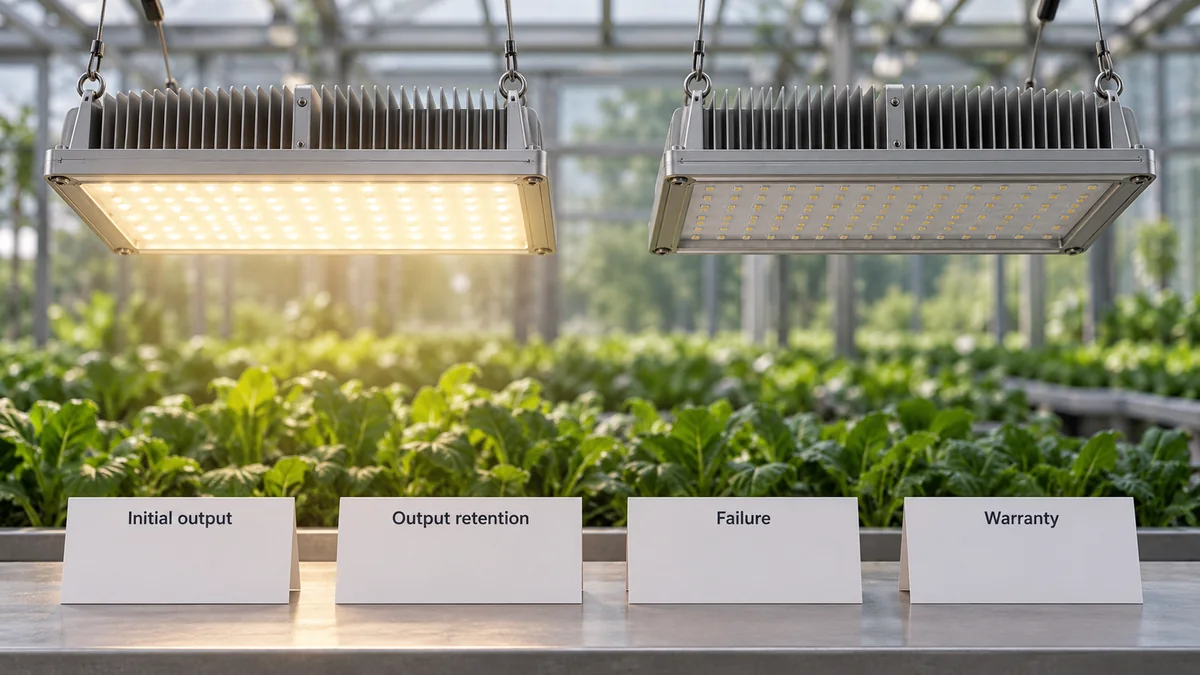
Translate the four different lifetime claims
| Claim | What to identify | What remains separate |
|---|---|---|
| Initial photon output | Measured quantity, wavelength band and operating conditions | How that output changes with use |
| Output retention | Retained fraction after stated hours and the projection basis | Whether the equipment stops functioning |
| Abrupt failure | Which failed products or components are counted and how | The light output of equipment still operating |
| Warranty | Covered event, term, conditions and contractual remedy | The measured or predicted performance itself |
Signify’s explanation of LED performance claims separates gradual photon-output change from the fraction of failed products. It also explains that manufacturers project longer-term behavior from shorter measurements. A projection should therefore identify the supporting test period and assumptions rather than presenting projected hours as hours already observed.
Ask how failures are handled in the specific retention claim. Do not assume a curve for surviving light sources also describes the complete population of installed fixtures. Likewise, an hour claim about an LED package does not automatically cover the fixture’s driver, optics or other components.
Read the quantity behind Q or L
The DesignLights Consortium’s horticultural V4.0 program provides one explicit framework. Its technical requirements, revised October 1, 2025, use Q for photon-based maintenance rather than the L convention associated with general-lighting lumen maintenance. They identify a 400–700 nm photosynthetic range and separate far-red reporting over 700–800 nm.
The policy also treats driver lifetime separately and requires the relevant projections at the maximum ambient temperature on the fixture specification. These are requirements of that qualification program, not universal greenhouse law or a guarantee of an individual product’s field performance.
If a horticultural quotation uses L90 wording, ask what the supplier has defined: lumens, photon flux or another quantity. Do not declare the product lumen-based or invalid from the letter alone. Conversely, Q90 without its defined band and conditions is still incomplete evidence. The number 90 needs a clearly stated quantity and reference output.
Compare two identical hour counts
Consider two invented quotations, each displaying 50,000 hours. Offer A explicitly projects retention of 90% of the fixture’s initial photosynthetic photon flux at a stated maximum ambient temperature. Offer B supplies only an LED-package lifetime and does not identify the measured quantity, temperature basis or driver coverage.
The hour counts match, but the claims cannot yet be ranked as equivalent. Offer A is more clearly defined; that alone does not validate its prediction. Ask for its supporting test duration, method and model-specific basis. Ask Offer B to define what the number covers and how it relates to the complete offered fixture.
The result might be two genuinely comparable retention claims, a documented difference in conditions, or one unresolved offer. It should not be a table that quietly places 50,000 beside 50,000 and awards them equal lifetime credit.
Keep drive-current and thermal assumptions attached to the exact model. A favorable result for a different operating condition or component is not a substitute for the offered configuration. If the greenhouse specification changes, identify whether the claim’s stated basis still covers it.
Do not turn retention into a replacement or crop rule
A retained-output fraction describes one lighting-performance input. It does not directly predict a yield fraction, set a universal replacement date or establish the best commercial response. The crop’s light requirement, daylight contribution, installed distribution and other constraints remain relevant.
For the same reason, avoid dividing a claimed lifetime by assumed daily hours and presenting the result as a guaranteed number of service years. Operating hours and calendar warranty terms are different records, and the stated thermal and operating assumptions still apply.
Once an assumption is accepted by the lighting designer, connect it to the existing greenhouse light-deficit calculation. Do not compensate for an uncertain claim by inventing additional lamp hours or an electrical modification.
Keep the warranty beside the evidence
Read the actual warranty for the offered fixture. What event is covered, what evidence is required and what remedy is provided? A replacement or other contractual remedy is not the same thing as a promise that no output loss or interruption will occur. Keep warranty questions visible even after the retention comparison is complete.
Download the grow-light lifetime-claim translator. This manual worksheet has no degradation or payback formula. Open it as UTF-8 comma-separated data, copy each claim’s exact wording and then identify its quantity, band, fraction, projected hours, tested hours and complete-fixture scope.
Use the final rows to request the missing evidence and record the lighting designer’s accepted assumption. A useful result is a claim that can be traced to the proposed equipment and conditions, with failure and warranty questions still handled on their own terms.