
Extending the lighting timer feels like a simple response to a dark week. It may work, or the installed lights may be too weak to close the daily deficit within the crop's suitable lighting period. Calculate the contribution before changing the schedule.
Daily light integral, or DLI, is the accumulated photosynthetically active light received per square meter in a day. PPFD describes the rate at a particular moment. A useful plan combines measured daylight inside the greenhouse with the contribution of the lamps, using a crop-appropriate target and photoperiod.
Convert a steady lamp reading into a daily contribution
For constant output, lamp DLI = PPFD x operating hours x 0.0036. PPFD is in micromoles per square meter per second; DLI is in moles per square meter per day. The factor converts seconds to hours and micromoles to moles.
Virginia Tech's introductory DLI guide explains this calculation and the need to account for greenhouse light transmission. When output is dimmed or daylight varies, sum the contributions over measured time intervals rather than treating one midday reading as a daily average.
Work through the deficit with explicit assumptions
Consider a hypothetical crop for which an adviser has selected a target DLI of 16. Measured daylight at crop level supplies 9, leaving a deficit of 7. These values demonstrate the calculation; they are not a recommended target for every lettuce or fruiting crop.
| Installed lamp PPFD | DLI supplied per hour | Hours to add 7 mol/m2 |
|---|---|---|
| 150 micromol/m2/s | 0.54 | About 13.0 hours |
| 250 micromol/m2/s | 0.90 | About 7.8 hours |
The lower-output installation needs much more operating time. If only eight hours are suitable for supplemental operation in the selected crop plan, it supplies 4.32, leaving 2.68 of the example deficit unmet. A longer timer is not an unlimited substitute for fixture capacity.
Use light measured where the crop receives it
An outdoor DLI estimate omits the effects of glazing, structure, screens, dirt and shading inside the house. If only outdoor data are available, identify transmission as an assumption and validate it with suitable crop-level measurements. Do not apply a universal percentage loss to every structure.
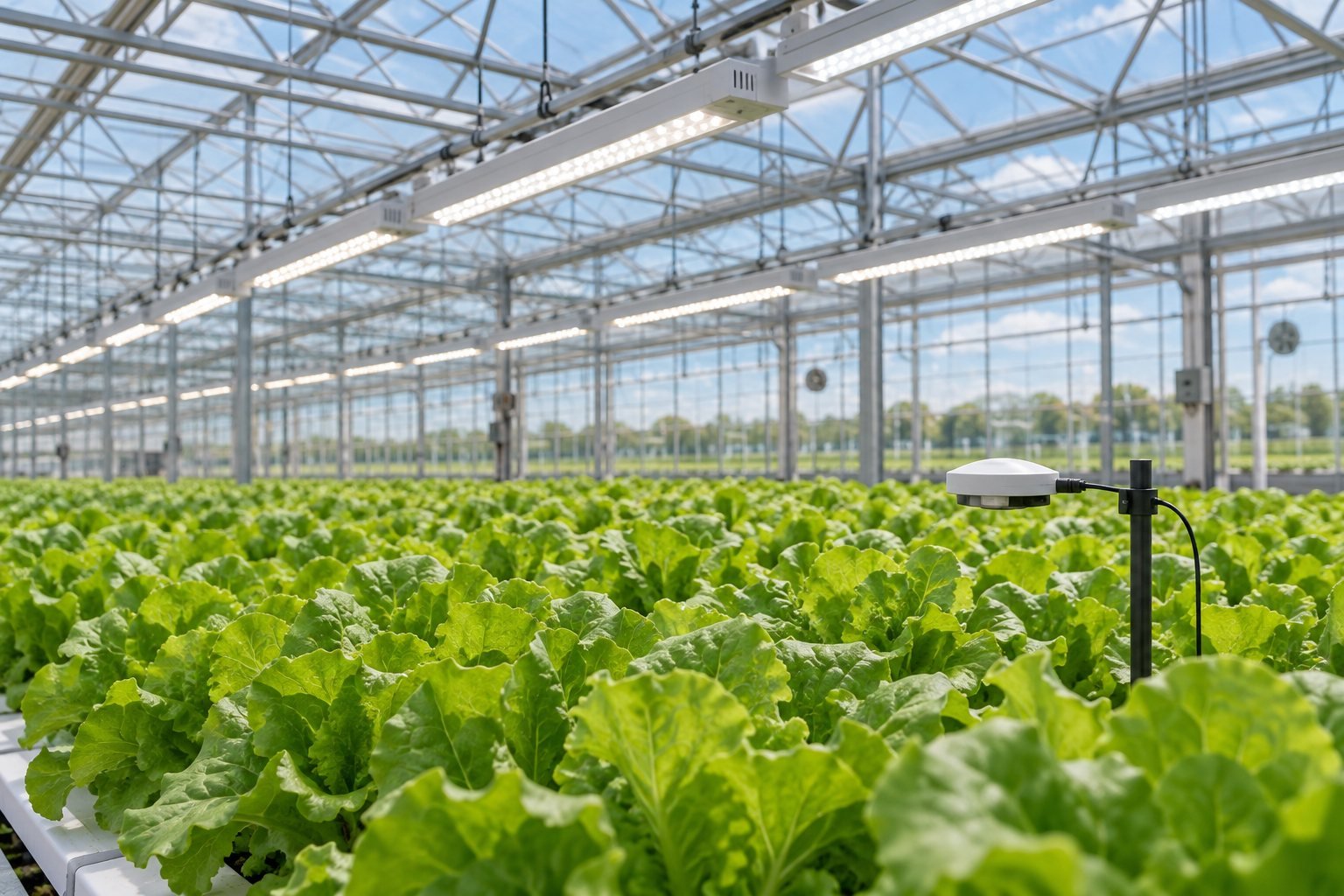
Measure representative positions and account for changes as the crop grows. The average can hide a poorly lit edge or an overly bright overlap. Use a suitable calibrated quantum sensor, not a phone lux reading treated as interchangeable with PPFD across different spectra.
Equal DLI does not make every schedule equivalent
DLI is an accumulation metric, not a complete description of crop response. Photoperiod, instantaneous intensity, temperature and growth stage still matter. Delivering the same total in a much shorter, brighter interval or eliminating a required dark period may not produce the same result.
Set an approved lighting window and maximum intensity with crop-specific advice. Then define how the controller responds to measured daylight, tariff periods and equipment limits. Record when the target cannot be met rather than silently treating the programmed target as achieved.
Keep the commercial calculation separate
Electrical consumption follows input power and operating hours, not PPFD alone. Compare fixtures using a lighting design at the intended mounting height and crop plane, then assess energy, demand charges and maintenance. A high-output fixture may close the deficit faster without necessarily producing the lowest whole-project cost.
The winter lettuce lighting article provides crop-planning context. For a CFGET lighting-layout discussion, bring the crop target, internal daylight record, permitted photoperiod and bench or row geometry. Request the predicted distribution and a measurement plan, not just a lamp count.