
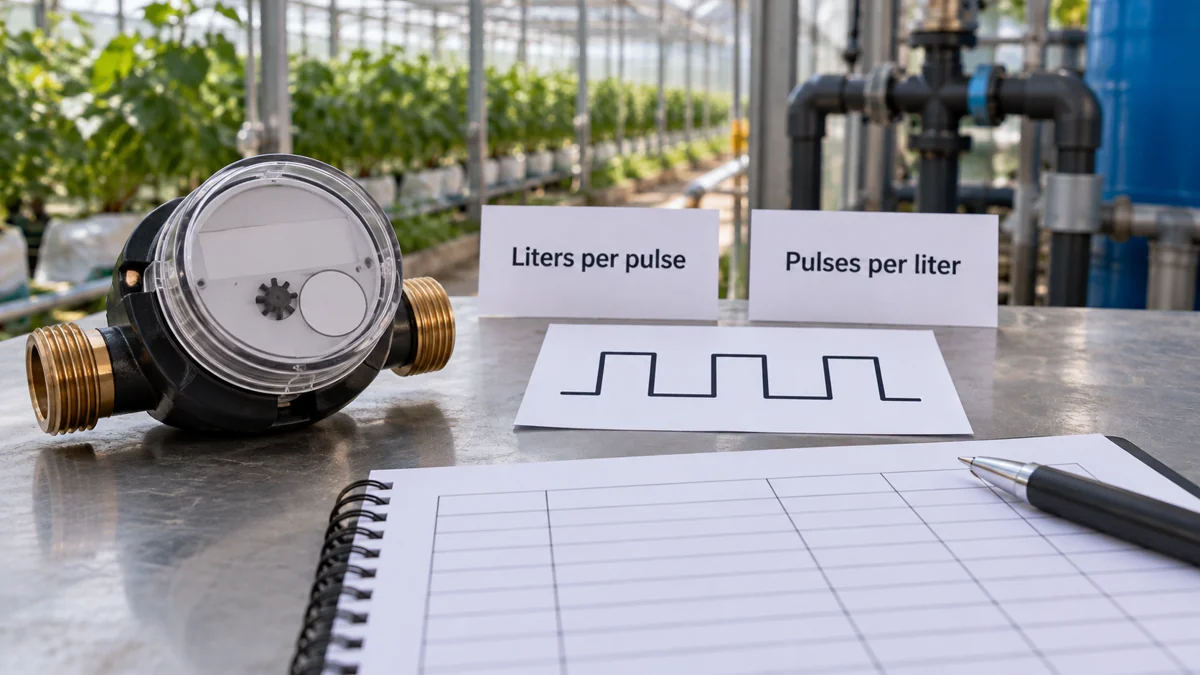
The meter dial advances by one volume, while the greenhouse controller records another. Before changing an irrigation or dosing setting, check how each device expresses the pulse factor. “Liters per pulse” and “pulses per liter” describe reciprocal quantities. Copying the same number between those fields can produce a convincing display with the wrong volume behind it.
A useful investigation preserves the original settings, identifies the units and reconciles one shared observation interval. It then separates a scaling question from possible pulse loss or a problem with the underlying flow measurement.
Write the unit beside the factor
A factor in liters per pulse tells you the volume represented by one counted pulse. A factor in pulses per liter tells you how many pulses represent a unit of volume. The number is incomplete without that direction.
Netafim's GrowSphere Max manual distinguishes PPL and LPP in its dosing-meter configuration description. That is an example of why the field definition matters, not a setting recommendation for an unidentified irrigation meter. Check the exact controller input, software version and connected device.
The physical dial may also use a different volume unit from the controller screen. Preserve the complete dial reading, including its unit and any marked multiplier. A photograph of only the changing digits may leave out the information needed to interpret them.
A reciprocal-unit example
Hypothetical arithmetic only: a pulse output representing 0.25 liter per pulse is equivalent to 4 pulses per liter. For 80 counted pulses, multiplying by 0.25 liter per pulse gives 20 liters. Dividing by 4 pulses per liter gives the same 20 liters.
The equivalence follows from the units. It does not mean that either value belongs in your controller. A screen might ask for volume per pulse, pulses per volume, a device-specific factor or another documented input. Read its definition before anyone proposes a change.
Keep the original configuration in the service record. If a factor appears wrong, report the factor, its displayed unit and the documentary reason for questioning it. Do not edit a live dosing configuration to see whether the totals become closer.
Follow the signal through three records
Separate the meter's local accumulated reading, any available raw pulse count and the controller's calculated volume. Label each record with the device and channel that produced it. A total on an irrigation summary screen may have a different reset time or accounting boundary from the meter beside it.
Ask whether the local totalizer and pulse output share a sensing element. Agreement between two outputs from the same measurement chain is useful for checking interpretation, but it should not automatically be described as independent confirmation of the true volume.
Netafim's NetaFlex 3G installation manual links pulse-meter selection to the controller's limitations. This makes compatibility part of the review. The actual meter output and controller input must be checked together rather than chosen from a preferred number alone.
Use one reconciliation sheet
| Field | Recorded value or document | Uncertainty or review question |
|---|---|---|
| Meter model, serial number and location | ________ | ________ |
| Controller model, software version and input channel | ________ | ________ |
| Local dial unit and marked multiplier | ________ | ________ |
| Pulse output factor and full unit | ________ | ________ |
| Controller field definition, value and full unit | ________ | ________ |
| Applicable meter and controller manual revisions | ________ | ________ |
| Observation start and finish times | ________ | ________ |
| Start and finish local totalizer readings | ________ | ________ |
| Pulse count for the same interval, if available | ________ | ________ |
| Controller start and finish accumulated volumes | ________ | ________ |
| Resets, communication gaps and operating events | ________ | ________ |
| Independent volume evidence and its method | ________ | ________ |
| Supplier interpretation and authorized next step | ________ | ________ |
Use observations available during permitted operation or an approved test arranged by the responsible technician. Do not disconnect the pulse wiring, open energized controls, interrupt a protection input or divert a chemical stream to collect evidence.
For each total, subtract the starting reading from the ending reading only after checking for resets, rollover and consistent units. Keep raw readings alongside the calculation so another person can reproduce it. If the interval cannot be aligned, mark the comparison inconclusive.
Let the pattern guide the next question
If the raw pulse count agrees with the meter's documented pulse convention but the controller volume does not, ask the controls supplier to examine the interpretation and configured channel. If counts are incomplete or intermittent, request a review of the signal path and input compatibility. Neither pattern alone establishes the final cause.
If the meter and controller agree with each other but conflict with credible independent volume evidence, the investigation may need to move back to the meter, its installation or the measurement method. Changing the displayed factor to force agreement would conceal that unresolved question.
Small observation volumes also need care. Ask the supplier whether the meter resolution, pulse increment and record timing are adequate for the comparison. There is no universal test duration or acceptable discrepancy in this article.
Change settings only with a verified basis
The authorized technician should document any correction, the affected control functions and the planned verification. Where the input influences dosing or flow protection, the review must include those consequences. A better-looking total is not sufficient evidence that the connected process is operating correctly.
Once the meter-to-controller chain is understood, use the greenhouse water-balance audit for wider questions about sources, storage, crop delivery and reuse. That broader balance should start with trustworthy volume inputs.
The immediate goal is modest and specific: every number in the signal chain has a known unit, a known observation period and an explanation that the meter and controls suppliers can verify.
Download the working files
Use these CSV files with the instructions in this article.