
Two sensors can both be sold as moisture sensors and answer different questions. One reports how much water occupies a volume of growing medium. Another reports matric tension or potential, describing how water is held by the medium. Choose the physical measurement first, then compare products that can measure it under your conditions.
A water-content percentage and a pressure reading in kPa are not interchangeable irrigation settings. There is no universal multiplier that converts one into the other for every substrate. A purchase should identify the question, measurement, medium and interpretation before anyone proposes a control trigger.
Match the question to the measured quantity
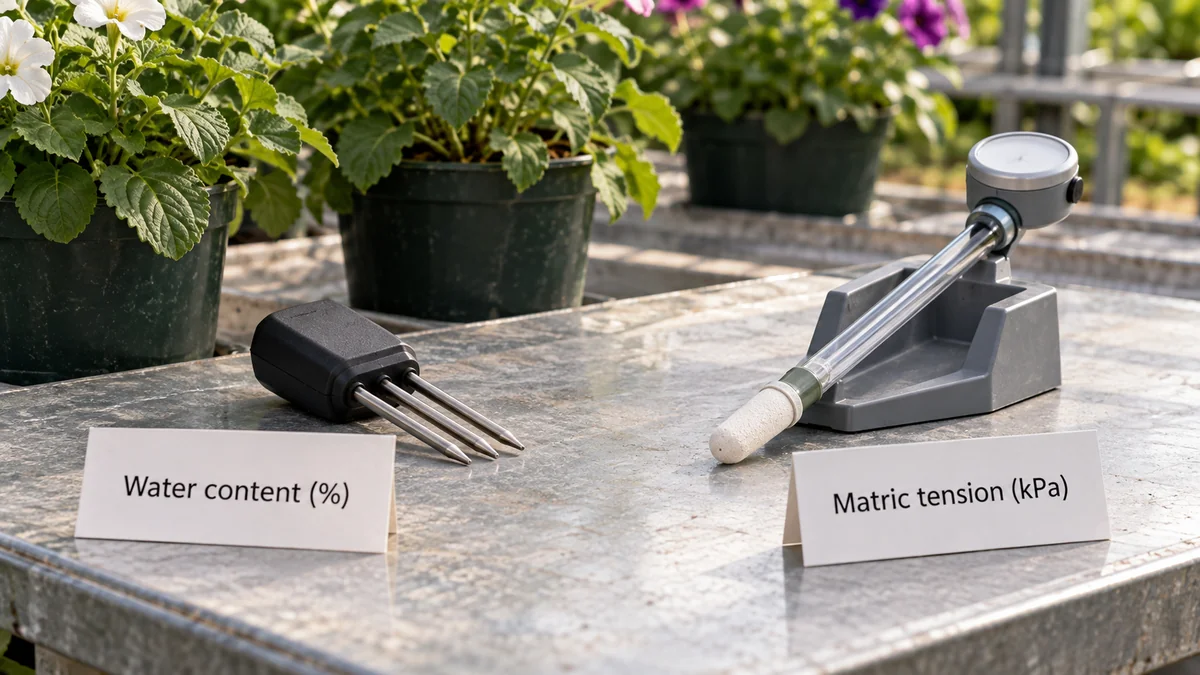
University of Minnesota Extension distinguishes volumetric-water-content sensors from soil-tension sensors. Volumetric water content is water volume divided by medium volume. A reading of 30% VWC means 0.30 units of water volume per unit of medium volume within the measurement’s basis. It does not mean that 30% of the plant’s available water remains.
Matric tension or potential addresses a different physical property. Check the declared convention: an instrument may report positive tension, while another reports negative matric potential. Under these respective conventions, increasing positive tension and increasingly negative matric potential describe stronger matric water retention. Preserve the sign and unit in the record rather than deleting a minus sign to make two displays look alike.
| Grower’s question | Measurement to discuss | What remains to establish |
|---|---|---|
| How is the amount of water in this medium changing? | Volumetric water content | Calibration, sensing volume and whether the sampled region represents the intended crop area |
| How strongly is the medium holding water? | Matric tension or potential | Model range, response, contact and crop-specific interpretation |
| Is the crop experiencing water stress? | More than one measurement may be needed | Crop observations and other relevant factors, including salinity |
These questions can coexist. The aim is not to award one sensor category a universal win. It is to prevent a supplier’s convenient output from quietly changing the decision the grower intended to make.
Ask what the electronics actually measure
A digital display or cable does not identify the measurement. IRROMETER’s current sensor page distinguishes its direct tensiometers from its electronic granular-matrix sensors. Both address water tension. Its product family also includes low-tension instruments described for greenhouse or container uses. Those descriptions justify asking about a specific model; they do not establish an irrigation target for your crop.
Another example appears in the historical METER TEROS 21 Gen 1 manual. The device measures the water-related dielectric response of a porous ceramic matrix and uses the matrix’s characteristic relationship to infer matric potential. An electronic sensing method therefore does not necessarily produce growing-medium water content.
For each quotation, ask the supplier to complete one plain sentence: “This model senses ___ and reports ___ in ___.” Then request the applicable range, resolution, response limitations and medium/contact requirements. A long measurement range alone does not establish useful resolution in the part of the range your adviser needs.
Keep calibration and water retention separate
Sensor calibration connects an instrument response with its reported quantity. A water-retention relationship connects the medium’s water content with matric potential. They are different relationships. The METER manual describes material-specific moisture characteristics and distinguishes matric from osmotic effects. Neither a generic probe calibration nor a convenient unit conversion supplies your substrate’s retention relationship.
Here is a hypothetical purchasing comparison. Supplier A offers a probe reporting VWC. Supplier B offers a sensor reporting matric potential. The grower wants to compare water-content changes in two container media. A’s output is closer to the stated question, but its medium-specific measurement basis still needs checking. B’s output cannot simply be relabeled as percentage water content. That would need a justified relationship for each medium.
Now change the question: the adviser wants to follow matric status across a particular operating range. B may be the relevant category, but only if the exact model’s range and response suit that purpose. A is no longer the automatic choice merely because its screen is easier to read. The decision changes with the question, not with which quotation has more displayed numbers.
A salinity claim needs careful interpretation
The IRROMETER page describes its direct tensiometer measurement as unaffected by salinity. This is a statement about that measurement principle. It does not establish that dissolved salts have no effect on crop water relations. The TEROS manual explicitly separates matric and osmotic components and also describes salinity limitations of its own sensing method.
Ask two distinct questions: can the actual medium’s salinity affect this instrument’s result, and what additional salinity evidence does the adviser need to interpret the crop’s condition? A satisfactory answer to one does not close the other. Avoid converting an instrument specification into a declaration that the plant is free of stress.
Finish the comparison with a usable decision record
Use the irrigation decision-to-measurement map for each proposed use. It has separate fields for the question, reported quantity and units, sign convention, model, range, calibration basis, medium, contact/sensing volume, representativeness and other evidence. The final fields record the proposed interpretation, adviser’s response and unresolved question.
Complete one row before comparing prices. If the grower question is clear but the supplier cannot identify the reported quantity, request clarification. If the quantity fits but the actual substrate basis is missing, retain that as a purchasing condition. If both fit but the crop interpretation is unconfirmed, keep the result as monitoring information until the qualified crop adviser has reviewed its use.
This record deliberately stops before an irrigation trigger. Field-soil thresholds, another grower’s settings and a manufacturer’s full-scale range do not become greenhouse prescriptions. Once the measurement choice is settled, keep it connected to the broader water-balance and irrigation audit. What reaches the crop and what a sensor reports are related evidence, but neither replaces the other.