
A replacement greenhouse vent drive should be ordered against the existing mechanism and control system, not just the motor's power rating. Two units can look similar and still differ in output speed, available travel, mounting, limit-switch arrangement or position feedback.
Before accepting a substitute, ask the supplier to complete a compatibility record for the exact installed and proposed part numbers. Every unresolved interface needs an answer before the drive is released for installation. This is especially important when the old model has been discontinued or several versions share the same family name.
Identify what is being replaced
First establish whether the proposal replaces a motor, a motor-and-gearbox assembly, or a larger package that includes position sensing and controls. An offer headed “vent motor” may leave that boundary unclear.
Collect the existing equipment tag, full nameplate, product code, manual revision and approved mechanism drawing. Add photographs showing accessible coupling and mounting details. Use existing records or photographs taken safely by qualified personnel; do not remove guards or climb to a drive to complete a purchasing checklist.
Ask the maintenance team to describe the failure and the last known operating condition. Record recurring trips, unusual noise or incomplete travel as observations. Have the supplier or service contractor establish whether the cause is within the drive or elsewhere in the mechanism. A replacement should not be selected on an unconfirmed assumption about why the old unit stopped.
When identification is incomplete, mark the request “identification required.” A partly legible label is a reason to obtain help, rather than guess the missing suffix from an online product image.
Compare the output where it meets the mechanism
Torque is the turning force at the specified shaft; speed states how quickly that shaft rotates. For a geared drive, the useful comparison is the approved gearbox output under the specified duty. A motor power figure alone does not describe that interface.
Ridder's drive-system catalogue illustrates the distinction: its RW45 information separately identifies output torque, output speed, intermittent duty, coupling details, limit-switch travel and a self-braking transmission. These are model-specific properties to check, not a selection rule for other drives.
Ask the designer to confirm the required torque and travel from the actual vent mechanism, including the approved operating conditions. Then ask whether the proposed speed, duty and holding arrangement fit that mechanism. A higher torque rating is not permission to impose a larger load on the existing shaft, rack, brackets or vent.
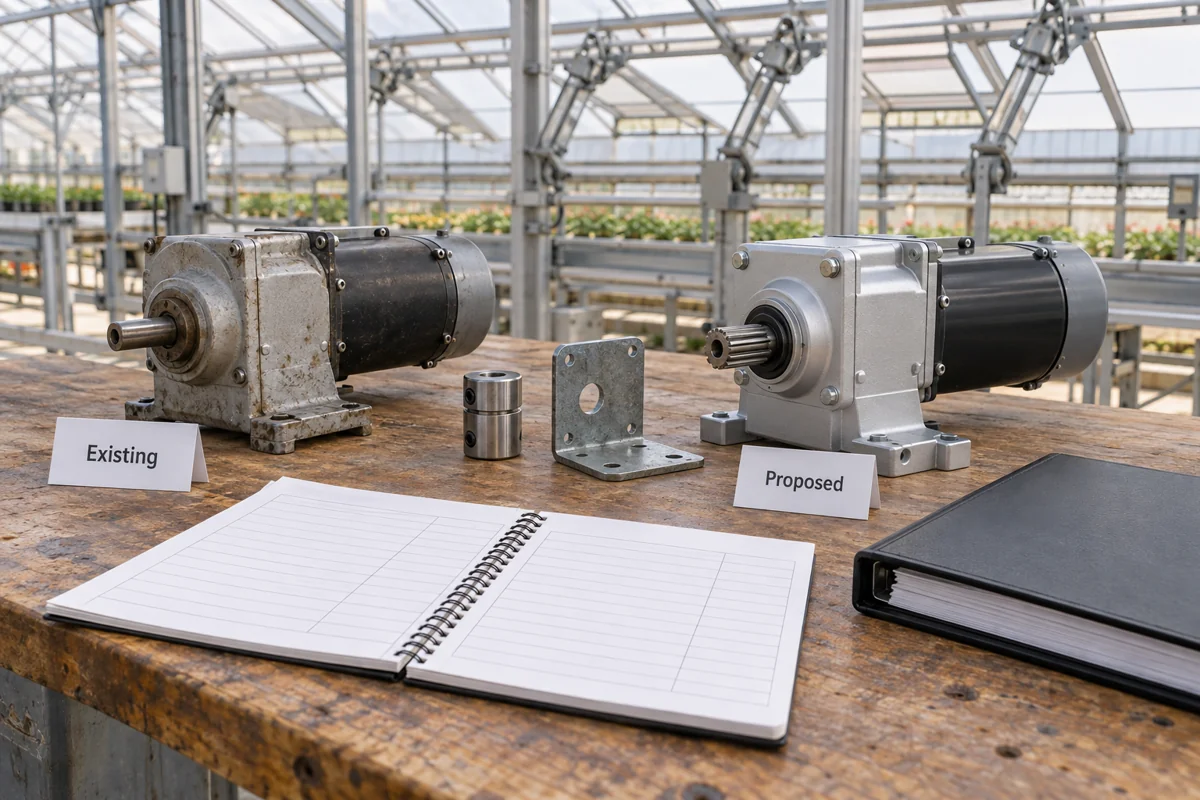
Make the mechanical comparison from dimensioned documents. Check the output shaft or sprocket, coupling type, mounting pattern, installed orientation and clearances. Record who has approved the supporting structure and connection loads. If an adapter or new bracket is proposed, it needs its own identified drawing and approval; “fits with minor modification” is not a finished scope.
Will the controller understand the new drive?
A drive that can move the vent may still need a different control interface. Record the normal end-position functions, any separate safety limits, position feedback and the way the greenhouse controller receives those signals.
For example, Ridder's Smartdrive product information describes digital end-position control and a Modbus interface. That is different information from a torque rating. It is also why a newer unit should not be assumed to connect directly to every controller used with an older drive.
Have the drive and controls suppliers identify the exact compatible hardware and software versions. Ask who is responsible for any panel change, configuration, updated documentation and commissioning. Keep frequency and supply-rating confirmation in the equipment record, but leave wiring and electrical design to qualified personnel.
Do not copy settings from a neighboring vent merely because the units look alike. The approved travel and control functions must correspond to the mechanism being replaced. This article does not provide limit adjustment, bypass, live-test or manual-drive instructions.
Use three answers in the replacement matrix
Download the vent-drive replacement matrix. Enter one requirement per row and attach the supporting drawing, manual page or written supplier response. Use these outcomes:
- Matched: the responsible supplier or designer has confirmed the proposed item against the stated requirement.
- Redesign required: an identified interface needs an approved change, with scope and responsibility recorded.
- Unresolved: evidence is missing, contradictory or awaiting review. Keep the item open.
| Requirement group | Evidence to compare | Decision record |
|---|---|---|
| Identity | Full part numbers, versions and replacement boundary | Status; document; approver |
| Mechanical output | Approved output torque, speed, travel and duty | Status; document; approver |
| Holding function | Braking or self-locking behavior where specified | Status; document; approver |
| Physical interfaces | Shaft or sprocket, coupling, mounting dimensions, orientation and clearance | Status; drawing; approver |
| Structure | Support and connection loads; proposed adapters or brackets | Status; drawing; approver |
| Controls | Normal limits, safety limits, feedback and controller interface | Status; version; approver |
| Operating environment | Applicable enclosure, ambient and exposure ratings | Status; specification; approver |
| Completion | Installation scope, approved checks, records and release responsibility | Open actions; owner; date |
“Matched” should describe a verified requirement, not a salesperson's general statement that the product is suitable for greenhouses. Keep the supplier's qualifications with the answer. A match that depends on a new control panel is a package decision, with that panel included in the scope.
Compare the installed proposal, not the loose unit price
Ask each bidder to identify included couplings, brackets, controls work, installation, access arrangements and verification. List exclusions beside the price. That makes a lower equipment price easier to interpret without inventing a saving from work that another contractor must still perform.
Agree the acceptance record before installation. The responsible installer should specify how the approved movement, end positions, feedback and protective functions will be checked safely. The owner needs the results and unresolved deviations, rather than a statement that the motor was briefly powered.
Keep the final part number, drawings, manuals and approved settings with the spare-parts and handover record. If the replacement changes an interface, update that record so the next purchasing decision does not start from an obsolete configuration.
The buying decision is complete when the proposed drive and all required changes have an approved place in the existing system. Until then, a plausible part number remains a candidate.