
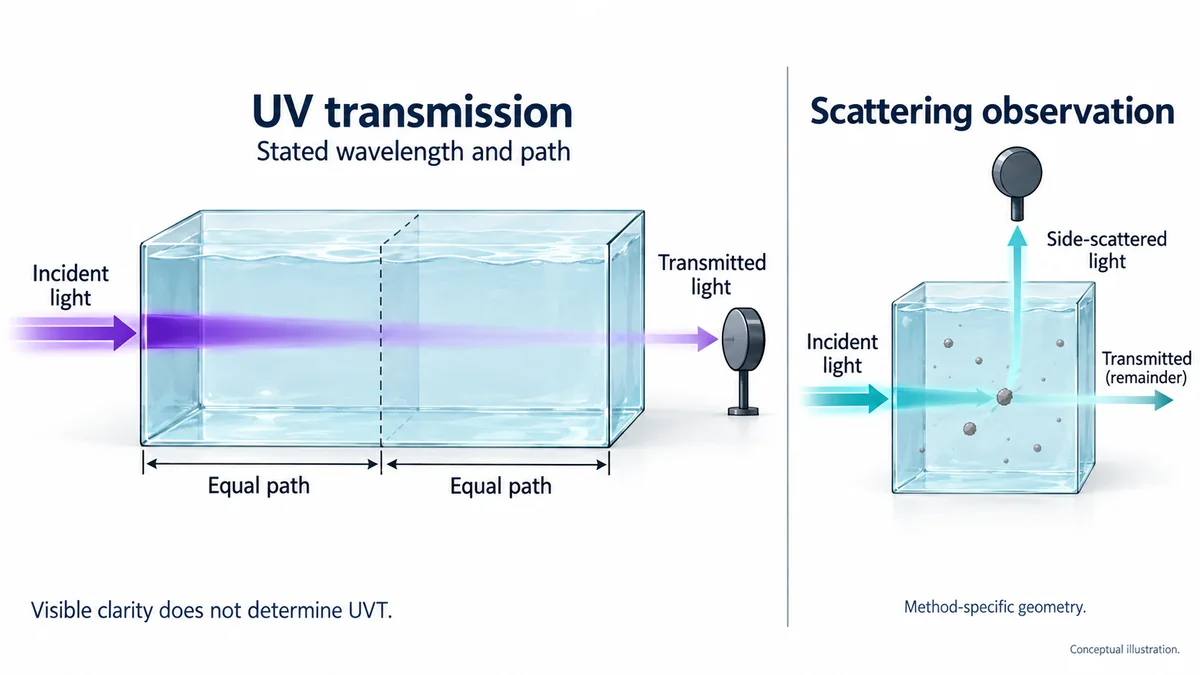
A turbidity result cannot stand in for the ultraviolet transmittance required by a greenhouse water-treatment proposal. Turbidity describes a scattering measurement. UV transmittance, or UVT, describes how much light at a stated ultraviolet wavelength passes through a stated water path. Water that looks clear can still contain dissolved UV-absorbing material.
Before comparing a water report with a reactor rating, match the wavelength, path length and sample basis. Otherwise, two percentages may describe different optical questions, and a reassuring-looking result may leave the equipment's actual water condition unresolved.
Follow transmission and scattering along different paths
Picture light entering a water sample. Some reaches a detector along the transmission path. Some may be absorbed, while particles can redirect light. A turbidity instrument evaluates scattering under its particular measurement method. Your eyes provide a third observation: visible appearance. These observations can be related without being interchangeable.
The EPA's November 2006 UV guidance, sections 2.2.2 and 2.5.1, explains wavelength-specific transmission and water constituents that affect it. Its drinking-water context supplies useful optical definitions, not a greenhouse approval. UVT commonly reported at 254 nm through 1 cm still needs those conditions written beside the percentage.
The distinction matters commercially. Priva's horticultural Vialux descriptions distinguish equipment offerings for lower-transmission and high-transmission water. The practical lesson is to identify which water description a proposed rating assumes. A product family name alone does not resolve that question.
Why a longer water path changes the percentage
Consider a fictional, ideal homogeneous absorbing sample at one stated wavelength. Assume each equivalent 1 cm segment transmits 80% of the light entering that segment, under a simplified Beer-law model. Start with 100 arbitrary light units:
| Position in the ideal example | Light remaining | Fraction of the original incident light |
|---|---|---|
| Before the first segment | 100 units | 100% |
| After one 1 cm segment | 80 units | 80% |
| After two equivalent 1 cm segments | 64 units | 64% |
The second segment transmits 80% of 80, so the result is 0.80 × 0.80 = 0.64. Subtracting another 20 percentage points would give the wrong answer. Real scattering, measurement geometry and reactor hydraulics are outside this exercise. The 64% is an optical result within the stated model, not pathogen survival, treatment success or a selected UV dose.
Read two reports before ranking them
Imagine report A gives a UVT percentage with a wavelength, a 1 cm path and an identified sample taken before the proposed reactor. Report B gives a larger percentage but omits the path and describes only “filtered water.” B does not establish better transmission on A's basis. Ask the laboratory to identify the missing conditions before comparing the numbers.
Then ask what “filtered” means in each report. Was filtration part of the greenhouse process before sampling, or preparation performed on the laboratory sample? Those descriptions can refer to different water. Preserve the laboratory's method rather than silently relabeling a prepared sample as the reactor inlet.
This gives the buyer a specific next step: resolve the report's optical basis, then have the treatment supplier identify the matching rating condition. The wider irrigation-water analysis remains useful, but neither a low turbidity value nor a particle-filter specification supplies the missing UVT information.
Download the optical-report comparison
Download the UVT optical-report comparison CSV. This is a manual worksheet with no formulas. Import it as UTF-8 with comma separators, widen the columns and wrap text. Save an editable spreadsheet copy, then enter report A and report B in their separate columns.
Complete the sample, wavelength, path and preparation fields from the reports. Mark an absent item as “not supplied.” In the final two rows, state which reactor-rating condition the evidence addresses and what remains unanswered. Leave dose, microbial reduction and water-release decisions outside this optical comparison. No lamp exposure or home treatment experiment is needed to identify a missing report definition.