
To choose a greenhouse upgrade for a lower tomato carbon footprint, first find which activities dominate the footprint of the product you actually sell. Then assess how a proposed change alters those activities while keeping the product boundary and output comparable.
A visible improvement, such as less packaging or a different covering material, may be worthwhile. Its visibility does not establish its importance in the carbon calculation. A useful first assessment directs attention toward the largest supported opportunities rather than whichever upgrade is easiest to describe as green.
Start with one defined product
Jensen, Knudsen and Mogensen’s Danish tomato study, published online in December 2023 and in a 2024 journal volume, assessed one commercial organic producer. Its late-start crop case used 2018–2020 company records and interviews, with monthly energy allocated by crop timing and area.
| Year | Heat, MWh/ha | Electricity, MWh/ha | Tomato output, kg/ha |
|---|---|---|---|
| 2018 | 3,950 | 211 | 525,320 |
| 2019 | 3,062 | 215 | 518,346 |
| 2020 | 3,383 | 246 | 528,230 |
The modeled mean climate impact was 1.06 kg CO₂e per kilogram of packaged organic tomatoes ready for distribution at the farm gate. The authors attributed 68% to heat and 10% to electricity. These are life-cycle model results, not measured retrofit savings. The published total is retained; rounded component values sum to 1.05.
This historical case gives a clear reason to investigate operating energy first in that system. It cannot assign the same priorities to a greenhouse with a different climate, crop calendar or energy supply.
Separate the meter reading from the footprint
An energy record describes an activity: how much heat or electricity was assigned to the crop. A carbon footprint also needs a model of how that energy was supplied, together with the other activities included in the boundary.
This distinction changes the questions you ask about an upgrade. A proposal can reduce delivered energy, change the emissions associated with supplying that energy, change crop output, or do several of these at once. Each pathway needs its own evidence. Calling a heat source renewable does not provide all the inputs for a product-footprint comparison.
The output denominator matters just as much. A lower annual greenhouse total can accompany a smaller crop. To establish an improvement per packaged kilogram, compare the emissions and the corresponding packaged output together. Do not substitute growing-bed area for total production area when combining records.
Shortlist changes by the activity they affect
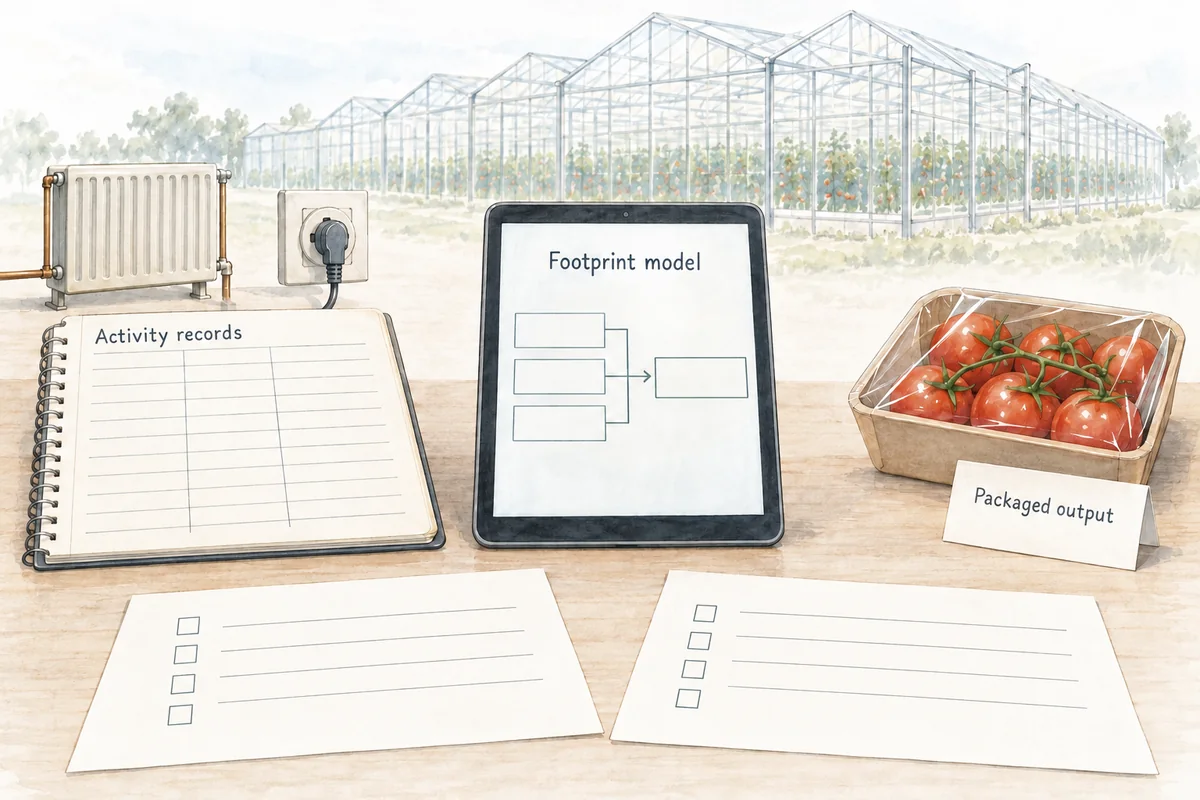
For each proposed upgrade, write a short assessment with six entries:
- Activity changed. Name the heat demand, electrical demand, supplied-energy mix, material use or crop loss that the proposal is expected to alter.
- Evidence for the change. Identify a calculation, measured operating comparison or supplier result that matches the proposed conditions. A target alone is not evidence of an achieved saving.
- Applicable footprint model. Specify the location, period, energy supply and allocation assumptions used to convert activity changes into climate impacts.
- Comparable product. Keep the grade, packaging boundary and output basis aligned. Explain any expected change in accepted yield.
- Added burdens. Include relevant construction, replacement, maintenance and operating requirements of the upgrade within the chosen assessment.
- Separate commercial case. Record capital and operating costs, implementation disruption and other environmental trade-offs alongside the carbon result.
This is a screening tool. It helps decide which alternatives deserve a detailed assessment; it does not produce a verified footprint from a checklist.
Ask what could reverse the ranking
Suppose a proposal reduces heat demand but also reduces crop light. The comparison should show how a plausible output change affects the result per packaged kilogram. Or suppose a new energy source has a favorable projected footprint: check the actual supply available for the project period rather than treating a future national scenario as an existing service.
Keep the original case and proposed case in the same model so that assumptions can be challenged one at a time. If a small change in yield or energy allocation reverses the ranking, report that sensitivity before making a large commitment.
The greenhouse energy-demand guide helps organize the operating inputs. A good next step is a local alternatives assessment using those records, followed by a separate investment decision. The lowest modeled climate impact and the strongest financial return may favor different projects.