
A greenhouse unit heater can have different published outputs for steam and hot-water service. Read the table for the confirmed heating medium and complete operating condition. The number in the model name, a steam capacity or the fan motor rating cannot substitute for the required hot-water output.
This matters when a proposal names a familiar heater but describes its duty incompletely. Before using its capacity in a project comparison, establish which manufacturer table actually supports that capacity.
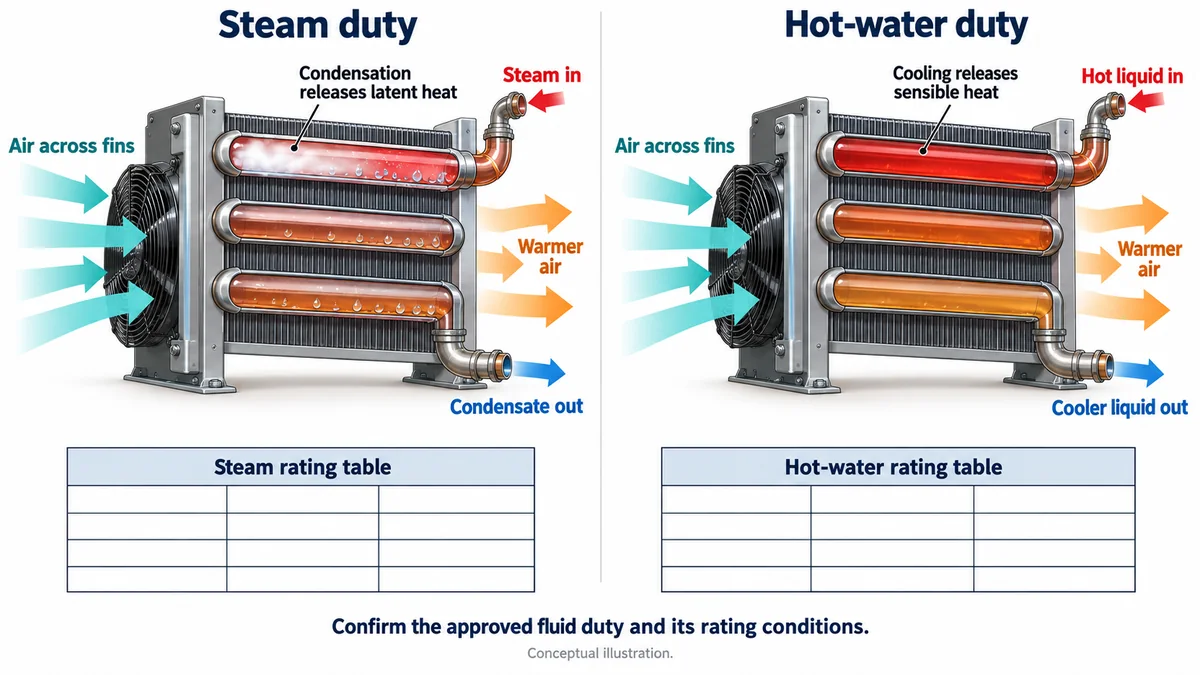
Follow heat through the correct fluid duty
In an appropriate steam-rated coil, steam condenses and releases latent heat. In hot-water service, liquid water transfers sensible heat as it cools through the coil. In both cases, the fan moves greenhouse air over the heat-transfer surface. The heating fluid stays within its intended circuit rather than being discharged into the crop air.
Spirax Sarco's unit-heater explanation describes the steam-coil and air-stream relationship and directs selection to manufacturer data. The two heat paths explain why a shared casing or model family does not establish the same output under different fluid conditions. They do not authorize converting equipment between services.
Water-to-air heaters are one distribution option described in UMass greenhouse heating guidance. Their emitted heat still has to be distinguished from the heat source's capacity and from the greenhouse's independently established demand.
Read one model in two actual catalog tables
The following is a catalog-reading example, not a suggested installation. Modine catalog 1-150.21, March 2026, lists the HSB/HC 86 standard model in separate steam and hot-water tables:
| Catalog location | Stated rating condition | HSB/HC 86 heat output |
|---|---|---|
| Table 12.1, steam | 2 lb steam as stated in the table heading; 60°F entering air; high motor speed | 86,000 Btu/h |
| Table 18.1, hot water | 200°F entering water; 60°F entering air; high motor speed; row water flow 6.3 GPM | 60,200 Btu/h |
These are conditional ratings for the named catalog entry. They are not contradictory measurements of one identical duty. In particular, the 86,000 Btu/h steam figure cannot be carried into a hot-water proposal just because “86” appears in the model designation.
The water-table flow belongs with that water rating. Keep GPM distinct from air volume flow, and keep both distinct from heat output and motor power. Each quantity answers a different question. Copying an entire row without its heading can lose the most important explanation of the numbers.
Route the proposal to the right evidence
Try this paper exercise. A fictional hot-water proposal names HSB/HC 86 and claims 86,000 Btu/h, but gives no water temperature or flow. The immediate conclusion is “hot-water output unresolved,” not “buy a larger heater.” Ask for the correct manufacturer selection at the proposed water, air and fan conditions.
Table 18.1 provides a useful reference for checking the quoted claim, but its 60,200 Btu/h is not automatically the corrected project capacity either. The fictional proposal has not established that its actual conditions match that table. Resolving the medium is the first step; matching the conditions completes the rating comparison.
If the proposed water condition differs, use the exact model's applicable manufacturer data or selection. Do not make a generic linear correction or borrow a factor from a different coil family. The greenhouse heating-load inputs can then be considered separately by the heating designer. No number of heaters follows from this reading exercise alone.
Download the catalog-routing worksheet
Download the unit-heater rating-route CSV. This manual worksheet has no formulas or conversion instructions. Import it as UTF-8 with comma separators, widen the columns and wrap text. Save an editable spreadsheet copy.
The two catalog-example columns retain the published conditions. Use the separate proposal column for your quoted medium, exact model and rating evidence. Leave missing conditions visible rather than copying the example's values into the proposal. End with a supported table reference or a precise request for the unresolved condition. Any equipment selection, service change, installation or live-system work remains a separate professional task.