
The short answer
Issue a controlled heating-load input sheet that defines the project location and weather source, outdoor design condition, crop-zone day and night setpoints, humidity and ventilation strategy, greenhouse dimensions, every roof and wall assembly, thermal bridges, perimeter condition, air leakage assumption, screen position, internal and distribution losses, zoning, redundancy, fuel and utility limits, elevation, future phases, and required calculation outputs.
Two greenhouses with the same floor area can have different surface area, glazing, infiltration, wind exposure, screen configuration, crop temperature, and heating distribution. A floor-area rule may be useful for an early sense check, but it is not an adequate basis for equipment procurement.
The load case and the annual energy estimate are different questions. Peak load supports capacity and distribution design. Annual consumption depends on the full weather sequence, operating schedule, setpoints, screen use, efficiency, internal gains, and crop practice. Both calculations should use consistent project data but should not be confused.
This planning guide supports procurement and coordination. Project-specific values and safety decisions remain with the grower, qualified designers, equipment manufacturers, contractors, and authorities responsible for the installation.
Inputs that should be fixed before supplier selection
| Input group | Record | Decision supported |
|---|---|---|
| Climate basis | Site coordinates, elevation, weather station, outdoor dry-bulb design value, wind assumption, snow operating case, humidity, and design return period. | Defines the external condition the system must withstand. |
| Indoor requirement | Crop and stage, occupied zones, day and night temperature, root-zone target, humidity strategy, ventilation during cold weather, and recovery requirement. | Defines what must be maintained and where. |
| Envelope | Measured roof and wall areas, glazing layers, frames, doors, vents, fan shutters, foundations, perimeter, screen position, U-values or transmission factors, and age or leakage condition. | Defines transmission and infiltration paths. |
| Heating system | Fuel, source temperature, boiler or heater efficiency, distribution type, pipe losses, pumps, zoning, control stages, minimum turn-down, standby philosophy, and expansion. | Connects load to deliverable heat at the crop. |
| Calculation outputs | Zone and total peak load, transmission and infiltration breakdown, distribution allowance, equipment duty, flow and temperatures, fuel input, electrical auxiliaries, reserve, and assumptions. | Makes the result reviewable and usable by other disciplines. |
Identify each provisional item and the date by which it must be closed. A supplier can offer alternatives, but each alternative should state which input changed and how that change affects capacity, layout, utilities, controls, maintenance, and price.
A practical design and review sequence
1. Freeze geometry and assemblies
Use the current greenhouse drawings rather than a generic span. Calculate exposed areas by material and orientation. Record roof vents, roll-up walls, doors, fan openings, gables, service buildings, and connections to adjoining houses. State whether U-values represent the complete installed assembly or only the center of a panel.
2. Define credible design conditions
Select outdoor conditions from an accepted local source and document the value, station, elevation, and return period. Set indoor temperatures from the crop and production plan. If the greenhouse may be operated cooler during severe weather, describe that emergency mode separately instead of hiding it in the normal design setpoint.
3. Treat infiltration and screens transparently
Air leakage can be material in an older or highly ventilated structure. State the assumed air-change or leakage basis and the effect of wind. For a thermal screen, show open and closed cases, fabric and edge performance, the volume remaining heated, and the operating conditions under which the credit applies.
4. Match capacity to distribution and control
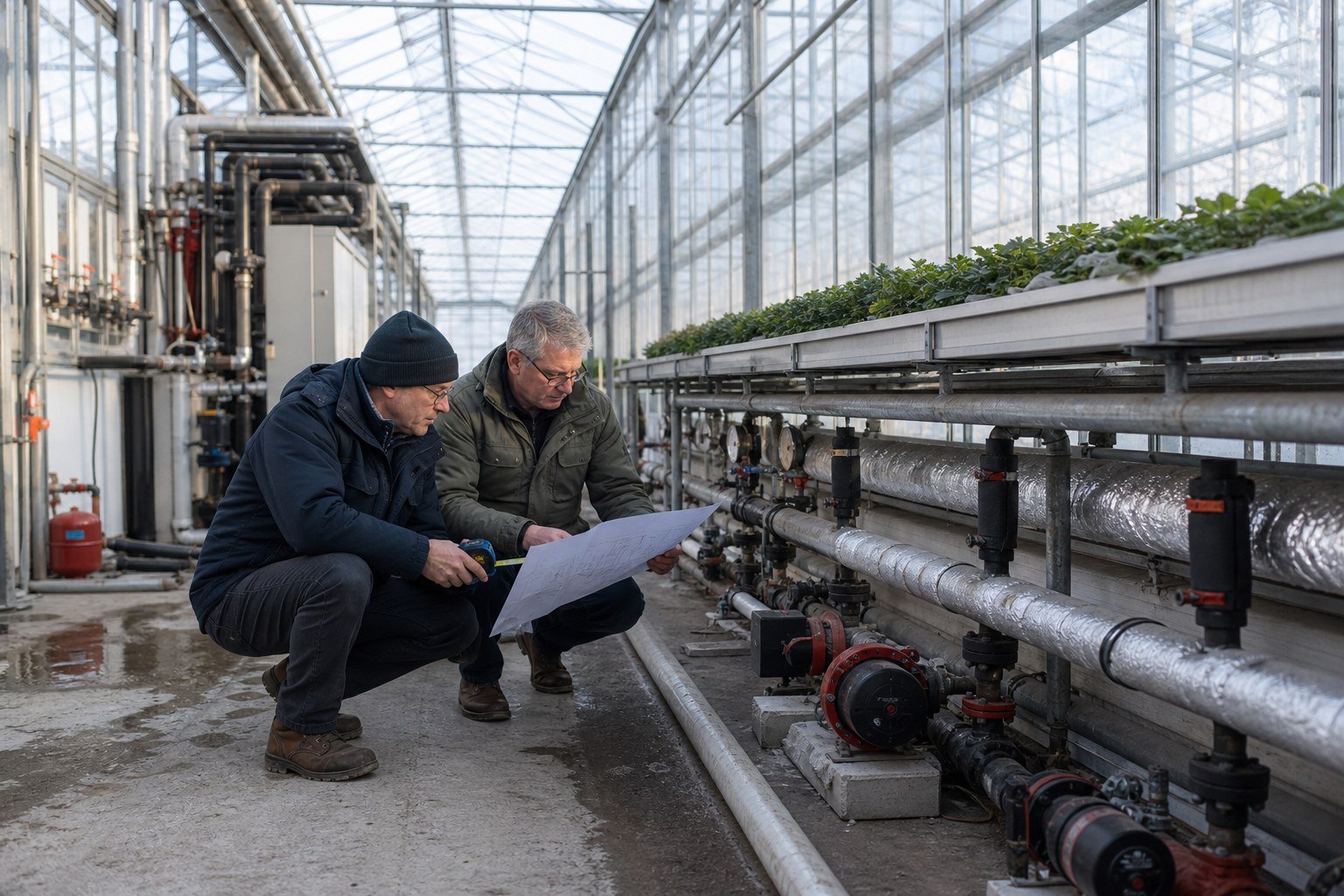
A central source can have adequate nameplate capacity while the crop zone remains cold because flow, pipe area, air circulation, valve authority, or control staging is inadequate. Review source output, distribution loss, zone balance, minimum load, redundancy, startup, and recovery as one system.
Keep the assumptions with the calculation or equipment schedule. When the crop plan, source condition, greenhouse geometry, or operating sequence changes, the responsible designer can then identify which result must be recalculated instead of relying on an obsolete approval.
Divide responsibilities at the interfaces
Owner and grower
Provide crop, operating hours, acceptable risk, local practices, staff capability, utilities, expansion plan, and approval priorities.
Greenhouse supplier
Provide structure, envelope, equipment, layout, loading, utility, control, installation, and commissioning interface data within the contracted scope.
Specialist designer
Apply local climate, codes, calculation methods, safety duties, equipment selection, system integration, and professional approval.
Contractor and operator
Confirm site conditions, installation, access, testing, records, training, safe operation, inspection, and maintenance.
Use a responsibility matrix for supply, design, installation, power, water, drainage, controls, network, civil works, testing, permits, consumables, spares, training, and warranty response. Phrases such as complete system are not enough when the interfaces cross several contracts.
Common specification failures
| Failure | Why it matters and what to do |
|---|---|
| Floor area is the only input | This ignores exposed surface, height, glazing, leakage, wind, screen, and setpoint. Use actual envelope geometry and documented assumptions. |
| Input fuel rating is mistaken for useful heat | Combustion and equipment losses separate fuel input from delivered output. Use rated output at the project condition and include distribution losses where appropriate. |
| A screen credit is always applied | A screen only reduces loss when it is closed and performs as assumed. Provide screen-open, screen-closed, and failure or snow-management cases where relevant. |
| Redundancy is added as an unexplained percentage | Define the consequence of failure, required standby duty, repair time, turndown, phased expansion, and which components need independent backup. |
Record every accepted deviation. A verbal clarification during a meeting should be transferred to the controlled drawing, schedule, calculation, or specification that governs manufacture and site work.
Plan acceptance before equipment is ordered
Agree on document review, factory checks where appropriate, delivery inspection, installation inspection, pre-start checks, calibration, functional tests, representative operating tests, abnormal-mode tests, training, and handover. State the instruments, conditions, tolerances, data format, witnesses, and corrective-action process.
Use the project commissioning plan to connect design intent to field evidence. Where continuity matters, coordinate power, alarms, operator response, and recovery through the greenhouse backup power and alarm planning. Keep final settings, test results, and approved changes with the equipment record so maintenance staff have a usable baseline.
Acceptance is not a substitute for ongoing observation. Trend the measurements that reveal deterioration, compare them with the commissioned condition, and define who investigates a sustained change. This is particularly important where crop damage can begin before a component reaches complete failure.
Questions the project team should answer
Which weather source and outdoor design condition are accepted? Which crop-zone temperature must be maintained, for how long, and during which operating mode? What assemblies and leakage conditions exist? Is a thermal screen always available in the peak case? What useful output is available from the selected fuel and equipment at site elevation? Which pumps, controls, and fans are critical? What happens when one heater, pump, sensor, or power source fails?
Frequently asked questions
Can greenhouse floor area be used to size a heater?
Only for a rough early comparison. Final design should use exposed envelope area, assembly heat transfer, indoor-outdoor temperature difference, infiltration, wind, screens, distribution, and the required operating case.
Should solar gain reduce the peak heating load?
The critical heating case commonly occurs at night or under low solar input. Any credited gain must be available during the selected design condition. Keep daytime energy analysis separate from the conservative capacity case.
How should a thermal screen be represented?
Use documented properties and installed closure assumptions. Show whether the screen changes effective surface, air volume, or heat-transfer path, and calculate cases for its planned positions. Do not apply a marketing saving directly as a load factor.
Who should approve the calculation?
A qualified heating or mechanical designer familiar with local climate, codes, fuel safety, emissions, hydronics or air systems, and greenhouse operation should own the final calculation and equipment selection.
Prepare the input schedule before requesting a fixed offer
Send the site coordinates, greenhouse drawings, covering build-up, doors and vents, crop temperature plan, screen details, fuel and utility data, zoning, redundancy target, and future phases. Chengfei Greenhouse can supply greenhouse envelope and equipment inputs for the qualified heating designer.
Contact Chengfei GreenhouseReferences
- Heating Greenhouses. Heating Greenhouses.
- Calculating Greenhouse and High Tunnel Heat Loss. Calculating Greenhouse and High Tunnel Heat Loss.
- Heating Systems. Heating Systems.