

Toplighting and interlighting describe where light enters a crop. An overhead fixture sends light toward the canopy from above. An interlighting fixture emits from within a tall crop, creating a different relationship between the source, surrounding leaves and working space. Placement alone does not specify spectrum or prove that one layout produces more saleable crop.
Compare the proposed emitting positions against the canopy through its crop cycle. For a high-wire greenhouse, a young crop, a mature canopy and a later crop-work state can present very different targets to the same fixture.
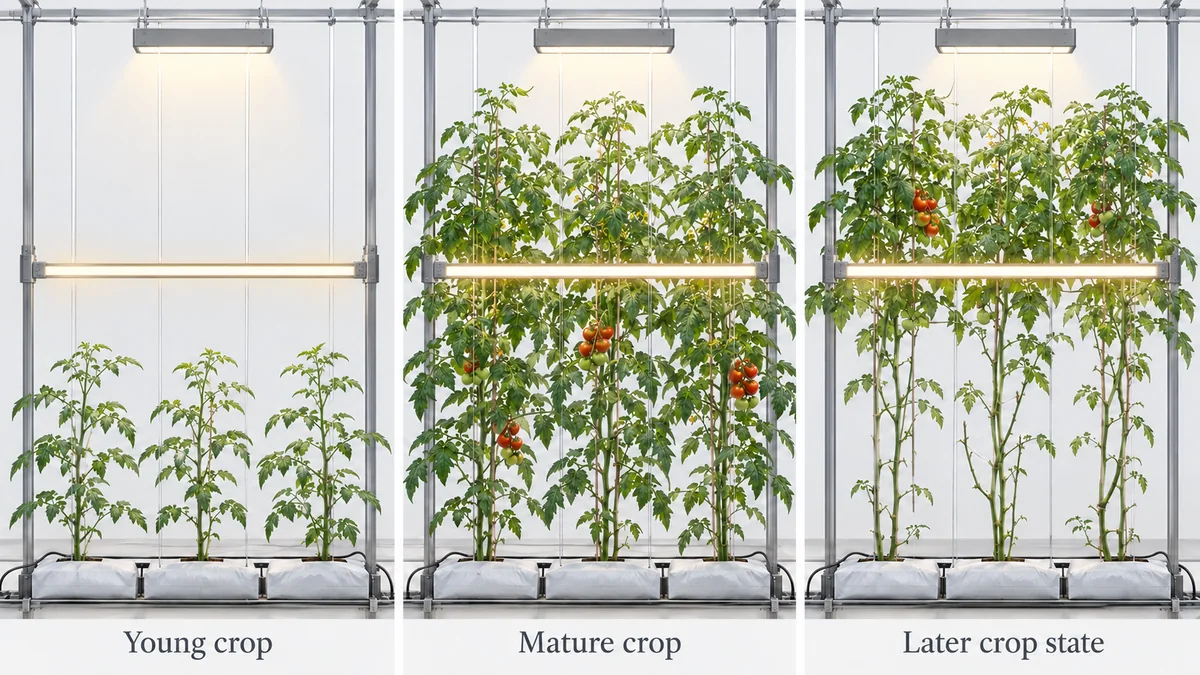
Follow the emitting position through three crop states
Begin with the same house, crop and reference section for both the top-only and proposed combined layouts. Mark the real emitting surfaces, not merely fixture symbols on a floor plan. Add the leaf bands the proposal intends to illuminate and the spaces through which light can travel without meeting those leaves.
| Crop state | Geometry to show | Question for the lighting designer |
|---|---|---|
| Young or sparse | Shorter or less-filled leaf envelope beside the proposed emitters | Which leaves intercept the intended light now? |
| Mature productive canopy | Actual vertical foliage, gaps and nearby obstructions | How does the distribution serve the intended leaf bands? |
| Later crop-work state | Changed leaf envelope and routine worker/service paths | Does the original placement still address the useful crop target? |
This is a geometry review, not a prescription to remove leaves or move a lamp. Use the crop adviser’s planned states and the equipment supplier’s applicable constraints. The designer needs to understand the crop configuration that will actually coexist with the luminaires.
Recognize the equipment architecture without adopting the sales promise
A Signify interlighting sheet describes sideward light distribution inside high-wire crops and use alongside daylight or supporting toplighting. The document is dated February 2022 and available at a 2023 asset URL. It demonstrates the equipment concept, not current stock, a project quotation or guaranteed crop returns.
The manufacturer’s toplighting page provides the corresponding overhead-equipment context. Ask each supplier for the distribution evidence of the exact proposed models. Product-family names do not establish how a particular layout illuminates the intended crop.
Research has also distinguished these architectures. The Purdue repository abstract of Celina Gomez Vargas’s tomato-lighting dissertation describes comparisons involving overhead, intracanopy and hybrid positions in high-wire tomato. The abstract was reviewed here, not the thesis body. It supports treating source position as a genuine research and design variable; it does not establish a universal winning layout.
A fixed light bar can face a changing target
Imagine a hypothetical combined layout with an inter-row bar at one fixed location. During the early crop, much of the space opposite the bar is unfilled. Later, the developing canopy surrounds it. After the crop’s planned lower-leaf work, the nearest useful leaf band changes again.
The fixture count has not changed. The relationship between its emission and the crop has. A quotation showing only a mature-canopy illustration cannot answer all three states, and a light average on an empty horizontal plane does not describe that vertical relationship.
Ask the designer to annotate the same bar position on all three sections and relate it to model-specific light-distribution evidence. Which intended leaves are present? Which direction leads into a gap? Which structural or crop-support obstruction matters? Keep any quantitative capture claim separate until the corresponding calculation or evidence is supplied.
In a top-only alternative, ask the same questions about the overhead source and the changing canopy. The comparison should not give one option a detailed crop model while judging the other from a bare fixture count. Hold the project and crop assumptions consistent enough to understand what the placement change is doing.
Include the space people and equipment need
Within-canopy equipment shares space with crop support and routine work. Show the worker path, intended cleaning and service access, and the crop operations that change nearby foliage. Identify unresolved access questions before the layout is treated as complete.
Do not infer an acceptable lamp-to-leaf clearance from a conceptual picture, or copy a mounting dimension from a different product. The supplier and responsible designers must establish the actual equipment and access constraints. This article does not provide installation, electrical or crop-work instructions.
Keep electrical and climate implications connected to the placement review. The electrical load-schedule guide addresses connected duties. The light-deficit guide addresses required supplemental light. Neither replaces the crop-section comparison, and that comparison does not replace their calculations.
Use a crop-state comparison before choosing the package
Download the high-wire light-position and crop-state comparison. It is a manual drawing-reference tool, without light-capture, yield or energy formulas. Open it using UTF-8 and comma separation. Complete one row for each layout and crop state, linking the applicable section and supplier evidence.
Finish by identifying which states the proposal has addressed and which need a revised layout or additional evidence. A decision supported only for the mature canopy should remain labeled that way. A useful package shows where its light enters the crop throughout the intended program, while leaving crop response and commercial returns to their own evidence.