

An ISO 9001 certificate arrives with a greenhouse quotation. The logo and expiry date look familiar, but the order names a trading company and the factory address appears on a different document. What has the certificate actually established?
Match the certificate to the organization, sites and activities involved in the order, then verify its current status. ISO 9001 concerns a quality management system. It does not, by itself, approve the greenhouse design, certify each supplied component or confirm compliance at the destination.
Start with the order, not the certificate logo
Write down the quoted legal entity, the party expected to manufacture the goods and each relevant production location. Identify separately who undertakes design or installation when those activities are part of the offer. Use the quotation and the supplier's written explanation, rather than assuming a familiar group name identifies every company in the chain.
Now compare that map with the full certificate, including any site schedule or annex. Read the certified legal name, addresses and scope of activities. Similar branding does not resolve a different legal name. A matching headquarters address does not establish coverage of a separate manufacturing location.
ISO's explanation of conformity attestations explicitly distinguishes management-system certification from product certification. This is why a certificate can be relevant evidence about the supplier's management system while leaving specific product and project questions unanswered.
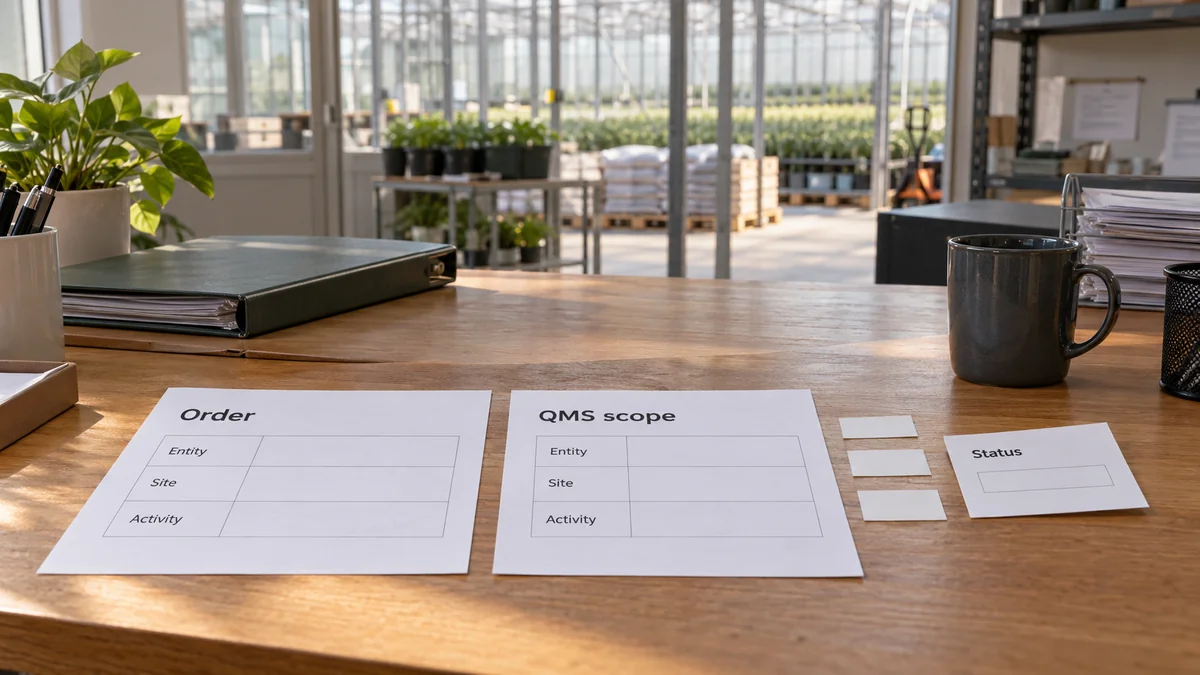
Map the certificate to the actual order
Download the certificate-to-order map. Complete one map for the certificate being relied on, with additional entries where the order spans organizations or sites. Keep the source document beside each answer.
| Compare | Evidence to retain |
|---|---|
| Identity | Quoted legal entity, certified entity and the documented relationship between any different names. |
| Locations | Actual manufacturing address, covered-site list and the annex or verification record that connects them. |
| Activities | Exact scope wording and which ordered activities it supports, such as manufacture or design. |
| Certificate details | Standard and edition, certificate identifier, issue and expiry details, and the complete document revision. |
| Current status | Verification source, date, status reported and unresolved discrepancies. |
| Issuer and accreditation | Certification body, claimed accreditation and evidence relevant to the standard and certificate. |
| Order evidence still needed | Separate drawing, material, test, inspection or destination-specific records required by the purchase. |
Transcribe the scope without broadening it. If the scope describes manufacture but the offer also includes design, ask for the evidence supporting the design activity. If only a sales activity is identified, do not silently describe the document as proof of the factory's certified manufacturing system.
The purpose is to identify a specific unanswered question. It is not to reject an organization merely because the group has more than one legal entity or uses subcontractors.
Check status through an identifiable source
The official IAF CertSearch FAQ describes a database for accredited management-system certificates. Its records can identify the standard, scope, locations, status, issuing certification body and accreditation body. It is not a product-certification register.
Use the exact certificate number and legal name when a verification service is available. Compare the returned details with the supplied document. Retain the date and result, because a saved certificate image and a current status check answer different questions.
If a search returns no matching result, mark the entry unresolved. Check the identifier and request clarification from the supplier and issuing body through independently verified contact information. A missing search result alone is not evidence of fraud. Equally, a supplier's assurance alone should not be recorded as an independent status check.
Where accredited certification is a purchasing requirement, examine the accreditation evidence as part of that requirement. Do not assume a logo establishes its scope, and do not substitute a general entry about the certification body for confirmation of the certificate you are evaluating.
Handle the 2026 edition without guessing a deadline
As checked on 2 October 2026, ISO's current ISO 9001 page identifies the 2026 edition, published on 16 September. Its guidance directs certified organizations to their certification body for transition information.
Record the edition shown on the supplier's certificate and ask the issuing body to confirm the applicable status and transition arrangements. Do not automatically treat a certificate referencing the 2015 edition as invalid merely because a newer standard has been published. Do not invent a universal transition deadline from the certificate's printed expiry date.
For an order extending over several months, decide when procurement will recheck the evidence. A revised certificate, changed manufacturing site or changed legal entity should reopen the relevant part of the map. Keep the earlier version so the order record remains understandable.
Resolve a mismatch with a precise question
Consider a hypothetical order from Party A, with fabrication at Plant B. The supplied certificate names a related group organization and lists Site C. None of these labels refers to a real company.
The useful question is: “Which certificate record or annex covers the organization and activity at Plant B for this order?” Ask for the complete document and a clear explanation of the relationship. If the response only repeats the group name, the location question remains open. If the response provides an applicable annex and verified details, retain them with the order.
Use three outcomes: evidence matches the stated requirement, a specific clarification remains open, or the supplied evidence does not cover the stated requirement. Record the reason. Avoid turning this narrow check into a claim that the supplier or its products are generally good or bad.
Keep the project evidence alongside it
Return the completed map to the greenhouse quotation comparison. The certificate belongs beside the relevant scope item, with the separate evidence still due. It should not replace agreed design calculations, component specifications or inspection records.
Bring an experienced quality or procurement specialist into unresolved entity, site or scope questions, and obtain interpretation from the issuing body where necessary. Project engineers and local conformity specialists should address their own technical and destination requirements. The resulting purchase file should show both what the certificate supports and what the order still needs.