
If a steel substitution is justified only by the same strength number, the comparison is unfinished. A greenhouse member was designed around a product, a section and a set of assumptions. Matching one part of the grade name does not establish that the proposed member preserves those assumptions.
Compare the complete product designations and section data before accepting the change. The useful outcome is a documented disposition from the responsible structural designer for the actual member and drawing revision. A nominal grade match is a starting point for that review.
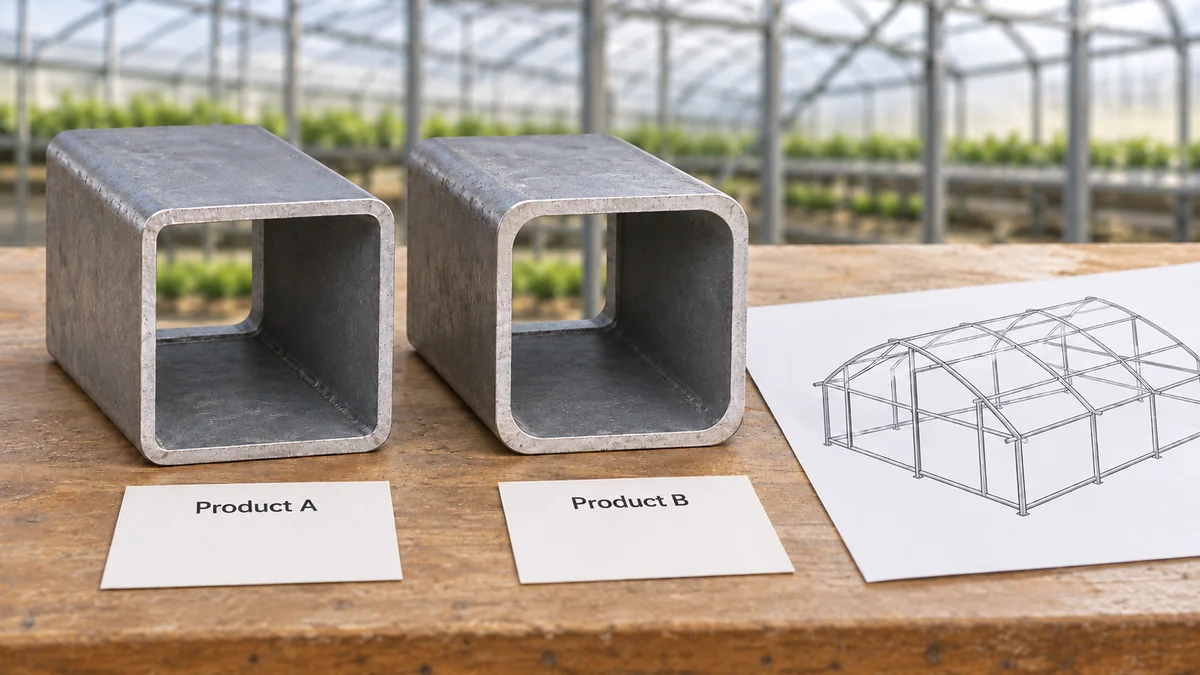
Compare the complete product designations
Two current Tata Steel product pages make the distinction concrete. The Celsius page identifies Celsius S355NH as a hot-finished structural hollow section to EN 10210. The Hybox page identifies its cold-formed product as EN 10219 S355 J2H. Both descriptions contain 355. Their full designations, product standards and manufacturing routes differ.
| Comparison field | Named Celsius example | Named Hybox example |
|---|---|---|
| Full grade in the product description | S355NH | S355 J2H |
| Product standard identified | EN 10210 | EN 10219 |
| Manufacturing route identified | Hot finished | Cold formed |
| Still required for a substitution | Exact offered size, wall-thickness basis, section properties, applicable certified properties and designer review | |
This is a comparison of named European-standard products, checked October 3, 2026. It does not establish that either is preferable for a particular greenhouse or interchangeable with the other. The Celsius page also states compliance with both NH and J2H classifications. That additional claim does not erase the product-standard, manufacturing-route or section-data questions.
Read the property-table headings, not just the largest number. A yield-strength entry has a thickness condition; an impact-test value has a specimen and temperature basis. Removing those conditions can make two unlike entries appear equivalent. For an actual order, ask for the applicable product documentation and the evidence tied to the supplied material.
Separate material strength from member capacity
SCI/BCSA steel-property guidance treats strength, toughness, ductility and weldability as distinct design considerations. Yield strength concerns a material property. Toughness concerns resistance to brittle fracture; ductility concerns deformation before fracture. Weldability depends on the material and the relevant fabrication requirements. One strength designation does not answer all of these questions.
A greenhouse buyer also needs the section used in the design. Two quotations might show the same outside width and depth while differing in wall-thickness specification or corner geometry. The designer needs the applicable section-property data rather than an assumption that the outside outline describes the entire member.
The SCI/BCSA hollow-section discussion explains that hot-finished and cold-formed rectangular sections can differ in corner geometry and section properties. Manufacturing also affects residual stress and the buckling treatment in the cited European design context. It explicitly cautions against substitution without examining the design implications. A visual comparison may reveal a question; it cannot settle the structural calculation.
Keep the member’s location in view. A proposed replacement for one identified brace is not automatically a decision for every column, truss or connection using a similar-looking tube. The relevant drawing and design revision tell the reviewer where the proposed change would apply.
Read a substitution request as a set of differences
Consider a hypothetical offer that says: “Same 355 grade, same outside dimensions, galvanized.” The buyer has the original member schedule, but the alternative’s full standard and section-property table are missing.
Three parts of that statement need separate follow-up. The grade number leaves the complete product identity unresolved. The outside dimensions leave the wall and corner basis unresolved. The coating description leaves the structural comparison untouched. The next action is to request the missing product and section data, then give the marked comparison to the structural designer. There is no basis here to approve a thinner wall, accept the change or reject an entire manufacturing route.
Now suppose the supplier provides complete material evidence. That closes an information gap, but it does not itself establish member capacity or connection compatibility. The reviewer still needs to relate the proposed product to the actual design assumptions and interfaces. A useful reply identifies the members covered, any conditions and the revised document that governs the purchase.
Keep coating and connection questions visible
A galvanized surface describes corrosion protection, not the underlying steel grade. A quality-management certificate likewise does not replace product identification or the structural assessment. Keep the coating review linked to the Z275 and hot-dip galvanizing buyer guide, which addresses a different evidence layer.
Ask the designer and fabricator to identify any affected connection geometry, fabrication specification and coating interface. Do not turn a product-page weldability statement into an on-site welding instruction. The goal is to locate the consequences of the change before material is ordered or fabricated.
Use the comparison to obtain a bounded decision
Download the steel-product substitution comparison. It is a manual worksheet with no formulas or automatic approval. Open it as a UTF-8, comma-separated file, place the approved specification and proposed product side by side, and record each difference with its source.
- Identify the member, location and approved design revision.
- Complete both product identities before comparing properties.
- Attach the applicable dimensions, tolerances, section table and material evidence.
- Send unresolved differences and affected interfaces to the responsible structural designer.
- Carry the written disposition into the controlled purchase and drawing records.
The technical-deviation process can then record the decision. Keep the technical comparison as its supporting evidence. “Accepted for these members under this revision” is useful; “same strength, so equivalent” leaves the central question unanswered.