
A warm root zone can help a crop while the greenhouse air remains too cold for its leaves, flowers or exposed equipment. That is why a bench-heating proposal should not simply subtract the same number of kilowatts from the existing air-heating system.
Root-zone heating supplies heat near the growing medium. Whether it allows a different air-temperature strategy depends on the crop, growth stage, heat distribution and outdoor conditions. Keep the remaining air-heating duty explicit when assessing a retrofit.
Begin with the cold problem you actually have
Log substrate temperature at representative pots or trays alongside canopy-air temperature and outdoor conditions. Include perimeter and central benches. A single sensor beside a heating pipe may report the warmest point, while a wall thermostat may miss a cold root zone altogether.
Distinguish a persistently cold substrate from uneven temperatures, a slow morning recovery or an undersized whole-house heating system. These are different design problems. Heating the bench is not an automatic remedy for all four.
What belongs in the retrofit scope
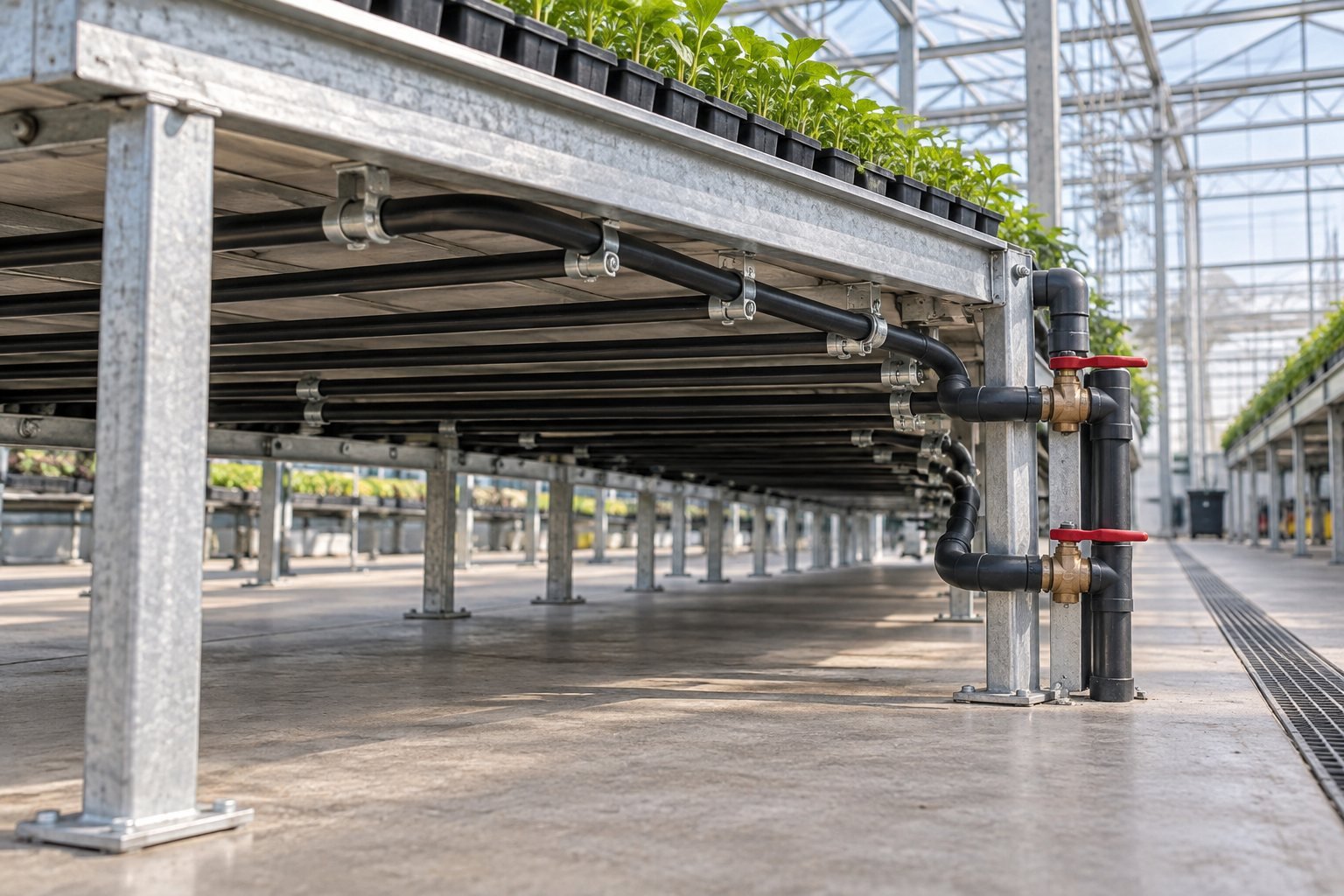
UConn's root-zone heating guidance discusses heat distribution, tubing compatibility, circulation and separation from the boiler circuit. It also notes that gaps in plant coverage can allow heat to escape differently from a full bench. Those details explain why a proposal needs the actual bench arrangement, not just the floor area.
| Design issue | Information to provide | Evidence to request |
|---|---|---|
| Crop temperature requirement | Crop, stage, container and acceptable root-zone range | Sensor locations and a control sequence matched to that range |
| Heat distribution | Bench construction, occupied fraction and changing crop layout | Expected output and uniformity under the proposed arrangement |
| Existing heat source | Boiler type, available temperatures and current loads | Hydraulic integration and return-temperature compatibility |
| Materials and water | Existing metals, tubing and any freeze-protection fluid | Compatibility, separation and maintenance requirements |
| Failure response | Power interruptions and crop-protection priorities | Alarm, isolation and backup-heating behavior |
Recalculate the duty that remains
A heating designer should assess envelope losses, leakage, ventilation requirements and distribution at the site design condition. Root-zone heat may contribute to the indoor balance, but its useful output cannot be assumed from the boiler rating. The crop-level requirement and the room-level requirement must both be met.
Use the greenhouse heating-load input checklist to assemble the building and climate information. Do not disable existing capacity based on a mild-weather trial; a trial can reveal control and distribution problems without establishing cold-night sufficiency.
Commission with empty and occupied benches
Before planting, have the installer verify pressure integrity, circulation, electrical protection and the intended isolation arrangement. Then check operating temperatures with the actual containers and crop layout. Keep exposed hot surfaces and service points protected according to the equipment instructions and local requirements.
Record supply and return temperatures, representative substrate temperatures and the controller state over a complete operating cycle. A large difference between the first and last bench may justify hydraulic balancing or a layout review; it is not automatically evidence that the boiler setpoint should be raised.
What a purchasing decision can reasonably promise
A defensible proposal states the design conditions, expected heat output, control arrangement and duties excluded from the system. It should not guarantee a percentage fuel saving without a defined baseline, weather normalization and comparable crop conditions.
For CFGET to review a retrofit layout, prepare a bench plan, cold-period temperature log and the existing heat-source information. Decide in advance how you will judge success: root-zone uniformity, recovery time, crop response and measured energy under comparable conditions. Those observations can support the next investment decision; an equipment brochure cannot replace them.