
A quotation promises enough treated water for the greenhouse, but the well cannot supply the feed volume needed to produce it. Or the treatment unit fits the irrigation demand while its reject stream has nowhere acceptable to go. Either problem can turn a water-quality solution into a project constraint.
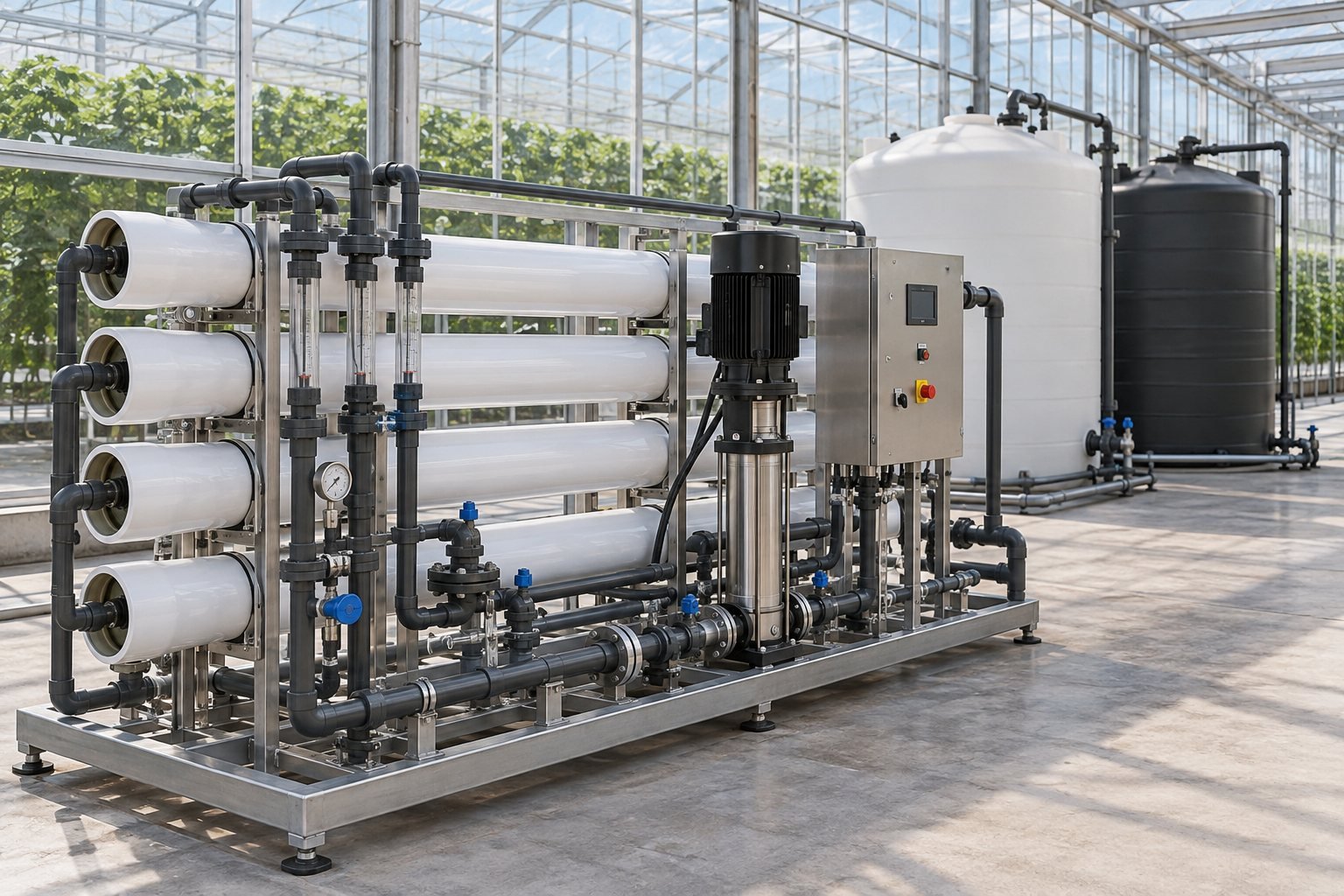
Reverse osmosis, or RO, separates feed water into a lower-salt product stream and a concentrated reject stream. Evaluate all three flows, not only the product rating. Start with a current water analysis and the crop's requirements before deciding whether full treatment, blending or another approach is appropriate.
Recovery is a water-balance ratio
Recovery = product-water volume divided by feed-water volume. For a simplified steady-state balance, reject volume equals feed volume minus product volume. Include flushing, cleaning and downtime separately when estimating daily source demand.
Suppose a hypothetical project needs 20 cubic meters of RO product per day. At 75% recovery, feed demand is 20 / 0.75 = 26.7 cubic meters and reject flow is about 6.7 cubic meters. At 50% recovery, feed demand is 40 cubic meters and reject is 20 cubic meters. These are arithmetic scenarios, not recommended recovery settings.
The water analysis limits the attractive percentage
Higher recovery concentrates the rejected constituents more strongly. Membrane selection, pretreatment, feed temperature, pressure and scaling risk affect the achievable operating point. University of Arkansas irrigation-water guidance discusses treatment choices including RO and blending. Treatment should respond to the actual water problem rather than to pH or total EC alone.
| Before accepting the rating | Ask for | Reason |
|---|---|---|
| Feed conditions | Analysis, temperature range and available pressure/flow | A catalog test condition may not match the source |
| Product quality | Predicted constituent concentrations and an acceptance sampling plan | Low conductivity alone does not define the entire crop-water specification |
| Pretreatment and servicing | Filter, dosing, cleaning and replacement responsibilities | Rated output depends on maintaining the membrane system |
| Reject management | Composition, volume and authorized disposal or reuse route | Moving salts out of irrigation water does not make them disappear |
Size production and storage together
A unit making 1 cubic meter per hour cannot deliver 20 cubic meters per day if it runs for only 12 hours. A storage tank can bridge an hourly peak but cannot repair a persistent daily production deficit. Model the irrigation draw, treatment availability and storage level over a demanding day, including maintenance interruptions.
Specify usable storage between operating limits, not just the tank's nominal capacity. Keep treated-water storage protected from contamination and make its level visible to the controls. A low-level alarm should produce a defined response before the irrigation pump loses supply.
Blending needs constituent checks
For a nonreacting constituent, a preliminary mixed concentration can be calculated from each stream's volume and concentration. But pH does not mix as a simple arithmetic average, and EC is not a substitute for individual-ion analysis. Have the agronomist and treatment designer confirm the blend for the crop and fertilizer program.
A proposed blend that meets one sodium limit may still have an alkalinity or another constituent problem. Verify the finished water and then account for it in the nutrient formulation. Do not assume that RO product contains every mineral the crop needs.
Make the procurement brief a complete balance
Give CFGET and the water-treatment specialist the analysis, peak irrigation demand, source capacity, planned operating hours and reject constraints. Use the water-quality equipment guide to connect those findings to the wider system. Ask for a feed-product-reject table at the actual design conditions and a storage-level calculation. Those two records expose more project risk than the largest flow number on the quotation.