
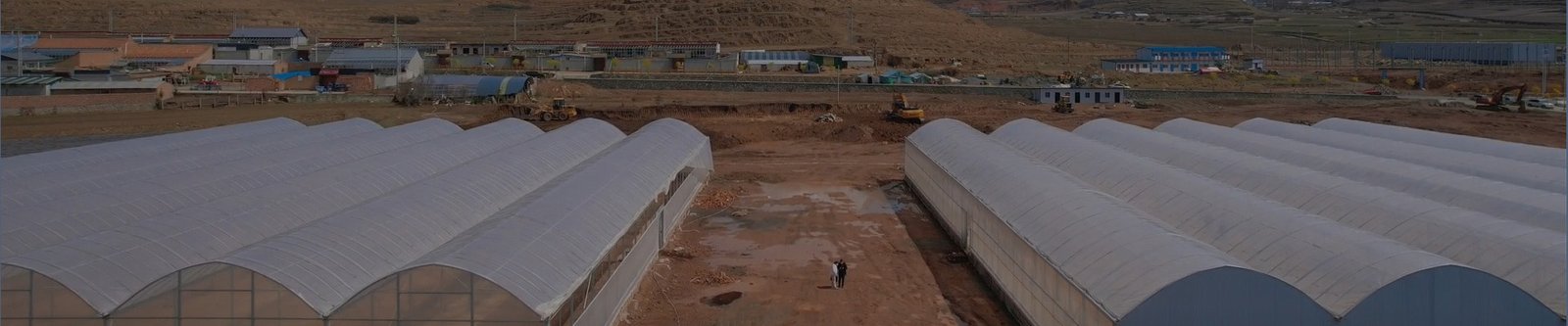
A pipe-rail trolley may have the right nominal track width and still lack the evidence needed for use in your greenhouse. Rail diameter, wheel and flange arrangement, supports, condition and intended operating configuration remain part of the combination.
Buy against a documented machine-and-track match, not one matching dimension. Supply the actual installed geometry and proposed duty to the manufacturer, and have the relevant competent person review the operating suitability. A purchasing worksheet does not release an uncertain combination for use.
Confirm which distance the quotation uses
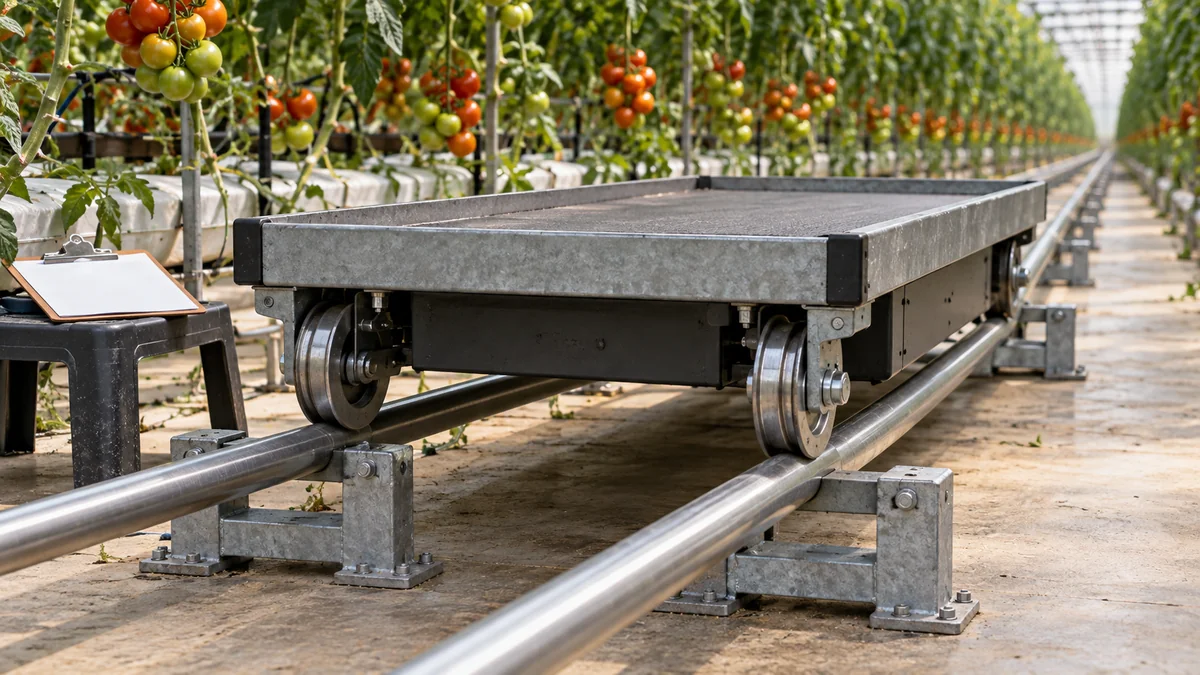
Track gauge in this review means the centre-to-centre distance between the two rails. It is different from the clear gap between their inner edges or the overall distance across their outer edges. A number without its measurement basis can therefore describe the wrong interface.
Royal Brinkman's purchasing guidance defines this centre-to-centre distance and notes that pipe spacing and diameter differ between greenhouses. Give the supplier a labelled end view and the supporting as-built or survey record, with units. Do not assume a trolley ordered for one house will match another house on the same farm.
The supplier's wheel and flange terminology also needs to be clear. The same guidance uses “open” and “closed” pipe-system descriptions in discussing flange arrangements. Ask the supplier to identify the intended arrangement on the end-view and support drawing. Do not interpret those words as an instruction about an open water-pipe end.
Compare the machine, rails and supports together
The trolley-to-track matching card puts the offered machine requirements beside the installed evidence. Use a separate card for each materially different house or track configuration. Keep its identifier linked to the track evidence register.
| Interface | Information the review needs |
|---|---|
| Machine | Exact model, version, options, wheelbase, wheel and flange arrangement, and current requirement documents. |
| Rails | Centre-to-centre gauge, outside diameter, wall and material evidence, and the identified route. |
| Supports | Support type, geometry, spacing, attachment and foundation information for that route. |
| Condition | Relevant inspection evidence and unresolved damage, movement, corrosion or alteration. |
| Operating duty | Intended load and its distribution, required working height and the operating states being requested. |
| Transfer | How the machine interfaces with the end aisle or other route, including the relevant ground and equipment requirements. |
Use existing drawings and ground-level evidence gathered under the site's normal safe access arrangements. If a dimension or material is unknown, enter unknown and ask how the responsible specialist will establish it. A photograph alone cannot establish wall thickness, material grade or the condition of a concealed support.
Brinkman's support-selection article identifies base, tube and height differences as relevant. Those differences are a reason to describe the installed support system accurately. They are not permission to design a replacement support from an online illustration.
Keep fit separate from operating acceptance
A supplier may confirm that a wheel arrangement matches the stated gauge and pipe profile. That closes a geometric question for the evidence supplied. It does not, by itself, confirm the requested load, elevated working condition or the installed support system.
The Berg Hortimotive BRW170/BRW185 manual, version 3 from 2016, illustrates why these matters interact. Its pipe-rail section relates track width, pipe dimensions, support spacing and machine loading conditions. Its tables and exceptions belong to that historical model and regulatory context. They are not current global design values for another trolley.
Request the current requirements for the exact machine being offered and the applicable review for the project location. The purchasing record should identify who accepts the installed combination and which evidence remains outstanding. Do not convert an old manual's table into a new allowable-load calculation.
Describe the intended load honestly, including the actual distribution and accessories the manufacturer needs to assess. A bare machine pictured in a brochure is not the same configuration as the machine equipped for the planned crop job.
Two houses can share a gauge and need different answers
Consider a hypothetical farm with Houses A and B. Their recorded centre-to-centre gauge is the same. House A has a documented rail-and-support arrangement. House B has a different rail profile and a history of support alterations, with incomplete records.
The common gauge allows one comparison field to be filled for both houses. It does not allow House A's acceptance to be copied to House B. The buyer should request confirmation of the wheel arrangement against each profile and obtain the missing support and condition evidence for House B.
If the supplier confirms only House A for the intended duty, the order should say so. If a proposed alternative requires changes in House B, those changes need their own approved design and acceptance. “It rolls along the rails” is not a substitute for that work, and the buyer should not arrange a test load to settle the uncertainty.
Include the end aisle in the purchase boundary
The trolley eventually has to meet the end aisle, turning or transfer arrangement used by the operation. Ask the manufacturer which configuration and conditions cover that interface. Record exclusions such as a separately supplied transfer device or an aisle condition that has not been reviewed.
The broader harvest-route planning guide addresses where equipment and people must move. Use that layout evidence alongside this machine-specific check. A workable harvest route cannot establish pipe-rail compatibility, while a compatible track does not settle every aisle interaction.
Make the order's limits explicit
Close the card with one of three outcomes: documented for the named configuration and reviewed duty, awaiting stated evidence, or not supported by the current proposal. Attach the manufacturer response and qualified review to the exact machine and house identifiers.
Changes to the machine options, intended duty, track or supports should trigger another review of the affected fields. That keeps the purchasing decision connected to the combination the operator will actually receive.