
The short answer
Write a storage and preservation matrix by component family before shipment arrives. Define permitted environment, support and stacking method, cover and ventilation, moisture and condensation control, temperature and sunlight limits, electrical enclosure protection, corrosion prevention, rotation or lubrication, battery or desiccant checks, packaging retention, fire and security controls, inspection frequency, maximum storage period, location code, issue method, and responsible person. Record condition at receipt and during storage, then inspect again before installation.
One rule does not suit every greenhouse component. Galvanized steel needs drainage, air circulation, stable supports, separation from contaminants, and protection against white rust conditions. Glass, polycarbonate, film, and screen fabric have different edge support, bending, sunlight, temperature, and cleanliness risks. Motors, drives, sensors, panels, seals, adhesives, fertilizers, and irrigation parts need their specific manufacturer limits.
Store for installation flow, not merely available space. Packages buried behind later work create double handling, damage, crane conflicts, and missing-item discoveries. Assign each package a location and planned issue date; keep critical small hardware secure and kitted by zone without losing part identification.
This guide is a project-control framework, not a substitute for the contract, approved design, manufacturer instructions, carrier terms, local law, or advice from qualified engineers, contractors, insurers, customs specialists, and safety professionals.
What the buyer should control
| Control point | Required record or action | Release evidence |
|---|---|---|
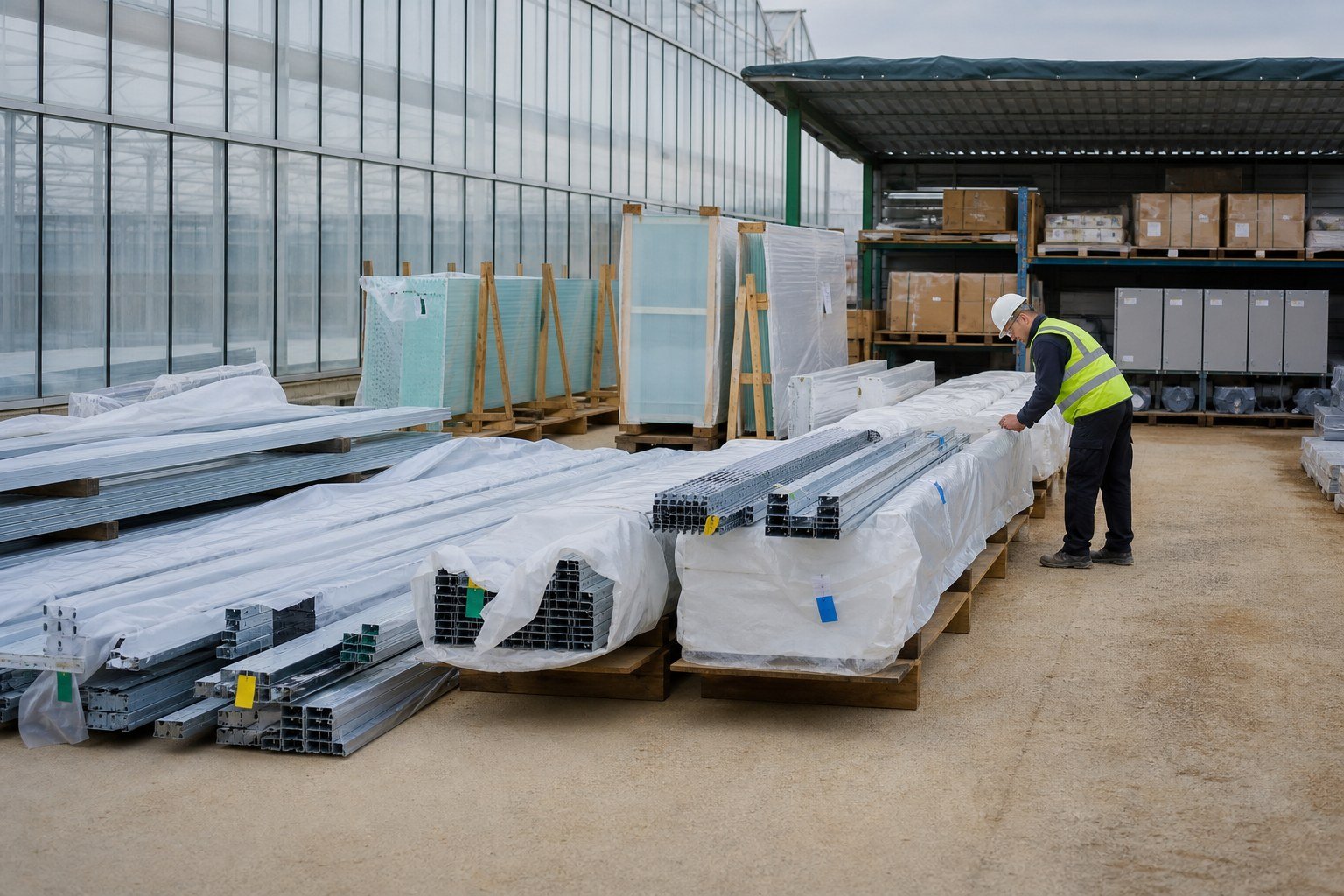
| Structural steel and gutters | Store level on adequate dunnage, off soil and standing water, supported to prevent distortion, separated from chemicals and dissimilar-metal contamination, with sloped breathable cover where required. | Periodic coating, deformation, water-trap, package, and identification inspection; approved repair of any damage. |
| Glass, polycarbonate, film, and screens | Use manufacturer-approved racks, support, angle, edge protection, shade or UV limits, ventilation, temperature control, dry cleanliness, and no incompatible straps or solvents. | No chips, cracks, pressure marks, bowed sheets, blocking, moisture staining, contamination, or lost roll and panel identity. |
| Motors, gearboxes, fans, pumps, drives, and panels | Keep dry, secure, clean, and within temperature and humidity limits; maintain heaters, desiccants, shaft rotation, lubrication, plugs, seals, batteries, and packaging exactly as instructed. | Logged preservation tasks, insulation or condition checks when specified, intact enclosures, and approved pre-installation inspection. |
| Sensors, controls, cables, seals, and consumables | Use enclosed controlled storage, shelf-life and batch tracking, electrostatic or moisture protection where applicable, capped cable ends, original containers, and first-expiry-first-out issue. | Valid shelf life, complete certificates, correct revision, undamaged connectors, and traceable batch or serial data. |
| Irrigation and water-treatment parts | Cap pipes and fittings, exclude dust and pests, protect membranes and instruments from freezing or heat, separate chemicals, preserve pumps, and maintain hygienic storage. | Clean internal surfaces, intact caps and seals, matched material and pressure class, and manufacturer release after extended storage. |
| Store and issue control | Zone map, package register, quarantine area, restricted access, drainage, lighting, fire route, lifting access, housekeeping, preservation calendar, weather-event inspection, and issue voucher. | A current inventory shows location, status, condition, quantity, responsible custodian, and installation destination. |
Give every open item an owner, due date, status, related drawing or package, and effect on cost, time, quality, safety, and performance. “Discussed,” “in progress,” or “by others” is not a closure record.
A practical workflow
1. Translate supplier instructions into a site matrix
Collect packing, handling, storage, shelf-life, preservation, and warranty requirements before dispatch. Resolve conflicts with climate, customs delay, site duration, available buildings, and local regulations. Budget temporary enclosures or conditioning where necessary.
2. Prepare and inspect the storage areas
Confirm bearing capacity, drainage, flood exposure, wind, dust, sun, temperature, humidity, security, fire separation, access, dunnage, racks, lifting lanes, lighting, and quarantine. Photograph the empty zones and assign location codes.
3. Receive directly into traceable locations
Record condition and package identity, retain protective packaging that remains suitable, replace wet or damaged protection correctly, and locate packages without unsafe rehandling. Do not trap moisture under impermeable tarpaulins or rest steel and electrical equipment on soil.
4. Perform scheduled preservation
Use daily, weekly, monthly, weather-event, and manufacturer-specific tasks as appropriate. Inspect covers, supports, condensation, corrosion, pests, cleanliness, seals, desiccants, heaters, batteries, shaft position, lubricants, shelf life, and identification. Escalate deterioration early.
5. Release material to installation
Check the approved drawing and revision, quantity, package condition, preservation record, manufacturer limits, installation area, and receiving crew. Record issued and returned material. Keep incomplete or suspect items quarantined until technical disposition.
Use one controlled register and preserve superseded records. The team should be able to reconstruct which information was current when a component was approved, manufactured, shipped, installed, tested, accepted, and handed over.
Roles at the interfaces
Owner and project manager
Set acceptance authority, priorities, contractual notice routes, decision dates, local advisers, and the evidence required before payment or release.
Greenhouse supplier
Provide controlled drawings, component data, manufacturing and packing records, installation requirements, tests, manuals, deviations, and technical responses for its scope.
Local contractor and specialists
Control site labor, safety, temporary works, civil and utility interfaces, local inspections, installation records, testing, protection, and legally required approvals.
Logistics and operations teams
Control transport documents, receipt evidence, storage conditions, preservation, spares, training, operating readiness, defects, and warranty communications.
Apply a release test, not a progress impression
Before the next commitment, ask whether the required input is current, the responsible reviewer has acted, stated conditions are closed, affected interfaces have been notified, the physical item matches the record, and the evidence is stored where the operations team can retrieve it. If any answer is no, classify the risk and assign a time-bound action rather than allowing an informal assumption to travel downstream. The release decision should also state what may proceed, what must remain on hold, and which later inspection, test, document, payment, or warranty event depends on closure. This discipline makes an early gap cheaper to correct and prevents apparent progress from hiding unfinished obligations.
Common failure modes
| Failure | Buyer response |
|---|---|
| A plastic sheet is treated as universal protection | Impermeable covers can trap condensation, blow loose, abrade finishes, or overheat cladding. Use material-specific weather protection and ventilation. |
| Packages are opened without location control | Small hardware and documents disappear. Open in a designated area, record contents, repackage, and issue by work zone. |
| Electrical equipment waits outdoors | Even covered enclosures may suffer condensation, corrosion, insulation deterioration, or lost warranty. Follow environmental and preservation instructions. |
| Condition is checked only at delivery | Damage and shelf-life expiry develop during delay. Schedule inspections and additional checks after storms, floods, heat, cover failure, or relocation. |
Buyer decision questions
What is the maximum expected storage period and seasonal climate? Which manufacturer instructions and warranty conditions apply? Which items need conditioned indoor storage, racks, dunnage, ventilation, shaft rotation, heaters, desiccants, lubrication, shelf-life control, or security? How will packages be located and issued by installation sequence? Who inspects, records, quarantines, and authorizes corrective action?
Link the answer to the container arrival checklist, the installation supervision and local labor plan, the corrosion protection specification, so decisions remain connected from procurement through installation and handover.
Frequently asked questions
Can galvanized steel be stored outside?
Often only with correct support, drainage, air circulation, separation, duration, and supplier instructions. Closely packed wet surfaces can develop storage staining or white rust.
Should original packaging stay on?
Keep it only while it remains suitable for the actual environment and inspection needs. Wet, damaged, non-ventilated, or long-term export packaging may need controlled replacement.
How often should material be inspected?
Set frequency by component sensitivity, climate, storage duration, warranty, and manufacturer instruction, with additional checks after severe weather, relocation, or protection failure.
Who pays for storage damage?
That depends on custody, delivery terms, contract duties, cause, evidence, notice, and mitigation. Maintain condition and inspection records and obtain qualified commercial advice.
Turn the requirement into a controlled deliverable
Send the component list, packing method, destination climate, expected storage duration, site layout, available buildings, installation sequence, and local hazards. Chengfei Greenhouse can provide storage and preservation requirements for its supplied items so the site team can build a complete plan.
Contact Chengfei Greenhouse