
An electromagnetic flowmeter can read low-conductivity greenhouse water only within the fluid conditions supported by its exact model and version. A matching pipe connection and flow range do not settle that question. Start with the water at the proposed meter location, then compare representative conductivity evidence with the manufacturer's applicable requirement.
This is especially important around reverse osmosis and blending. A record for prepared feed may be perfectly valid for that feed while saying little about the product-water line upstream.
Locate the fluid before checking the meter
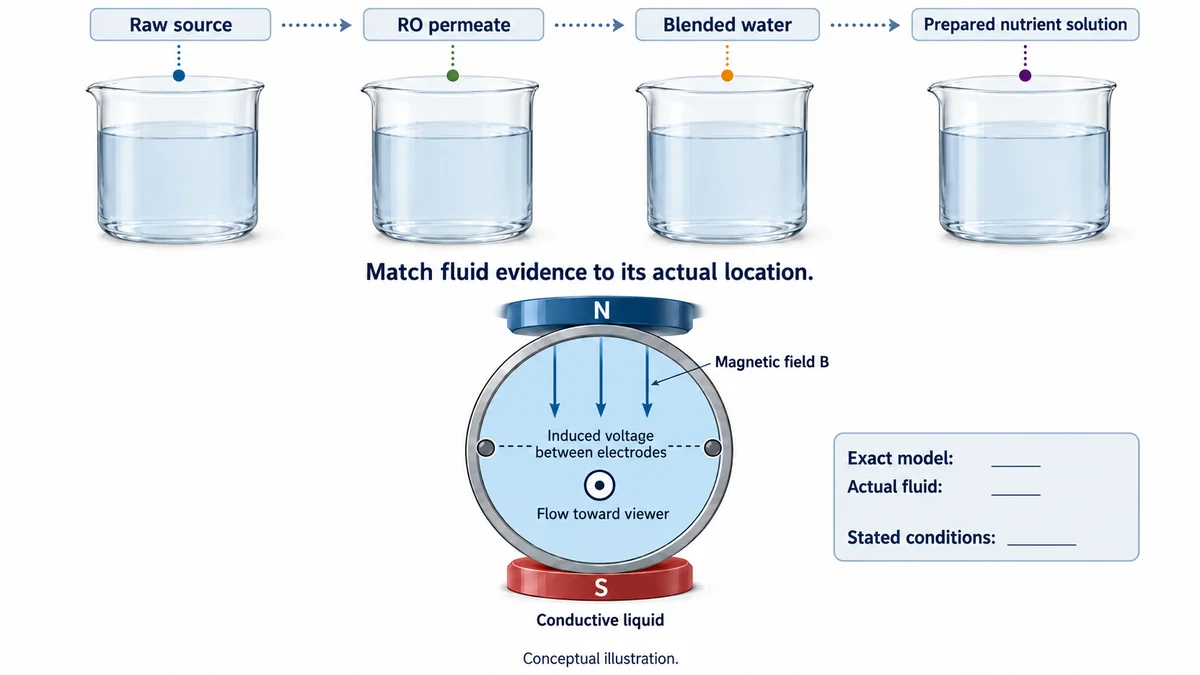
An electromagnetic meter uses a flowing, electrically conductive liquid in a magnetic field. The movement produces an induced voltage detected by electrodes; that signal is related to velocity and used to determine volume flow. Endress+Hauser's measuring-principle explanation describes this relationship.
Conductivity is therefore part of fluid applicability, rather than simply another name for the flow reading. If a device also reports conductivity, that output describes a different quantity. A conductivity value does not tell you how many cubic metres passed, and a flow value does not establish the water's crop suitability.
On a water-treatment drawing, give each relevant location its own name:
| Location | Fluid to identify | Easy substitution to avoid |
|---|---|---|
| Before treatment | Actual raw source water | Using a later blended-feed sample |
| RO product-water line | Permeate at that point | Assuming it matches the raw supply |
| After blending | The defined blend under its operating conditions | Applying that evidence upstream |
| After nutrient preparation | The prepared solution | Treating all earlier water as the same liquid |
These locations need not have the same conductivity. Clear water is not a conductivity specification, and filtration does not establish one. Equally, “RO water” is not a universal rejection category: the actual permeate and the exact sensor's supported range must be considered together.
Read the model's requirement as a condition
Manufacturer documentation can specify a minimum liquid conductivity for a particular sensor, as illustrated by the GF Type 2551 datasheet. No numerical limit from that document is applied here. The useful purchase question is which requirement belongs to the quoted model, version and operating conditions.
Keep the manufacturer's stated basis alongside the site's measurement basis. A limit detached from its conditions, or a sample identified only as “greenhouse water,” is incomplete evidence. Some electromagnetic meters support lower conductivities than others; changing the brand name on a quote is not a substitute for reading the relevant specification.
Meeting a conductivity condition is also only one part of selection. It does not independently prove installed accuracy or resolve all fluid and installation requirements.
A downstream sample cannot approve an upstream location
In a fictional proposal, a supplier selects a magnetic meter from the nominal pipe size and expected flow range. The drawing places it on the RO product-water line. The supporting laboratory record, however, describes blended irrigation feed after another water stream has been introduced.
The immediate conclusion is “fluid compatibility unresolved,” not “zero flow” and not “the meter is unsuitable.” The evidence and the proposed measurement point refer to different liquids. Ask for the model-specific fluid requirement and a representative record for the product-water location, including relevant operating variation.
If the supplier instead proposes another location, review what that location would actually measure. A downstream total and an upstream product-water total answer different water-accounting questions. Do not quietly accept a location change just to make the paperwork appear consistent.
Once the actual measurement is supported, it can feed the existing greenhouse water-balance audit. Compatibility review is not a reason to add salts or fertilizer to process water or to bypass treatment.
Download the location-to-model comparison
Download the flowmeter fluid-location CSV. This manual worksheet separates four process locations, the selected meter position and the exact model's documented requirement. It contains no numerical example, formulas or automatic compatibility verdict. Import as UTF-8, comma-separated text, widen and wrap the columns, and save a spreadsheet copy. Link each fluid record to its own location; leave missing conditions explicitly unresolved before asking the supplier to complete the comparison.