
A lux reading can tell you about illuminance. It does not automatically tell you how much photosynthetic light reaches a greenhouse crop. Before converting the number, identify the light source, the meter and the question you are trying to answer.
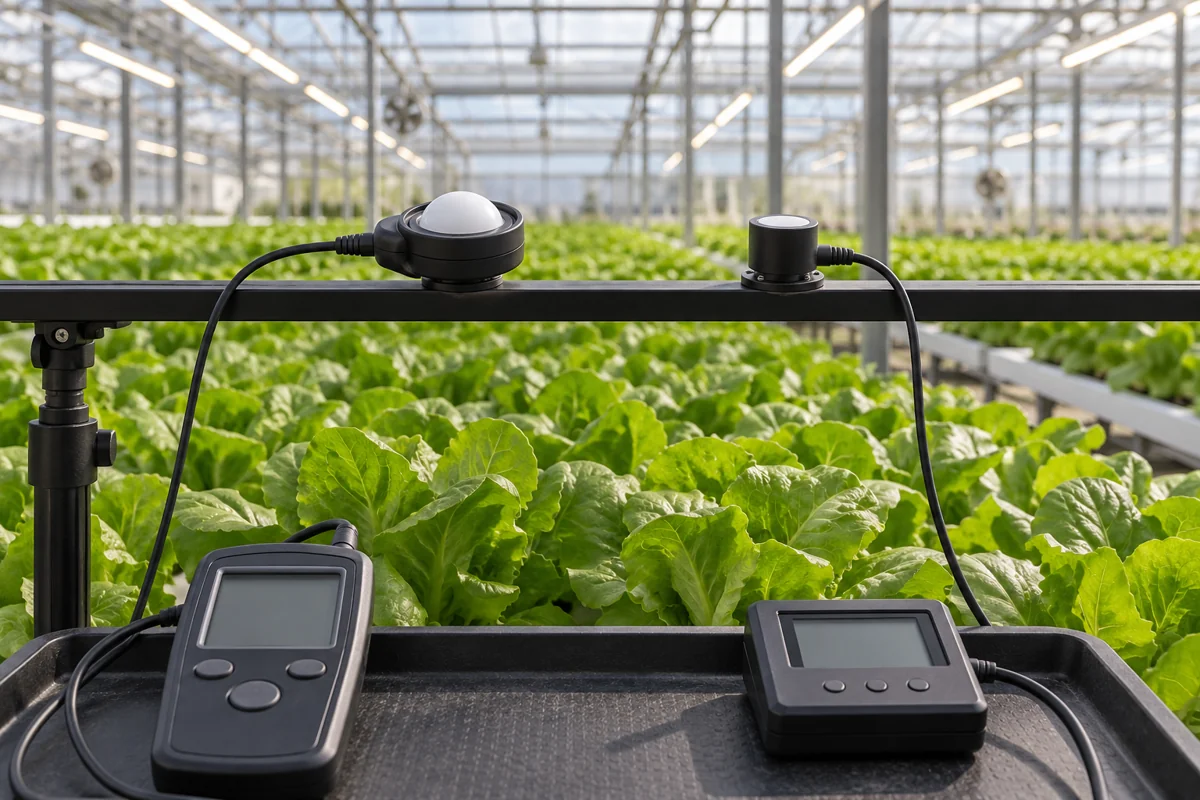
For a crop-light decision expressed in PPFD, a suitable quantum sensor is normally the more direct measurement tool. A lux meter may still be useful for a limited comparison under consistent conditions. The important step is to keep that comparison separate from a claim about crop photon exposure.
Read the unit before interpreting the value
Lux is a photometric unit: its weighting reflects human visual response. PPFD is photosynthetic photon flux density, conventionally expressed in micromoles of photons per square meter per second within the 400–700 nm band. These measurements weight the spectrum differently. A brighter appearance therefore cannot establish the same proportional change in PPFD.
Apogee's PPFD-to-lux reference page gives different relationships for different light sources. That source dependence is the key point. A factor selected for sunlight should not be assumed valid for a greenhouse LED fixture or an unknown mixture of sunlight and electric light.
Also check whether an instrument reports PPFD or an extended photon range such as ePPFD. Record the waveband alongside the value. A reading covering a different band should not be compared directly with a crop target unless the target uses the same definition.
Choose a method for the decision you need to make
| Question | Useful method | Boundary |
|---|---|---|
| Has illuminance changed at a fixed point? | Repeat lux readings with the same meter and a documented light source | A change in source spectrum weakens the comparison |
| What is crop-plane PPFD? | Use a quantum sensor suited to the source and required waveband | Check spectral response, calibration and measurement geometry |
| Is electric lighting distributed evenly? | Measure a planned crop-plane grid under repeatable lighting conditions | A single central reading cannot describe the whole growing area |
| How much light accumulated over the day? | Log suitable photon measurements across the full day | A midday snapshot does not establish the daily total |
| Can an existing lux record be converted? | Review source spectrum and meter information with the instrument supplier | Leave the result unconverted if a defensible relationship is unavailable |
The table is a method-selection aid. It does not set a crop target. Obtain that target from a current production protocol or crop adviser for the crop, cultivar and growth stage you are managing.
Why mixed light makes conversion harder
In a greenhouse, the light at the sensor may include daylight and several electric-light channels. Their relative contribution can change when clouds move, screens close or a fixture changes settings. Even if you know a suitable conversion for one source, you still need evidence that it represents the light present during the measurement.
Consider a purely hypothetical measurement visit. A grower records lux under daylight in the morning and under an LED-dominated condition later. Dividing both values by the same convenient number would hide the change in spectrum. The spreadsheet would look consistent while the underlying measurement method had changed.
Where the decision has consequences for lighting purchases or crop management, ask the meter supplier whether the instrument is suitable for the actual source combination. If it is not, arrange an appropriate measurement rather than giving a converted value more precision than the evidence supports.
Make the measurement repeatable
Apogee's DLI meter manual discusses spectral-response errors and the need to level the sensor for a horizontal measurement plane. It also distinguishes instantaneous measurements from accumulated daily light. These details are instrument-specific, but they show why the meter model and deployment method belong in the record.
Before a survey, write down the height and orientation of the measurement plane. Mark the locations on a simple bay plan. Keep the operator and equipment from shading the sensor. Note the screen position, lighting command, crop stage and outside conditions so another person can understand what the map represents.
If daylight changes substantially while you walk the grid, do not label the resulting map as a clean fixture comparison. Choose a method and conditions that suit the test. For a daylight-distribution study, the changing daylight may itself be part of the question, so record it rather than attempting to hide it.
Keep a short method record with every dataset
| Field | Your record |
|---|---|
| Decision and crop target source | ________ |
| Crop, cultivar, growth stage and bay | ________ |
| Instrument model, serial number and calibration record | ________ |
| Reported unit and waveband | ________ |
| Light sources, fixture settings and available spectrum data | ________ |
| Sensor position, height and orientation | ________ |
| Screen state and daylight conditions | ________ |
| Instantaneous survey or full-day logging period | ________ |
| Conversion or correction used and its evidence | ________ |
| Known limitations and missing data | ________ |
Keep original readings as well as any processed result. If a correction is later revised, the original dataset allows the calculation to be checked without pretending a new measurement was taken.
Use the equipment you have within its limits
If a lux meter is all that is available, label its data as lux. It may support a narrow question about relative illuminance where the source and measurement geometry remain comparable. Do not relabel the values PPFD simply because a spreadsheet offers a conversion field.
A phone reading also needs evidence about the device, sensor and method before it can support a crop-light decision. Convenience does not establish equivalence to a calibrated quantum instrument. For an equipment acceptance test, agree the required instrument and procedure before collecting data.
When lighting is part of a new installation, include the measurement plan in the greenhouse commissioning process. The useful output is a dataset whose units, conditions and limitations are clear enough to support the next decision. If those details are missing, improving the measurement comes before refining the lighting calculation.
Download the working files
Use these CSV files with the instructions in this article.